


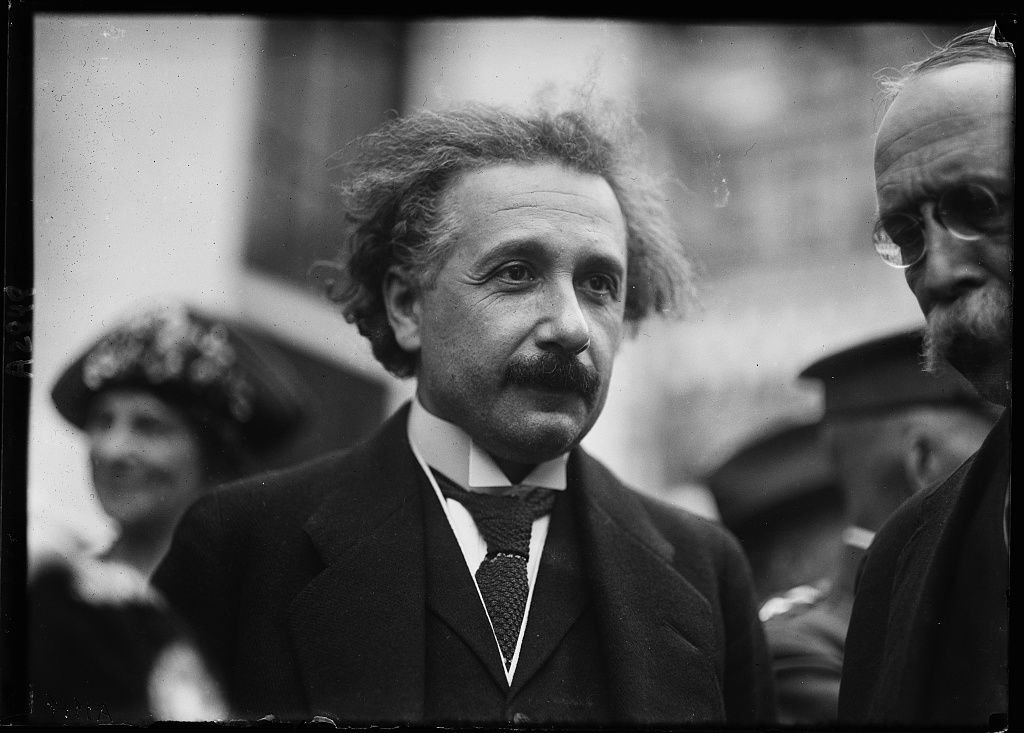
In the early 20th century, physics was undergoing a major transformation. Among the most important breakthroughs came from a young scientist named Albert Einstein, who reshaped humanity’s understanding of time, space, and motion with his theory of special relativity.
Albert Einstein
Special Relativity
The Scientific World Before Einstein
Before 1905, most scientists relied on Newtonian physics, which assumed:
- Time is absolute and universal
- Space is fixed and unchanging
- The laws of motion are the same for all observers
These ideas worked well for everyday objects but failed to explain phenomena involving extremely high speeds or light.
Einstein’s 1905 Breakthrough
In 1905, Einstein published a paper titled “On the Electrodynamics of Moving Bodies”. In it, he introduced two revolutionary principles:
- The laws of physics are the same for all observers moving at constant speed
- The speed of light in a vacuum is constant for all observers, regardless of motion
These simple ideas completely changed the foundations of physics.
Key Ideas of Special Relativity
Einstein’s theory led to several surprising conclusions:
- Time dilation: Time slows down for objects moving at very high speeds
- Length contraction: Objects appear shorter in the direction of motion
- Relativity of simultaneity: Two events may appear simultaneous to one observer but not to another
These concepts showed that time and space are not fixed—they are flexible and relative.
The Famous Equation: E = mc²
One of the most well-known results of Einstein’s work is the equation:
- Energy and mass are interchangeable
- Even a small amount of mass can be converted into a huge amount of energy
This principle later became the foundation for nuclear energy and modern astrophysics.
Impact on Science and Technology
Einstein’s special relativity had a deep and lasting impact:
- It reshaped theoretical physics
- It influenced the development of modern cosmology
- It became essential for technologies like GPS systems, which must correct for time differences caused by motion
Without relativity, many modern scientific and technological systems would not function accurately.
Conclusion
The 1905 publication of special relativity marked the beginning of a new era in science. It challenged long-standing beliefs about reality and introduced a universe where time and space are interconnected and dynamic. More than a century later, Einstein’s ideas continue to define the way we understand the cosmos.