


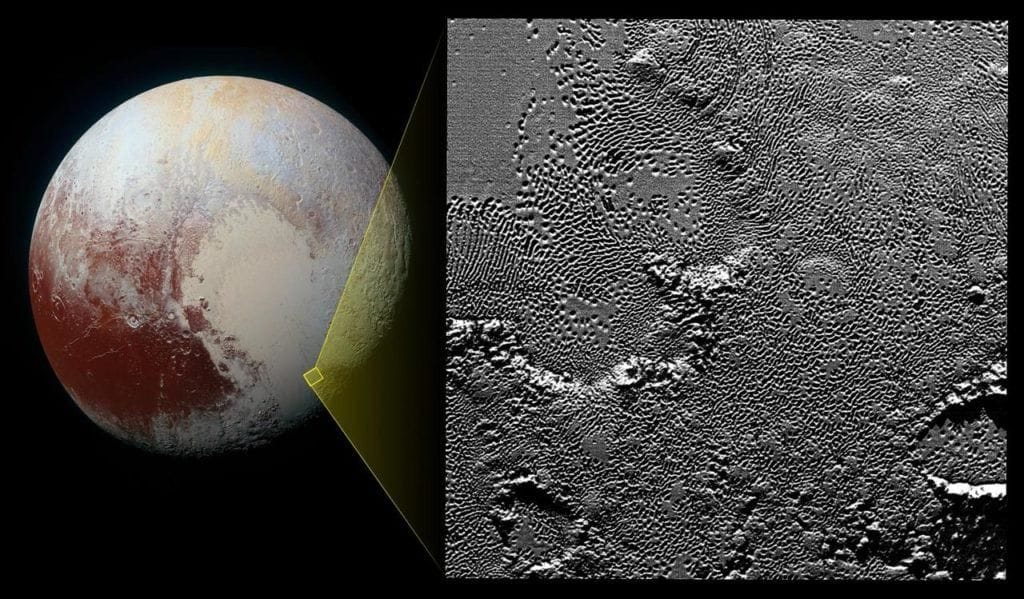
Ten years ago, humanity achieved an unprecedented feat in space exploration as NASA’s New Horizons spacecraft made its historic flyby of Pluto. This pivotal moment saw the robotic explorer come closer to the enigmatic dwarf planet than any spacecraft in history, skimming a mere less than 8,000 miles (approximately 13,000 kilometers) above its icy surface. The mission redefined our understanding of the distant outer solar system and continues to yield breathtaking insights.
The close encounter delivered a treasure trove of data and imagery, fundamentally reshaping our perceptions of Pluto and its moons. Among the stunning visuals captured was an enhanced-color image, a marvel of cosmic photography, taken when New Horizons was still about 280,000 miles (around 450,000 kilometers) away from its target. This particular image, showcasing Pluto’s varied terrain and intriguing hues, provided one of the clearest early glimpses of its complex surface.
Before New Horizons, Pluto was largely a mystery, a distant, fuzzy dot even to the most powerful telescopes. The mission transformed it into a vibrant, geologically active world, revealing towering ice mountains, vast plains of nitrogen ice, and a surprisingly active atmosphere. The sheer audacity of sending a spacecraft across billions of miles of space to study such a remote object, and succeeding with such precision, stands as a testament to human ingenuity and scientific ambition.
As we commemorate a decade since that groundbreaking flyby, the legacy of New Horizons continues to unfold. The data it collected has kept scientists busy, unraveling the secrets of the Kuiper Belt and expanding our knowledge of planetary formation and evolution at the solar system’s fringes. The mission not only pushed the boundaries of technological capability but also ignited public imagination, reminding us of the endless frontiers awaiting discovery in the cosmos. New Horizons remains a shining beacon of scientific endeavor, inspiring a new generation to look beyond our world and pursue the unknown.