


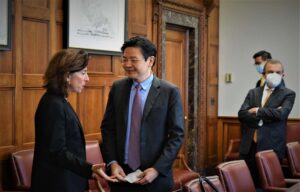
Singapore — Singapore Prime Minister Lawrence Wong has raised serious concerns over what he described as the growing “weaponization” of critical maritime chokepoints, warning that recent disruptions in the Strait of Hormuz could create a destabilizing precedent for global trade routes.
Addressing an international gathering of policymakers and economic leaders on Saturday, the Prime Minister said that even temporary interference in major sea lanes poses a systemic risk to global stability, particularly as markets continue to adjust following tensions in the Middle East.
Although the Strait of Hormuz has reportedly been reopened for commercial shipping under a ceasefire arrangement, officials caution that the political messaging surrounding its control has triggered wider fears about the security of other vital waterways, including the Suez Canal and the Malacca Strait.
Concerns Over Strategic Maritime Pressure
Singapore’s leadership stressed that global commerce depends heavily on uninterrupted maritime movement, especially for energy, food, and industrial goods. Any attempt to restrict access to key shipping corridors for political leverage, officials warned, could undermine long-standing international maritime norms.
Key concerns highlighted include:
- Erosion of Maritime Stability: Allowing periodic restrictions on key shipping routes could weaken established international laws governing freedom of navigation and traffic separation systems.
- Economic Sensitivity: Trade-reliant economies such as Singapore face immediate inflationary and supply chain pressures when global shipping routes become unstable.
- Rising Insurance and Fuel Costs: Even after reopening of affected routes, elevated risk perceptions continue to influence shipping insurance premiums and energy pricing.
Calls for Neutral and Protected Sea Lanes
Prime Minister Wong urged the international community to reaffirm the principle that major maritime corridors must remain neutral zones, free from military or political interference. He emphasized that safeguarding these routes is essential not only for regional stability but for the functioning of the global economy.
Wider Regional Impact in Asia
The concerns expressed in Singapore reflect growing unease across Asia, where governments and shipping industries are closely monitoring developments in the Middle East. While commercial traffic has resumed through the Strait of Hormuz, analysts note that a persistent “risk premium” continues to influence logistics costs and energy markets.
Experts also suggest that recent tensions are accelerating long-term strategies among Asian economies to diversify energy imports and strengthen alternative trade routes, including overland corridors and regional supply networks.
As global leaders continue discussions on maritime security, Singapore’s warning underscores a broader consensus emerging among trade-dependent nations: the stability of critical sea lanes is not just a regional concern, but a fundamental pillar of global economic security.