Black Hole’s “Cosmic Indigestion” Reveals a Surprising Side of the Universe’s Hungriest Objects
This discovery challenges the traditional view of black holes as objects that simply consume everything in their path. By showing that black holes can eject a substantial amount of incoming material long after an outburst, the research offers valuable insights into galaxy evolution, matter recycling, and the complex processes that shape the universe, opening new directions for future astrophysical studies.
Black holes are often portrayed as unstoppable cosmic giants that consume everything crossing their path. Their immense gravity has earned them a reputation as the universe’s ultimate predators, swallowing gas, dust, stars, and even light itself. However, a remarkable new astronomical study has revealed that black holes are far more complex than previously believed. Instead of simply devouring everything around them, they can eject enormous amounts of matter back into space, creating what scientists have described as a form of “cosmic indigestion.”
The discovery comes from detailed observations of the black hole system Swift J1727.8−1613, which erupted dramatically in 2023 and briefly became one of the brightest X-ray sources visible in the sky. The sudden outburst offered astronomers a rare opportunity to observe every stage of a black hole’s feeding process, from the initial surge of material falling inward to the lingering aftermath that followed months later.
An international team of researchers, led by Dr. Noel Castro Segura of the University of Warwick, monitored the event using the European Southern Observatory’s Very Large Telescope. Their observations captured an extraordinary sequence of events that challenged long-held assumptions about how black holes grow and interact with their surroundings.
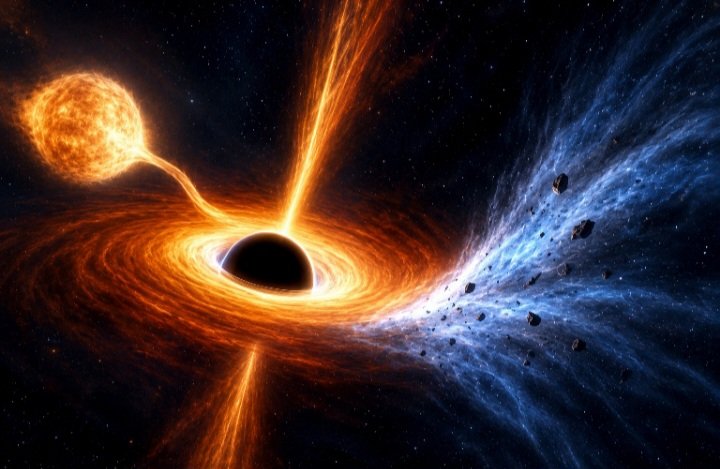
The black hole was drawing gas from a nearby companion star through its immense gravitational pull. As the stolen material spiraled inward, it formed a rapidly spinning accretion disk that heated to millions of degrees, producing intense X-ray radiation detectable across vast distances. Such feeding events are among the most energetic phenomena in the universe.
What surprised scientists was that the black hole was not simply consuming all the incoming material. While part of the gas continued toward the event horizon, powerful jets and fast-moving winds simultaneously blasted huge quantities of matter back into space. Instead of acting as a one-way cosmic vacuum cleaner, the system behaved more like a powerful engine that both absorbs and expels material.
The most unexpected discovery came after the black hole’s spectacular outburst had largely faded. Even when its brightness had dropped to just one percent of its peak intensity, astronomers detected dense gas continuing to stream outward at high speeds. These persistent outflows lasted far longer than researchers had anticipated, suggesting that the system continued to redistribute matter well after the brightest phase had ended.
Scientists estimate that the amount of material expelled during this extended phase may be comparable to the amount that actually crossed the event horizon. If confirmed by future observations, this finding suggests that black holes may be significantly less efficient at consuming matter than previously believed. A considerable fraction of the gas they capture may ultimately be returned to the surrounding environment rather than permanently disappearing inside the black hole.
This process has important consequences for understanding how galaxies evolve. Material expelled by black holes can influence the formation of new stars, alter the movement of interstellar gas, and regulate the growth of galaxies over millions of years. Rather than serving only as destructive forces, black holes may also play a vital role in recycling matter throughout the cosmos.
The complete observation of an entire feeding cycle—from the initial eruption to the prolonged aftereffects—marks an important milestone in high-energy astrophysics. Previous studies often captured only the beginning of similar outbursts, but this event allowed researchers to follow the system continuously through every major stage of its evolution.
The findings also demonstrate the power of modern observatories and advanced astronomical instruments, which now enable scientists to study some of the universe’s most extreme environments with unprecedented precision. Each new observation helps refine our understanding of gravity, matter, and the energetic processes operating near black holes.
As researchers continue investigating systems like Swift J1727.8−1613, they hope to uncover why some black holes eject more material than others and how these powerful outflows shape the galaxies that surround them. Future space telescopes and ground-based observatories are expected to provide even deeper insights into these mysterious cosmic engines.
The latest observations remind us that black holes are far more dynamic than the simple “space vacuum cleaners” often imagined. They not only consume matter but also redistribute enormous amounts of it across the universe, influencing their surroundings in ways scientists are only beginning to understand. Even the universe’s most powerful gravitational objects, it seems, do not keep every bite of their cosmic feast.