
Americans Divided Over Which Constitutional Right Matters More, State-by-State Debate Shows
The state-by-state comparison is visually powerful, but it should not be presented as a definitive picture of current American opinion without verified polling information. The latest AP-NORC evidence indicates that voting rights command broader national agreement as a core element of American identity, while gun rights remain particularly important among Republicans and many other Americans. The deeper story is not simply “voting versus guns,” but the continuing American debate over how different constitutional freedoms should coexist.
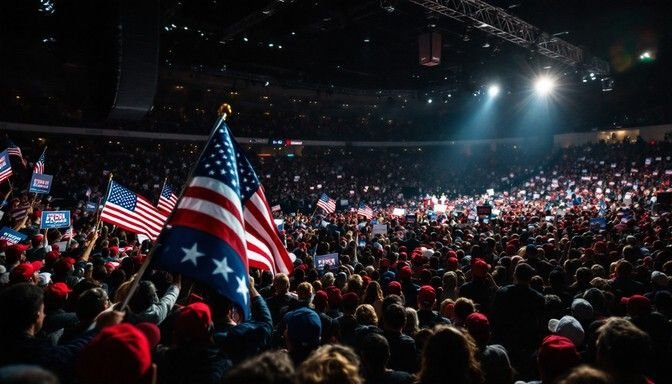
A striking comparison of American attitudes toward two of the country’s most debated constitutional freedoms has renewed discussion about the different priorities held across the United States. The graphic asks a simple but politically sensitive question: Would Americans consider the right to vote or the right to bear arms more important if they were forced to choose between the two?
The comparison highlights a broad regional divide, with different states appearing to favor different rights. However, the graphic should be treated cautiously because the version circulating online does not clearly identify its original polling organization, sample size, survey date or methodology.
The underlying question remains significant because voting and firearm ownership occupy very different places in America’s constitutional and political traditions.
Voting and Gun Rights Represent Different Ideas of Freedom
The right to vote is closely associated with representative government and the ability of citizens to influence who governs them. The right to keep and bear arms, meanwhile, is protected by the Second Amendment and has become a central issue in debates about individual liberty, self-defense and government regulation.
For many Americans, the two rights are not necessarily competing concepts. They represent different parts of the country’s broader constitutional framework.
Recent polling demonstrates that Americans continue to regard both freedoms as important, although support varies considerably according to political affiliation and other demographic factors.
An AP-NORC survey conducted in April 2026 found that roughly nine in ten Americans considered the right to vote very or extremely important to the country’s identity. Around six in ten said the right to keep or bear arms was similarly important.
Political Differences Remain Strong
The debate becomes particularly interesting when political affiliation is considered.
The 2026 AP-NORC findings showed that Republicans were considerably more likely than Democrats to regard the right to bear arms as highly important to American identity. About eight in ten Republicans expressed that view, compared with roughly four in ten Democrats. Independents fell between the two groups.
Voting rights, meanwhile, receive broad support across the political spectrum, although people differ over how secure they believe those rights are.
This distinction is important because the question of how important a right is is different from the question of whether that right is currently under threat.
Voting Rights Remain Central to American Identity
The right to vote has played a particularly important role in the development of American democracy.
The United States did not establish universal voting rights at the beginning of its history. Voting eligibility expanded gradually through constitutional amendments, legislation, court decisions and political movements.
Women, Black Americans and other groups faced significant barriers before gaining fuller access to the political system.
That historical experience helps explain why voting rights remain a powerful subject in American political debates.
The 2026 AP-NORC survey found that about two-thirds of Americans believed voting rights faced at least some threat, while only about one-third said they faced no threat at all.
Gun Rights Have a Different Historical Foundation
The Second Amendment states that the right of the people to keep and bear arms shall not be infringed.
Its interpretation has become one of the most contested constitutional questions in modern American politics.
The U.S. Supreme Court’s 2008 decision in District of Columbia v. Heller recognized an individual constitutional right to possess a firearm for lawful purposes such as self-defense in the home. Subsequent cases have continued to shape the legal boundaries surrounding firearm regulation.
For many gun-rights supporters, firearms are associated with personal independence, self-defense and protection against excessive government power.
For opponents of expansive gun rights, the focus is more often on public safety and reducing firearm-related deaths and injuries.
A Geographic Divide Is Visible
The graphic presents a noticeable geographic pattern, with many western and southern states appearing in one category and numerous northeastern, Midwestern and Pacific states appearing in the other.
However, geography alone cannot explain Americans’ opinions.
Political ideology, gun ownership, rural or urban residence, age, education, party affiliation and personal experiences can all influence views about constitutional rights.
A state-level graphic can therefore be visually striking while still simplifying a much more complicated national debate.
The Poll Behind the Graphic Matters
One of the biggest issues with viral political graphics is that the image itself often provides insufficient information about its source.
The graphic shown here does not clearly identify the pollster, survey year, number of respondents or exact wording of the question.
That matters because changing even a few words in a survey question can significantly influence how respondents answer.
For example, asking people which right is “more important” is different from asking which right they would be willing to surrender. Similarly, asking about the importance of a right to national identity produces different results from asking about personal importance.
Therefore, the state-by-state pattern shown in the graphic should not automatically be interpreted as a current nationwide poll.
Newer Research Shows a More Complicated Picture
Contemporary polling suggests that Americans generally do not view constitutional freedoms as mutually exclusive.
The AP-NORC survey found broad support for voting rights and freedom of speech, while freedom of religion also received strong support. Gun rights had lower overall levels of support as a core element of national identity but remained highly important to a large portion of the population.
The same survey also revealed significant partisan differences over perceived threats.
Democrats were more likely to view freedom of speech as facing a major threat, while Republicans were more concerned about threats to gun rights.
These findings suggest that Americans’ disagreements are not simply about whether constitutional rights matter. They also concern which rights are most vulnerable and what government should do to protect them.
Why the Debate Continues
The question of voting versus gun rights touches on a much larger argument about the meaning of freedom in the United States.
For one side, political participation is the foundation through which citizens protect other freedoms. Without the ability to vote, citizens may have limited influence over the laws governing them.
For another perspective, the ability to possess firearms represents an additional safeguard for individual liberty and self-defense.
There is also a large group of Americans who reject the premise that one right should have to be sacrificed for another.
From this perspective, the constitutional system is designed to protect multiple rights simultaneously.
The Bigger Picture
The most important lesson from the graphic may not be which color dominates individual states.
Instead, it illustrates how differently Americans can understand the concept of freedom.
Voting rights are connected to democracy and political representation. Gun rights are connected to the Second Amendment, individual liberty and self-defense. Both have deep historical roots, but they generate very different political debates.
Modern polling suggests that Americans overwhelmingly continue to place high value on fundamental freedoms, even while disagreeing sharply about which rights face the greatest danger.