Nigel Farage Faces Unusual Clacton By-Election Challenge From Count Binface
Clacton, United Kingdom, August 13, 2026 — Britain’s political landscape has taken an extraordinary turn as voters in the English constituency of Clacton head to the polls in a by-election featuring Reform UK leader Nigel Farage and a record-breaking field of candidates, including satirical political figure Count Binface.
The contest was triggered by Farage himself after he resigned his parliamentary seat and announced that he would seek to return to Parliament through a fresh election. He has presented the contest as an opportunity to ask Clacton voters for a renewed mandate amid controversy surrounding his financial affairs.
But the election has become far more unusual than a conventional parliamentary contest. Britain’s major political parties have chosen not to participate, while dozens of independent, fringe and novelty candidates have entered the race. The ballot contains 34 candidates, making it the largest field recorded in a UK parliamentary election.
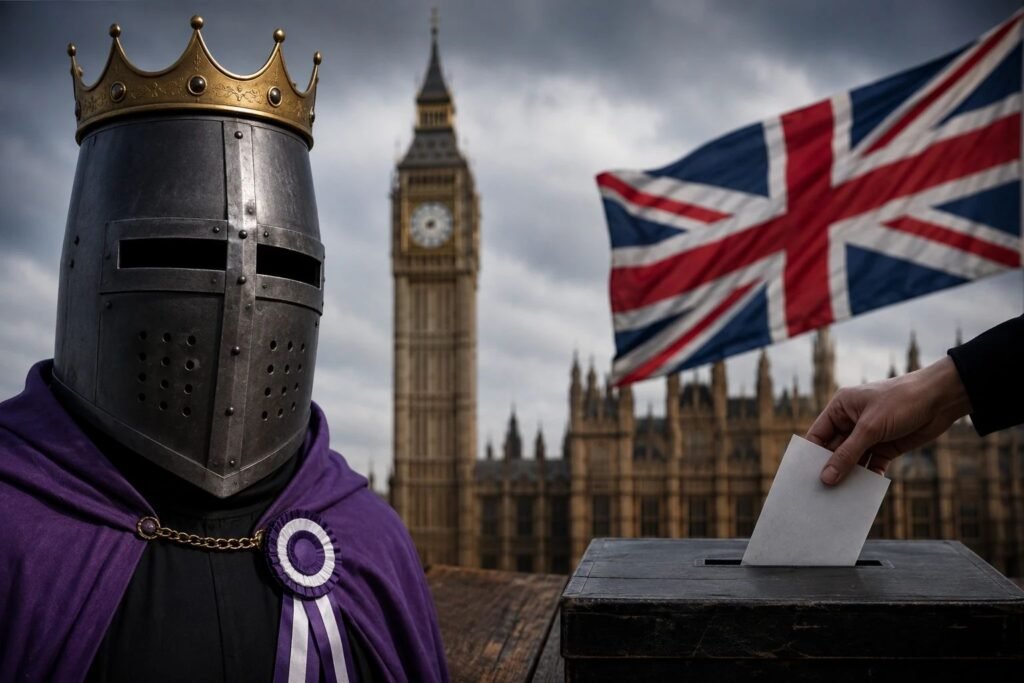
Among the most recognizable names is Count Binface, the satirical candidate known for appearing in public wearing a large bin-shaped helmet. His presence has transformed what began as a political battle over Farage’s parliamentary position into a highly unusual test of voter sentiment.
Why Farage Called the By-Election
Farage’s decision to resign his Clacton seat came while his finances were under scrutiny.
A parliamentary standards investigation was examining an undeclared £5 million gift Farage received from cryptocurrency businessman Christopher Harborne before the 2024 general election. Farage has argued that the money was a personal gift rather than political funding and has denied wrongdoing.
By resigning his seat, Farage triggered a by-election. He then immediately announced that he would contest the same constituency again.
Farage has framed the move as a direct appeal to voters. Rather than allowing parliamentary authorities or political opponents to determine his future, he argues that the people of Clacton should decide whether he deserves to continue representing them.
Critics, however, have described the move as a political manoeuvre designed to delay or complicate the parliamentary investigation. If Farage wins and returns to Parliament, the standards process could resume, potentially creating another political problem for the Reform UK leader.
Count Binface Becomes a Symbol of Protest
Count Binface has emerged as the most internationally recognizable challenger to Farage, although his campaign is deliberately satirical.
The character has previously contested elections in Britain and uses humour to criticize politicians and the political system. His campaign in Clacton has attracted considerable media attention precisely because of the unusual circumstances surrounding the contest.
The candidate’s presence also offers voters an opportunity to register dissatisfaction without necessarily supporting another mainstream political party.
For some voters, the election has therefore become less about a conventional contest between competing policy programmes and more about expressing frustration with the political establishment.
The unusual ballot has also generated substantial interest outside Clacton, with the contest receiving attention across Britain and internationally.
Major Parties Stay Away
One of the most important features of the election is the absence of Britain’s major political parties.
Labour, the Conservatives and Liberal Democrats have declined to field candidates, arguing that Farage’s decision to resign and immediately seek re-election turned the contest into a political spectacle.
Their decision has fundamentally changed the character of the race.
In a normal by-election, voters would have several established parties to choose from. In Clacton, however, the field is dominated by Reform UK, independents, novelty candidates and smaller political organizations.
The boycott has also raised questions about how representative the eventual result will be.
Farage won 46.2% of the vote in Clacton at the 2024 general election, giving him a substantial electoral base. But the absence of his major party rivals means the political environment is completely different this time.
Financial Controversy Overshadows Campaign
The election is taking place under the shadow of wider questions surrounding Reform UK’s finances.
Separate from the £5 million gift involving Farage, Britain’s Metropolitan Police has been investigating two £250,000 donations made to Reform UK before the 2024 general election. The payments were made through Britain Means Business, a company controlled by Reform deputy leader Richard Tice.
Authorities are examining whether the donations complied with Britain’s rules governing political funding.
No conclusion of wrongdoing has been established against Farage in relation to the £5 million gift, and Farage has consistently denied that he breached the rules.
The financial controversy has nevertheless become a central feature of the political debate surrounding the by-election.
A Test of Farage’s Political Strength
The result will provide an important indication of Farage’s personal political standing.
A victory would allow him to argue that voters have rejected the criticism directed at him and have given him a fresh mandate.
However, the circumstances of the election mean that the result will need to be interpreted carefully.
Because major parties are not competing, Farage is not facing the same level of organized opposition that he encountered during the 2024 general election.
A victory would therefore demonstrate continued support among Reform voters, but it may not provide a straightforward comparison with his previous performance.
A weaker-than-expected result, meanwhile, could raise questions about whether his political popularity has begun to decline.
Clacton’s Local Problems
Behind the political drama are significant local concerns.
Clacton and surrounding communities have faced long-standing economic difficulties, including deprivation, limited employment opportunities and pressure on public services.
The constituency includes Jaywick, one of England’s most deprived communities, as well as other coastal towns that have experienced economic decline.
Immigration and the arrival of migrants across the English Channel have also become major political issues in the region.
Farage has built much of his political identity around opposition to illegal immigration and criticism of the government’s approach to border control.
His supporters argue that his strong stance on immigration reflects the concerns of many local residents.
Opponents counter that local economic problems cannot be solved simply through immigration policies and that voters should be offered broader plans for jobs, housing and public services.
What the Result Could Mean for Reform UK
The Clacton contest could have consequences extending beyond the constituency.
Reform UK has emerged as a significant force in British politics, challenging the traditional dominance of the Conservative Party on the political right.
Farage remains the party’s most recognizable figure and has played a central role in its electoral strategy.
A strong victory could strengthen his authority within Reform UK and reinforce his argument that the party has become a permanent part of Britain’s political landscape.
A disappointing result, however, could provide ammunition to opponents who argue that Reform’s support is less resilient than opinion polls suggest.
The unusual nature of the contest makes the result particularly difficult to interpret, but the political symbolism will still be significant.
Voters Face an Extraordinary Choice
The Clacton by-election has become much more than a routine parliamentary vote.
It combines a high-profile political comeback attempt, a financial controversy, a parliamentary standards investigation, a major-party boycott and a record number of candidates.
At the centre of it all is Farage, who is asking voters to return him to the seat he voluntarily left.
Facing him is a remarkable collection of candidates, including Count Binface, whose satirical campaign has become one of the defining images of the contest.
The vote is taking place on August 13, with the result expected after counting.
Whatever the final outcome, the Clacton election is likely to remain one of the most unusual episodes in recent British parliamentary politics.
For Farage, it is an attempt to turn political controversy into a fresh democratic mandate. For his opponents, it is evidence of a political system increasingly shaped by personalities, media attention and political theatre.
And for Clacton’s voters, the election provides a chance to decide whether Nigel Farage should return to Parliament — in a contest unlike almost any other in modern British political history.