Peru’s Economic Growth Slows Unexpectedly as Mining and Agriculture Face Production SetbacksSeptember Growth Falls to 2.43 Percent
According to INEI, Peru’s national production expanded by 2.43 percent in September, compared with the corresponding period in 2025.
The latest figure represented a slowdown from the 3.66 percent growth recorded in July and 3.32 percent in August.
Despite the weaker monthly performance, Peru’s economy maintained positive growth for the first nine months of the year. Between January and September 2026, national production increased by 3.18 percent.
Over the 12 months through September, economic activity expanded by 3.22 percent.
The figures indicate that Peru’s economy continues to grow, but the pace of expansion is being affected by difficulties in important productive industries.
The performance of mining and agriculture has become particularly important because both sectors contribute significantly to exports, employment and economic activity in rural regions.
Mining Sector Faces Significant Production Decline
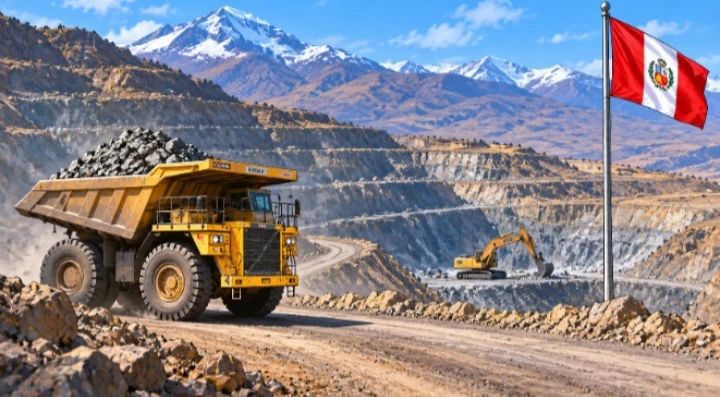
Mining remains one of the most important pillars of Peru’s economy, particularly because the country is a major international producer of copper, gold, zinc and other minerals.
However, the sector experienced another difficult month in September.
INEI reported that mining and hydrocarbons production declined by 6.32 percent compared with September 2025. Within this category, mining output fell by 7.22 percent.
Copper production decreased by 9 percent, while zinc extraction dropped by 21.1 percent. Gold production declined by 6.4 percent, silver by 11.8 percent and lead by 11.1 percent.
The decline across several major minerals highlights the challenges facing Peru’s mining industry.
Lower mineral production can affect export earnings, investment activity and government revenues, particularly when the affected commodities account for a significant share of the country’s international trade.
Copper is especially important because of its widespread use in electricity networks, construction, renewable energy infrastructure and industrial manufacturing.
A prolonged reduction in copper output could therefore affect both Peru’s domestic economic performance and its ability to benefit from international demand for critical minerals.
The hydrocarbons subsector recorded almost unchanged production, increasing by just 0.01 percent. Higher natural gas production, which rose by 10.6 percent, offset lower crude oil extraction and natural gas liquids production.
Agricultural Production Suffers From Adverse Weather Conditions
Agriculture was another major source of weakness in September.
INEI reported that agricultural and livestock production contracted by 5.44 percent compared with the same month last year.
The agricultural subsector experienced an even sharper decline of 9.78 percent, reflecting lower production across several important crops.
Olive production recorded an especially severe decline of 99.2 percent. Dry-grain beans fell by 37.1 percent, avocados by 33.4 percent and onions by 33.2 percent.
Palm oil production decreased by 28.2 percent, while mandarin production declined by 21.4 percent.
Sugarcane production also experienced a reduction of 11.6 percent.
According to the national statistics agency, adverse weather conditions, particularly rainfall above historical averages associated with the El Niño phenomenon, contributed to the weaker agricultural performance.
These conditions have created difficulties for agricultural production and increased uncertainty for farmers who depend on predictable weather patterns.
Peru’s agricultural industry is particularly sensitive to climate variations because production depends heavily on regional rainfall, temperature conditions and water availability.
Agricultural weakness can also have consequences beyond farming communities, affecting food supplies, transportation, processing industries and consumer prices.
However, the livestock subsector performed better, expanding by 1.38 percent in September. Higher production of pork, poultry, beef and fresh milk helped provide some support to the wider agricultural sector.
Construction and Commerce Provide Support to the Economy
Despite the weakness in mining and agriculture, several other industries continued to record positive growth.
Construction was among the strongest-performing sectors, expanding by 8.84 percent in September compared with the same month in 2025.
The increase was supported by higher domestic cement consumption, which rose by 12.22 percent, as well as a 1.14 percent increase in the physical progress of public works.
Private construction projects involving mining, electricity, transportation, manufacturing and telecommunications infrastructure contributed to the sector’s performance.
Residential buildings, commercial developments and urban infrastructure projects also supported construction activity.
Commerce and other services were among the main contributors to national economic growth.
The expansion of domestic business activity has helped offset some of the weakness in primary industries, demonstrating the importance of internal demand to Peru’s economic performance.
The electricity, gas and water sector also increased by 7.22 percent, supported by higher electricity generation, natural gas activity and water production.
Manufacturing recorded modest growth of 0.72 percent, while fishing expanded by 2.84 percent.
These developments suggest that Peru’s economy continues to receive support from several non-primary industries even as important export-oriented sectors face difficulties.
El Niño Adds to Economic Uncertainty
Weather conditions remain a major concern for Peru’s economic outlook.
The El Niño phenomenon can influence rainfall, temperatures and ocean conditions across different parts of the country.
These changes can affect agricultural production, fishing activity, infrastructure and transportation networks.
For farmers, excessive rainfall can damage crops, disrupt harvesting schedules and affect the quality of agricultural products.
In other regions, changing weather patterns can create water shortages and difficulties for agricultural planning.
The effects can also extend to food distribution and domestic markets, potentially increasing costs for consumers.
Fishing is another industry exposed to changing ocean conditions, particularly because the availability and distribution of marine species are influenced by sea temperatures and environmental patterns.
The impact of El Niño therefore extends beyond individual industries and can influence broader economic conditions.
Mining Weakness Raises Questions About Investment and Future Production
The mining sector’s performance is particularly important for Peru because mineral exports are a major source of foreign currency and government income.
The latest production figures have renewed attention on the challenges facing mining operations and the country’s ability to sustain mineral output.
Mining projects require substantial investment, long development periods and stable operating conditions.
Production can be affected by maintenance work, declining mineral grades, operational disruptions and delays in developing new projects.
A reduction in output from existing mines can become increasingly difficult to offset if new mining projects are delayed.
At the same time, international demand for copper and other industrial metals continues to create opportunities for countries with substantial mineral resources.
Peru’s ability to attract investment and improve production capacity will therefore remain important for its medium-term economic prospects.
Economic Growth Remains Positive Despite Sectoral Challenges
Although September’s figures indicate a slowdown, Peru’s economy has continued to expand during 2026.
The cumulative growth rate of 3.18 percent between January and September demonstrates that positive performance in construction, commerce and services has helped maintain overall economic activity.
The challenge for policymakers is to ensure that this growth becomes more balanced and less vulnerable to disruptions affecting individual industries.
Strengthening agricultural resilience, improving mining investment conditions and supporting infrastructure development could help reduce some of the pressures facing the economy.
Peru also needs to maintain economic stability while responding to climate-related risks that can affect production and supply chains.
The country’s future growth will depend partly on whether its stronger domestic sectors can continue expanding while mining and agriculture recover from their current difficulties.
Outlook for Peru’s Economy
Peru’s latest economic performance presents a mixed picture.
On one side, construction, commerce, electricity and several service industries are supporting economic activity. On the other, declining mineral production and agricultural difficulties are limiting the country’s overall growth momentum.
The slowdown in September demonstrates how strongly Peru’s economic performance remains connected to developments in its primary industries.
Mining and agriculture will continue to play an important role in determining export performance, employment and the country’s broader economic outlook.
Weather conditions associated with El Niño add another layer of uncertainty, particularly for farmers and industries dependent on natural resources.
The coming months will be important in determining whether Peru can maintain its current growth trajectory or faces additional pressure from declining production in its key sectors.
For now, the country’s economy remains in expansion, but the latest figures underline the need for stronger productivity, investment and resilience across its major industries.
Source: Peru’s National Institute of Statistics and Informatics (INEI), reported by Agencia Andina, November 15, 2026.