40 Satellites to Strengthen Amazon’s Global Internet Network
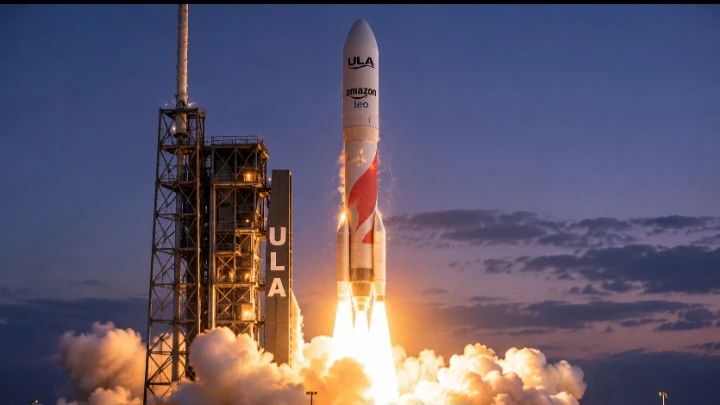
The LV-01 mission is carrying 40 Amazon Leo satellites, representing the largest number of satellites Amazon has attempted to deploy in a single launch.
The satellites are designed to operate in low Earth orbit and provide broadband internet connectivity to customers, businesses and communities that have limited access to traditional internet infrastructure.
Amazon is developing the Leo network to expand high-speed internet availability across different geographical regions, including remote communities where conventional broadband services are difficult or expensive to provide.
The company ultimately plans to establish a constellation of more than 3,000 satellites working together in coordinated orbits around Earth.
The expansion is intended to create a global communications network capable of delivering reliable internet services to residential, commercial and institutional customers.
The 40-satellite deployment is therefore an important step towards increasing the capacity and geographical coverage of Amazon’s developing network.
Vulcan Rocket Returns to Flight After Nine-Month Break
The mission is also significant for ULA because it marks the return of the Vulcan rocket following technical problems involving its solid rocket boosters.
During previous flights, the rocket experienced nozzle-related anomalies in its solid rocket boosters, raising concerns about the reliability of the launch vehicle.
One such incident occurred during a February 2026 national security mission, when a booster nozzle malfunctioned shortly after liftoff.
Although the rocket successfully delivered its payload into the intended orbit, the incident prompted additional investigations and technical reviews.
ULA worked with Northrop Grumman, the booster manufacturer, the US Space Force and other government agencies to investigate the problems.
The investigation identified three possible contributing causes, and the company introduced changes to the nozzle design and manufacturing processes.
The revised components underwent additional testing, including a full-scale hot-fire test of a GEM 63XL solid rocket motor.
The Amazon Leo mission provides an important opportunity to evaluate these improvements under actual flight conditions.
The US Space Force had also paused Vulcan’s national security launch operations pending further assessment of the corrective measures.
The results of the commercial mission could therefore influence decisions concerning the rocket’s future role in American national security launches.
Six Solid Rocket Boosters Provide Additional Launch Power
For the Amazon mission, Vulcan is flying in its powerful VC6L configuration.
The rocket uses six side-mounted solid rocket boosters manufactured by Northrop Grumman, providing additional thrust during the initial phase of flight.
Its first stage is powered by two BE-4 engines manufactured by Blue Origin, using liquefied natural gas and liquid oxygen.
The second stage is equipped with an optimised Centaur V system designed specifically for low Earth orbit satellite deployment.
The configuration allows the rocket to carry a substantial payload while maintaining the performance required to place the satellites into their intended orbital positions.
ULA has stated that the mission is designed to deliver more than 50,000 pounds of payload into orbit, setting a new payload-capacity record for the company.
The rocket also uses a 70-foot-long payload fairing to accommodate the large collection of Amazon Leo satellites.
Special Centaur V Upper Stage Designed for Satellite Deployment
Another important feature of the mission is the introduction of a shorter, low Earth orbit-optimised Centaur V upper stage.
The modified stage is approximately 35 feet long, around six feet shorter than the standard high-energy configuration.
It also carries approximately one-third less propellant than the standard version.
These changes reduce the overall weight of the upper stage, allowing Vulcan to carry additional satellites for Amazon’s constellation.
The modifications are particularly important because Amazon requires frequent launches involving large batches of spacecraft.
By adjusting the rocket configuration to the specific requirements of the Leo network, ULA aims to improve payload efficiency and support a higher launch frequency.
The new configuration demonstrates how commercial satellite operators and launch providers are adapting rocket technology to meet the requirements of large-scale broadband constellations.
Amazon and ULA Establish Dedicated Launch Infrastructure
The partnership between Amazon and ULA extends beyond the launch vehicle itself.
Amazon has invested in dedicated launch infrastructure at Cape Canaveral to support the processing and deployment of its satellite constellation.
The new Amazon Vertical Integration Facility, known as VIF-A, is designed specifically for preparing Amazon Leo missions.
The company has also supported the development of a dedicated mobile launch platform for Vulcan missions.
These facilities allow ULA to prepare multiple rockets simultaneously, potentially reducing the time required between launches.
The new infrastructure is expected to improve operational efficiency and support a more frequent launch schedule.
Amazon has also been preparing its second Vulcan mission in a separate processing facility while the first mission undergoes final launch preparations.
This parallel approach could help the company accelerate its satellite deployment programme if the initial missions perform as planned.
38 Launches Planned Under Amazon-ULA Partnership
The LV-01 mission is the first of 38 Vulcan launches contracted by Amazon.
The agreement represents a major commercial commitment and gives ULA an important role in expanding Amazon’s satellite internet infrastructure.
According to Amazon, Vulcan is expected to launch more than 1,500 first-generation Leo satellites across the contracted missions.
The company expects Vulcan to become one of its principal launch vehicles over the next several years.
Amazon is also working with other launch providers, including Arianespace, Blue Origin and SpaceX, to diversify its deployment capabilities.
Using multiple launch companies is intended to reduce dependence on any single provider and ensure that satellite deployment can continue as different rockets become available.
Amazon’s broader launch programme includes more than 100 planned missions across its various launch partnerships.
Competition With SpaceX’s Starlink Network
Amazon Leo’s expansion comes amid intense competition in the global satellite internet market.
SpaceX’s Starlink network has already established a substantial presence in low Earth orbit, with thousands of operational satellites providing broadband connectivity across numerous countries.
Amazon is attempting to build an alternative network that can compete through improved coverage, commercial partnerships and advanced satellite technology.
The company has already launched hundreds of Leo satellites using Atlas V, Falcon 9 and Ariane 6 rockets.
However, deploying the full constellation will require a much higher launch frequency and significant investment in satellite manufacturing and ground infrastructure.
The Vulcan partnership is expected to play a major role in achieving this objective.
Amazon’s strategy relies on launching large numbers of satellites in coordinated orbital deployments to gradually expand network capacity.
The competition between Amazon and SpaceX could ultimately benefit consumers by encouraging technological improvements and creating additional choices in the satellite broadband market.
Satellite Internet Could Improve Connectivity in Remote Regions
One of the major objectives of Amazon Leo is to provide internet connectivity to areas where traditional telecommunications infrastructure is limited.
Remote communities, rural businesses, maritime operators and organisations operating in isolated locations could potentially benefit from satellite-based broadband services.
Traditional fibre-optic networks require substantial physical infrastructure, making expansion difficult in certain geographical areas.
Satellite networks can provide an alternative by transmitting internet signals between orbiting spacecraft and ground terminals.
Amazon intends to use its growing satellite constellation to expand broadband availability and support customers who face connectivity challenges.
The success of the programme will depend on the number of operational satellites, network performance, service pricing and the development of supporting ground infrastructure.
What Comes Next for Amazon Leo?
Following the first Vulcan mission, Amazon is preparing additional launches to accelerate deployment of its satellite constellation.
The company has already indicated that its second Vulcan mission could follow within weeks of a successful initial flight.
Another important upcoming mission involves Arianespace’s Ariane 6 rocket, which is scheduled to carry 36 Amazon Leo satellites from French Guiana, with a target launch date no earlier than November 23, 2026.
These launches form part of Amazon’s broader strategy to establish a large-scale broadband network through multiple commercial launch partnerships.
The company is also expanding its satellite manufacturing capacity and preparing additional spacecraft for future deployments.
The combination of new launch infrastructure, multiple rocket providers and larger satellite batches could help accelerate the programme.
A Significant Development for the Commercial Space Industry
The Vulcan-Amazon Leo partnership represents an important development in the commercial space industry.
For ULA, the mission provides an opportunity to demonstrate the performance of its upgraded rocket following earlier technical problems.
For Amazon, it offers access to a powerful heavy-lift launch vehicle capable of deploying large numbers of broadband satellites in a single mission.
The partnership also demonstrates the increasing importance of cooperation between technology companies and commercial aerospace providers.
As demand for satellite internet expands, reliable and frequent launch services will become increasingly important.
The successful completion of the LV-01 mission and the performance of its upgraded rocket configuration will be important factors in determining how quickly Amazon can expand its satellite network.
With 38 Vulcan missions planned under the agreement, the partnership could become one of the most significant commercial launch programmes in the coming years.