
The Dark World of European Eel Trafficking: How a Wildlife Crisis Became a Global Criminal Enterprise
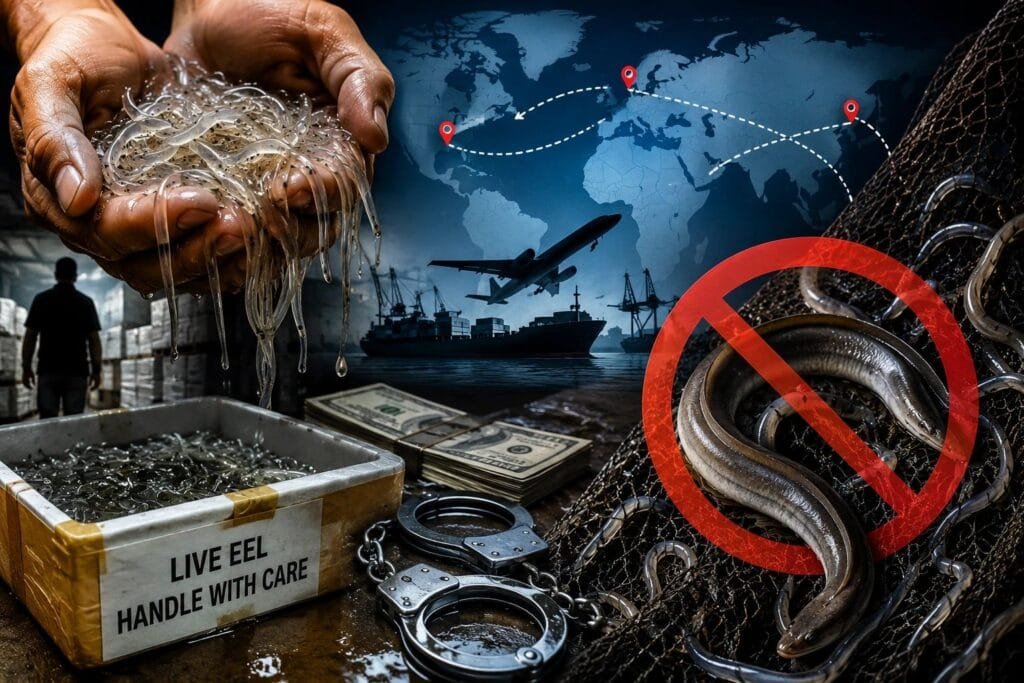
The European eel, a mysterious fish that spends much of its life in rivers and coastal waters before making an extraordinary journey across the Atlantic to reproduce, is at the center of a growing international trafficking crisis.
Once regarded mainly as a traditional food source, the European eel has become a highly valuable commodity. Its young, known as glass eels, can command extremely high prices in Asian markets. As wild eel populations have declined, demand has continued to rise, creating lucrative opportunities for illegal traders and organized criminal networks.
What appears to be a small wildlife trade is, in reality, a sophisticated international business involving collectors, middlemen, transporters, exporters and buyers operating across several countries.
A Species Under Severe Pressure
The European eel has experienced a dramatic decline in population over the past several decades. Pollution, habitat loss, barriers to migration, changes in ocean conditions, fishing pressure and illegal harvesting have all contributed to the species’ difficulties.
The eel’s unusual life cycle makes the situation particularly complicated. Mature eels migrate thousands of kilometers to the Sargasso Sea, where they are believed to reproduce. Their offspring eventually return toward European waters as tiny transparent glass eels.
Because reproducing European eels commercially remains extremely difficult, the supply chain depends heavily on wild-caught young eels.
That biological limitation makes every illegally captured glass eel potentially valuable.
Glass Eels: Tiny Fish, Huge Profits
Glass eels are only a few centimeters long and are almost transparent. Despite their tiny size, they can become worth enormous sums after passing through international supply chains.
During the annual migration season, fishermen and collectors can target rivers and estuaries where glass eels gather. Some of the catch enters legitimate channels, while other quantities are diverted into illegal networks.
The small size of the animals also makes concealment relatively easy. Large numbers can be transported in containers with water, making them difficult to detect unless authorities specifically know what they are looking for.
This combination of high value and easy concealment has helped make eel trafficking an attractive business for criminal operators.
From Local Poaching to International Crime
The illegal trade does not stop at the point where the eels are caught.
Investigations into the trade have revealed supply chains stretching across Europe and into major international trading centers in Asia. Paris, Hong Kong and mainland China have emerged in reporting and investigations as important locations in the broader commercial network.
The journey can involve multiple intermediaries and companies, making it difficult to determine where legally sourced eels end and illegally harvested animals enter the supply chain.
Once trafficked animals cross borders, tracing their original source becomes increasingly complicated.
Why the Business Is So Attractive
Wildlife trafficking generally becomes profitable when three conditions exist: high demand, limited supply and weak enforcement.
The eel trade possesses all three characteristics.
European eels are subject to strict conservation measures, while demand for eel products remains substantial, particularly in East Asian markets. The resulting price difference creates an incentive for illegal harvesting and smuggling.
For criminal groups, wildlife trafficking can also offer an advantage over some other illegal commodities because penalties and enforcement resources may be comparatively limited.
The result is a market in which a small quantity of wildlife can potentially generate enormous returns.
The Restocking Loophole
One of the most controversial elements of the eel trade involves the concept of restocking.
Young eels may legitimately be moved between locations for conservation purposes, with the objective of strengthening depleted populations. However, investigators have raised concerns that systems designed for conservation can potentially be manipulated to disguise illegally obtained animals.
If illegally caught eels are mixed with legitimate shipments or moved under apparently legal documentation, authorities can face significant difficulties establishing their true origin.
This demonstrates a broader problem in wildlife protection: regulations can only work effectively when supply chains are transparent and independently monitored.
A Trade That Crosses Continents
The eel business illustrates how modern wildlife trafficking has become increasingly global.
An animal can be captured in a European river, transferred through several intermediaries, transported across national borders and eventually sold thousands of kilometers away.
At every stage, paperwork, transportation companies and commercial intermediaries may become part of the supply chain.
Investigators therefore have to follow not only the animals but also money, company ownership, shipping records and business relationships.
This makes eel trafficking far more complicated than simply catching fish illegally.
Alleged Links to Wider Criminal Networks
Some investigations into the international eel trade have raised questions about connections between wildlife trafficking and other forms of organized crime.
The enormous profits involved can attract individuals who already operate within established smuggling networks. Such networks may possess the transportation routes, financial infrastructure and contacts needed to move wildlife internationally.
Reports have also examined controversial connections involving Haiti and Russia. Some claims have suggested that eel-related commercial networks intersect with wider criminal or geopolitical activities.
Such allegations require careful verification, however, because connections between companies, individuals and criminal activities can be complex and may not establish direct involvement without evidence from law-enforcement investigations or court proceedings.
Haiti and the Wider Investigation
The eel trade has also appeared in investigations examining unusual international commercial connections involving Haiti.
Questions surrounding eel exports have attracted attention because Haiti has been identified as an important location in parts of the wider eel supply chain. Investigators have explored whether legitimate-looking commercial operations could have been used to move valuable wildlife through international markets.
Some reporting has further connected people or businesses associated with the eel trade to investigations surrounding the assassination of former Haitian President Jovenel Moïse.
These reported links are particularly sensitive and should not be interpreted as proof that the eel trade itself was responsible for the assassination. Instead, they illustrate how investigators have followed financial and commercial connections that extend beyond traditional wildlife crime.
Environmental Consequences Could Be Severe
Behind the money and criminal investigations lies an even bigger issue: the survival of the European eel.
The species’ decline affects more than the fishing industry. Eels are part of aquatic ecosystems and interact with numerous other organisms throughout their complicated life cycle.
Removing large numbers of young eels from the wild before they have an opportunity to mature can place additional pressure on already declining populations.
If illegal harvesting continues alongside habitat degradation, pollution and other environmental pressures, recovery could become increasingly difficult.
Conservation Versus Profit
The eel trafficking crisis highlights a fundamental conflict between conservation and commercial demand.
For traders, glass eels are an expensive commodity.
For conservationists, they represent the next generation of a threatened species.
That difference in perspective creates a powerful incentive for illegal operators to exploit regulatory gaps and weak points in international supply chains.
Stopping the trade therefore requires more than increasing patrols along rivers. Authorities need stronger monitoring of exporters, importers, transport companies and financial transactions.
Technology Could Help Authorities
Modern technology may provide new tools for fighting wildlife trafficking.
DNA analysis can potentially help determine where animals originated. Digital tracking systems can improve the monitoring of shipments, while financial investigations can reveal suspicious transactions.
Better information sharing between customs agencies, environmental authorities and police forces could also make it more difficult for traffickers to move animals through multiple countries.
International cooperation is particularly important because no single country controls the entire supply chain.
The Future of the European Eel
The European eel’s story is ultimately about the consequences of turning a declining natural resource into an increasingly valuable commodity.
As wild populations become scarcer, the economic incentive to capture the remaining animals can become stronger rather than weaker. Without effective enforcement and conservation, that cycle could accelerate the species’ decline.
The fight against eel trafficking is therefore not simply a battle against illegal fishing. It is a test of whether international authorities can protect a species whose extraordinary life cycle crosses borders and oceans.
The tiny glass eel may look insignificant when held in a person’s hand, but its value has created a global industry—and, increasingly, a criminal market.
For the European eel to survive, conservation must remain more valuable than the short-term profits generated by its illegal trade.