Gaza Faces Deepening Humanitarian Crisis as Violence Continues Despite Peace Efforts
The Gaza crisis is now defined by a difficult gap between diplomatic efforts and conditions on the ground. A lasting solution will require more than a ceasefire announcement—it will need sustained humanitarian access, credible security arrangements, reconstruction funding and a workable political framework for Gaza.
The immediate priority should be protecting civilians and ensuring uninterrupted delivery of food, medicine, clean water and other essential supplies. At the same time, any long-term agreement will have to address Israel’s security concerns and the future governance of Gaza.
The biggest test of the current peace efforts will be whether they can produce a sustained reduction in violence and tangible improvements in civilian life, rather than another temporary pause in fighting.
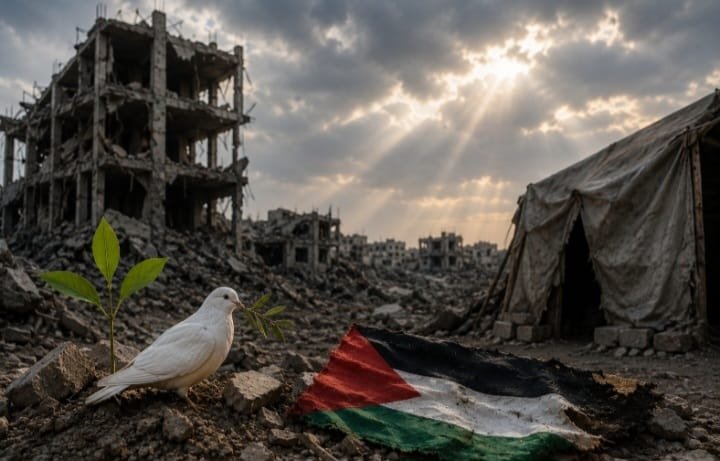
GAZA AI Generated Image
Gaza, August 8, 2026: The humanitarian situation in Gaza remains deeply fragile as Israeli military operations continue despite diplomatic efforts aimed at ending the conflict and creating a framework for Hamas disarmament and an eventual Israeli withdrawal.
The latest developments have created a stark contrast between diplomatic announcements suggesting progress and conditions on the ground, where Palestinians continue to face displacement, shortages and the consequences of prolonged fighting. Reuters reported that regional governments including Saudi Arabia, Egypt, the United Arab Emirates, Turkey, Qatar, Jordan, Pakistan and Indonesia recently condemned Israeli military actions in Gaza and expressed concern over attacks affecting civilian and medical infrastructure. Israel rejected the criticism and said Hamas continues activities including recruitment, rearming and tunnel construction.
Peace Plan Faces Serious Difficulties
The latest diplomatic effort is based on a U.S.-backed framework that seeks the disarmament of Hamas, a phased Israeli withdrawal and the establishment of a new administrative and security structure for Gaza.
U.S. President Donald Trump has described Hamas’s reported willingness to disarm as an important breakthrough. However, implementation remains uncertain because the parties continue to disagree over the order in which major steps should occur.
Israel has maintained that Hamas must give up its weapons and dismantle its military infrastructure before a complete withdrawal. Hamas, meanwhile, has demanded an end to Israeli military operations and guarantees concerning Israel’s withdrawal before surrendering its weapons.
That fundamental disagreement has left the peace process vulnerable to further setbacks.
Violence Continues Despite Diplomatic Efforts
The continuation of Israeli strikes has become one of the biggest obstacles to the proposed peace framework.
Reuters reported earlier this month that Israeli attacks had killed Palestinians even as Washington highlighted progress in negotiations. Palestinians interviewed by Reuters expressed frustration that diplomatic announcements did not appear to match the reality they were experiencing.
For residents, the difference between a political agreement and actual conditions on the ground is substantial.
Families remain displaced, buildings have been destroyed and access to essential services remains difficult in many parts of the territory.
Humanitarian Conditions Remain Critical
Years of conflict have left Gaza’s civilian infrastructure severely damaged.
Hospitals, roads, homes, schools and other essential facilities have suffered extensive destruction. The situation has made it increasingly difficult for humanitarian organizations to provide assistance to the population.
The latest regional statement specifically highlighted concerns over attacks affecting healthcare and civilian infrastructure.
For medical workers, the challenges extend beyond treating casualties. Hospitals must also deal with damaged facilities, shortages of equipment and supplies, and large numbers of people requiring treatment.
The destruction of medical storage facilities can have consequences well beyond the immediate damage because essential medicines and specialized equipment may become unavailable.
A Multinational Force Could Become Part of the Solution
Another major element of the proposed post-conflict arrangement is the possible deployment of an international stabilization force.
Uganda’s parliament recently authorized the country’s participation in a potential multinational security force for Gaza under Trump’s peace initiative. Ugandan officials said President Trump had asked President Yoweri Museveni to participate.
The proposed force would operate in areas of Gaza not controlled by Israel and would form part of a broader plan involving humanitarian assistance, Palestinian administration and Hamas disarmament.
However, the deployment has not yet become a reality on the ground.
Important questions remain about the force’s mandate, authority, rules of engagement and relationship with Israeli and Palestinian institutions.
Israel Has Approved International Participation
Israel has also taken steps toward allowing an international security presence.
An Israeli official said the country’s security cabinet had approved allowing a multinational force to enter parts of Gaza under the U.S.-backed plan. Countries including Uganda and Morocco have been discussed as potential contributors.
The development could eventually provide a mechanism for monitoring security arrangements and supporting areas from which Israeli forces withdraw.
But the success of such a force would depend heavily on whether all major parties accept its authority.
Without cooperation from Israel, Palestinian political structures and armed groups, international troops could face significant operational and political challenges.
The Burden on Gaza’s Population
For ordinary Palestinians, the continuing uncertainty has become another source of hardship.
Many families have been displaced repeatedly during the conflict. Even when fighting decreases in one location, people may remain unable to return because homes and infrastructure have been destroyed.
Access to clean water, healthcare, food and safe shelter remains a central concern.
The humanitarian crisis is also complicated by the difficulty of recovering bodies from destroyed buildings.
Reuters recently reported that the remains of 112 members of one extended Palestinian family were recovered from rubble and buried in a mass funeral. The recovery operation followed the destruction of several apartment buildings during an earlier Israeli airstrike.
The incident illustrates the enormous scale of destruction and the long-term challenges facing Gaza even if active fighting eventually stops.
Rebuilding Gaza Will Be a Huge Challenge
Ending the fighting would not immediately solve Gaza’s problems.
The territory would face a massive reconstruction task involving homes, hospitals, schools, roads, electricity systems, water networks and sanitation infrastructure.
Reconstruction would also require enormous financial resources and a stable security environment.
International donors are likely to demand mechanisms ensuring that reconstruction funds reach civilian projects and are not diverted toward military activities.
At the same time, Palestinians would need reliable access to basic services during the rebuilding period.
The international community would therefore face a challenge extending far beyond negotiating a ceasefire.
Regional Governments Increase Pressure
The latest criticism from Arab and Muslim-majority governments shows that Gaza remains a major diplomatic issue across the region.
Saudi Arabia, Egypt, Qatar, Turkey, Jordan, Pakistan, Indonesia and the United Arab Emirates have all criticized Israeli military actions in Gaza.
Their joint position reflects concern that continued violence could undermine diplomatic efforts and create further instability throughout the Middle East.
At the same time, these governments have an interest in preventing the conflict from spreading to other parts of the region.
The wider Middle East is already experiencing severe tensions connected to the U.S.-Iran conflict and the crisis surrounding the Strait of Hormuz.
A prolonged Gaza conflict could therefore complicate efforts to stabilize the region as a whole.
The Question of Hamas Disarmament
The future of the peace plan depends heavily on the issue of Hamas’s weapons.
Israel has made disarmament a central condition for ending its military campaign.
Hamas’s position has been more complicated, with the group facing pressure to surrender its weapons while also seeking guarantees about Israeli withdrawal and the future political administration of Gaza.
Any agreement would need a credible mechanism for verifying disarmament.
It would also need to determine who would administer Gaza, who would provide security and how former combatants would be treated.
These questions are extremely difficult because they involve both political legitimacy and security concerns.
What Happens Next?
The next phase of negotiations will likely focus on turning the broad peace framework into concrete arrangements.
Several issues will be particularly important:
- The sequence of Hamas disarmament and Israeli withdrawal.
- The creation of a Palestinian administrative structure.
- Deployment of an international stabilization force.
- Expansion and protection of humanitarian aid.
- Security arrangements around Israeli-controlled areas.
- Reconstruction of Gaza’s damaged infrastructure.
- Guarantees for civilians returning to their homes.
A failure to resolve these questions could lead to another prolonged period of uncertainty.
A Fragile Opportunity
Despite the enormous challenges, the diplomatic process represents an opportunity to move Gaza away from years of conflict.
The reported willingness of Hamas to discuss disarmament, international interest in a stabilization force and continued U.S. involvement provide potential building blocks for a political settlement.
But those elements will matter only if they can be converted into practical measures on the ground.
For Palestinians, the ultimate measure of progress will not be diplomatic statements. It will be whether fighting stops, aid reaches civilians, families can return safely and reconstruction begins.
For Israel, security guarantees and the removal of Hamas’s military capabilities remain central demands.
Bridging these positions will be the hardest part of the peace process.
Conclusion
Gaza remains caught between a potentially significant diplomatic opening and continuing realities of conflict.
The international community is increasingly focused on creating a framework that combines disarmament, Israeli withdrawal, Palestinian administration, humanitarian assistance and international security supervision.
Yet the continuing violence demonstrates how difficult it will be to implement that framework.
The coming weeks could determine whether the current peace initiative develops into a genuine pathway toward stability or becomes another unsuccessful attempt to end a devastating conflict.
For now, Gaza’s civilians remain at the center of the crisis, waiting for diplomatic promises to translate into lasting security and meaningful humanitarian relief.