London Police Arrest 139 Protesters Outside US Embassy During Demonstration Against Palestine Action Ban
LONDON, November 1, 2026: A major demonstration outside the United States Embassy in London has resulted in the arrest of 139 people, highlighting growing tensions over freedom of expression, government restrictions and the ongoing political debate surrounding Palestine Action.
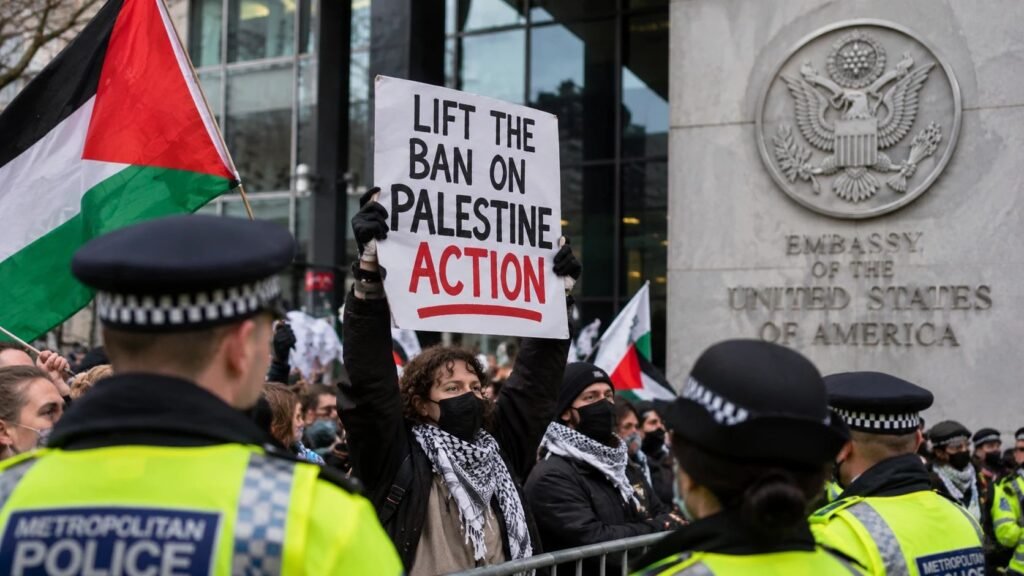
The arrests took place on Saturday, October 31, when hundreds of demonstrators gathered outside the US Embassy in Nine Elms, south London, to oppose the British government’s decision to ban Palestine Action under terrorism legislation.
According to the Metropolitan Police, most of those detained were suspected of expressing support for a proscribed organisation.
Hundreds Join Demonstration in Central London
The protest was organised by Defend Our Juries, a campaign group opposing the government’s ban on Palestine Action.
Around 400 people reportedly attended the gathering, carrying placards expressing solidarity with Palestinians and challenging the criminalisation of support for the banned organisation.
Several demonstrators displayed messages opposing the war in Gaza and criticising the British government’s approach to peaceful political expression.
Many participants were older people and retirees who said they had joined the demonstration because of concerns about civil liberties and the right to protest.
Police officers began making arrests during the gathering, with some demonstrators refusing to leave when instructed.
Why Did Police Arrest 139 People?
The British government formally proscribed Palestine Action in 2025 under the Terrorism Act 2000.
Under the legislation, membership in or public expressions of support for a proscribed organisation can constitute a criminal offence.
The Metropolitan Police warned participants before the demonstration that displaying support for Palestine Action could result in arrest.
By the end of Saturday’s operation, police had confirmed that 139 people had been detained, with the majority suspected of expressing support for the banned group.
Protest Organisers Challenge Government Decision
Defend Our Juries strongly criticised the police operation, arguing that people should not face criminal consequences for peaceful political expression.
The organisation claimed that more than 4,000 people had been detained since July 2025 in connection with demonstrations challenging the ban.
Campaigners believe the government’s restrictions threaten fundamental democratic freedoms and could discourage citizens from participating in peaceful political activities.
The British government, however, maintains that the ban was introduced because of Palestine Action’s activities and alleged involvement in serious criminal incidents.
Supreme Court Hearing Could Become a Turning Point
The London demonstration took place just days before a significant legal development.
The UK’s Supreme Court is scheduled to hear an appeal concerning Palestine Action’s proscription on November 4, 2026.
Supporters of the organisation hope the legal challenge could overturn the ban, arguing that the restrictions are disproportionate and interfere with freedom of expression.
The government continues to defend its decision to classify the organisation as a terrorist group.
The outcome of the proceedings could have important consequences for future protests, political campaigning and the interpretation of Britain’s anti-terrorism legislation.
Similar Demonstration Held in Edinburgh
The protests were not limited to London.
A separate demonstration took place outside the United States Consulate in Edinburgh, Scotland, where participants displayed similar messages opposing the ban.
Police Scotland reported that no arrests had been made during the gathering but confirmed that officers were reviewing evidence involving individuals displaying material supporting the proscribed organisation.
A Growing Debate Over Protest Rights in Britain
The latest arrests have intensified a wider national debate over the balance between national security legislation and democratic freedoms.
Supporters of the ban argue that authorities must prevent organisations associated with violence and criminal damage from operating.
Opponents believe that restrictions on public expressions of support risk creating a dangerous precedent for peaceful political activism.
With the Supreme Court hearing approaching, Britain’s legal and political institutions face an important test over how far the government can restrict support for a banned organisation.