China Announces $15 Billion Stock Market Support Plan as Central Bank Moves to Restore Investor Confidence
China has announced a major financial support initiative worth approximately $15 billion to strengthen its struggling stock market and improve investor confidence. The People’s Bank of China (PBOC) is preparing another round of its liquidity support programme, allowing financial institutions to access more liquid assets for stock market investments. The move comes after a difficult period for Chinese equities, with regulators looking for ways to stabilise financial markets and encourage investment.
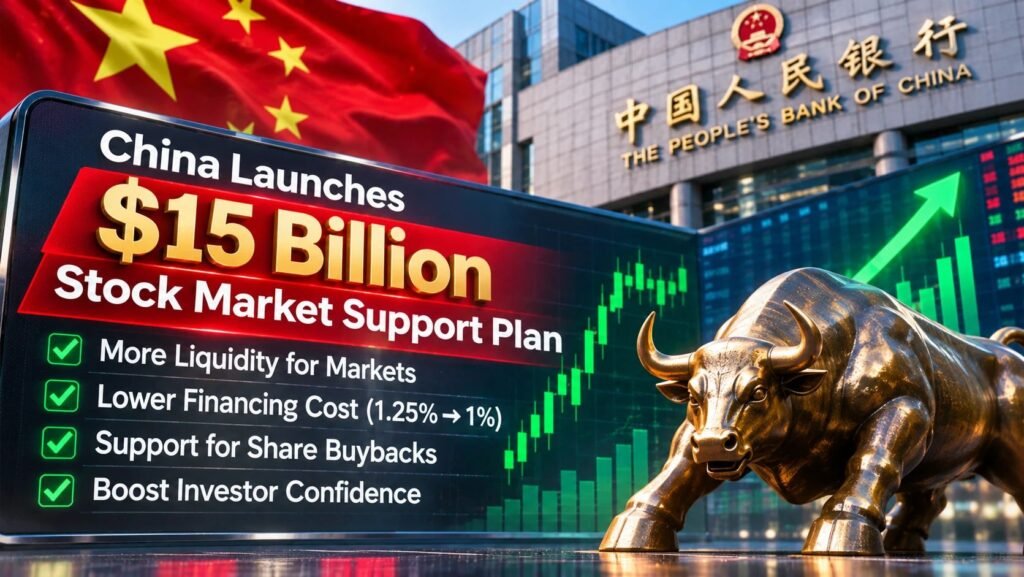
China Introduces a New Financial Support Initiative
China’s central bank announced on November 2, 2026, that it would conduct another round of operations under its Securities, Funds and Insurance Companies Swap Facility.
The programme is designed to help eligible financial institutions obtain liquid assets that can be used to support stock market investments.
According to the announcement, 31 securities firms and fund companies had submitted applications with a combined requested amount exceeding 100 billion yuan, equivalent to approximately $15 billion.
The new operation is scheduled for November 3 and represents the third activation of this financial support mechanism.
The initiative reflects Beijing’s efforts to strengthen the country’s capital markets following a prolonged period of uncertainty.
How Does the $15 Billion Support Programme Work?
Unlike a conventional government cash injection, the programme operates through an asset exchange mechanism.
Eligible securities companies, insurance firms and investment funds can use certain financial assets as collateral in exchange for highly liquid securities from the central bank.
These liquid assets can then be used to obtain financing through market transactions, including repurchase agreements.
The resulting funds are intended to support investments in stocks and exchange-traded funds.
This arrangement is designed to improve liquidity without requiring financial institutions to immediately sell their existing investments.
Chinese Stock Market Faces Investor Confidence Challenges
The announcement comes after a difficult October for China’s stock market.
The benchmark CSI 300 index declined approximately 8.5% during October, marking its weakest monthly performance since early 2016.
Several factors contributed to the decline, including economic uncertainty, falling technology shares and concerns about the country’s broader financial environment.
The property sector’s prolonged debt problems and relatively weak domestic consumption have also affected investor sentiment.
Chinese authorities are therefore looking for ways to encourage market participation and prevent further deterioration in confidence.
Central Bank Also Reduces Interest Rate on Stock Support Loans
Alongside the swap programme, China’s financial regulators announced another important policy change.
The interest rate under the stock buyback and shareholding increase relending programme has been reduced from 1.25% to 1%.
The programme will also move from a temporary arrangement towards a longer-term institutional framework.
This mechanism allows eligible financial institutions to provide loans for listed companies and major shareholders to purchase additional shares or buy back existing stock.
The lower financing cost is expected to make the programme more attractive to participating institutions.
Chinese Regulators Encourage Companies to Support Share Prices
China’s securities regulator has also encouraged major listed companies and leading technology businesses to consider share buybacks.
Authorities are encouraging investment funds to take advantage of market weakness and build positions where appropriate.
Newly established exchange-traded funds have also been encouraged to accelerate their investment activities.
These measures form part of a broader effort to stabilise financial markets and reduce excessive volatility.
Shanghai Stock Market Shows Signs of Recovery
Investor sentiment improved following expectations of additional government support.
On November 2, the Shanghai Composite Index gained approximately 1.1%, recording its strongest single-day percentage increase since August 27.
The recovery suggested that investors welcomed the latest policy announcements.
However, market analysts caution that short-term improvements do not necessarily indicate a complete recovery.
Long-term performance will depend on economic growth, corporate earnings, domestic consumption and the effectiveness of government measures.
What Does China’s Decision Mean for Global Financial Markets?
China is one of the world’s largest economies, making developments in its financial markets important for international investors.
A more stable Chinese stock market could improve confidence across Asian financial markets and influence investment decisions in other regions.
The country’s financial policies may also affect international demand for commodities, industrial products and technology equipment.
However, continued economic uncertainty could limit the impact of these support measures.
Investors will be watching whether the new liquidity programme produces sustained improvements in stock market activity.
Conclusion
China’s latest $15 billion financial support initiative represents another major effort to stabilise its stock market and strengthen investor confidence.
By providing financial institutions with improved access to liquidity and reducing borrowing costs for share purchases, policymakers are attempting to support market activity.
Although the Shanghai market has shown early signs of recovery, the longer-term success of these measures will depend on broader economic conditions and investor confidence.
The coming months will reveal whether China’s latest financial strategy can deliver lasting stability to its capital markets.