Indonesia President Apologises to Singapore and Malaysia Over Devastating Wildfire Haze, Promises Tough Action Against Companies SOUTHEAST ASIA | ASEAN SUMMIT
MANILA, Philippines — Indonesian President Prabowo Subianto has apologised to Singapore and Malaysia over the cross-border air pollution caused by forest and land fires in Indonesia, acknowledging that smoke and haze from the blazes have affected communities in neighbouring countries.
Speaking during the 49th ASEAN Leaders’ Summit in Manila, Prabowo conveyed the apology on behalf of the Indonesian government and people. He assured regional leaders that Indonesia was making substantial efforts to control the fires and would continue taking firm action against companies suspected of involvement.
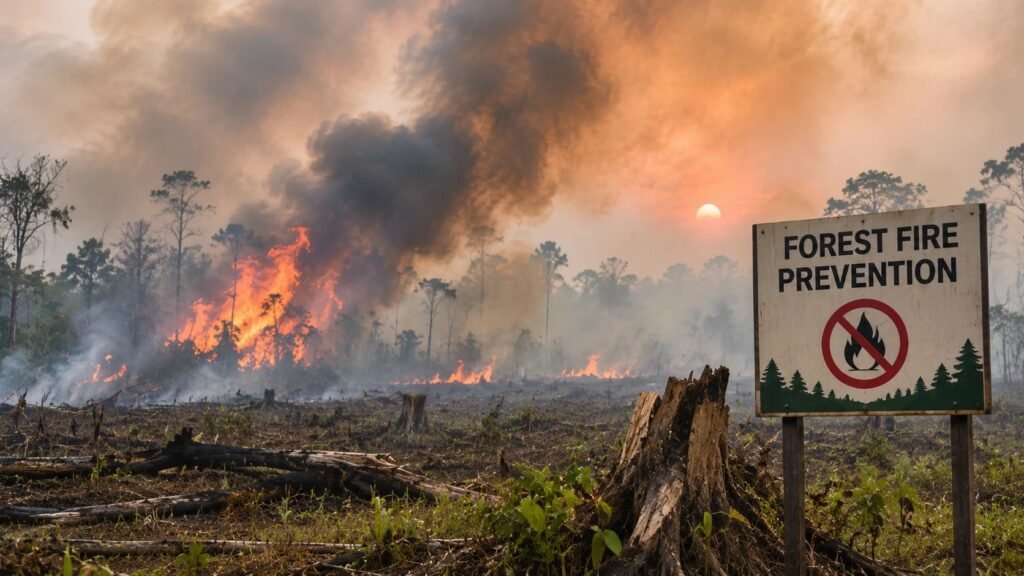
The apology comes as Indonesia battles its most intense wildfires in 11 years, with extensive areas of land affected across Sumatra, Borneo and Papua.
The fires have persisted for nearly four months, creating serious environmental challenges and sending smoke across national borders, particularly towards Singapore and Malaysia.
The Indonesian government’s statement highlights growing regional concern about transboundary haze pollution and the need for stronger cooperation among Southeast Asian countries.
Indonesia Promises Strict Action Against Companies Linked to Forest Fires
President Prabowo said his administration maintains a zero-tolerance policy towards corporations involved in forest and land fires.
He emphasised that authorities had already taken several enforcement measures and would continue pursuing companies suspected of contributing to the destruction of forests and other environmentally sensitive areas.
According to statements reported by CNA, Indonesia has revoked 17 corporate concessions, while 26 companies are currently under investigation.
Eleven companies have already been charged, and another 23 are expected to face charges.
Prabowo also stated that a total of 104 companies were under investigation by Indonesian police.
These measures form part of the government’s effort to establish accountability and discourage activities that contribute to forest destruction and recurring wildfires.
The investigation and legal proceedings are particularly important because forest and land fires can cause extensive environmental damage, destroy wildlife habitats and create serious public health problems.
More Than 71,000 Personnel Mobilised to Fight Wildfires
The Indonesian president also provided ASEAN leaders with details of the extensive firefighting operations undertaken across the country.
According to Prabowo, approximately 71,000 personnel have been deployed to combat the fires.
The firefighting operation has involved considerable human and material costs.
He disclosed that 16 personnel had lost their lives while fighting the fires, while many others had sustained injuries.
Two helicopters were also lost during firefighting operations.
The figures underline the scale of the emergency and the difficulties faced by emergency responders working in challenging environmental conditions.
Indonesia’s extensive forests, peatlands and remote geographical areas make wildfire prevention and suppression particularly difficult.
Authorities are therefore seeking to improve coordination, strengthen operational capabilities and introduce more effective preventive measures.
Singapore and Malaysia Face Cross-Border Haze Pollution
The wildfire crisis has become a regional concern because smoke generated by fires in Indonesia can travel across international boundaries.
Singapore and Malaysia have experienced the effects of transboundary haze, which can reduce visibility and deteriorate air quality.
Air pollution caused by forest and peatland fires can contain fine particulate matter that poses risks to human health, particularly for children, elderly people and individuals with respiratory conditions.
The problem also affects transportation, outdoor activities, tourism and economic operations.
For Singapore and Malaysia, the recurring haze problem has remained an important environmental and diplomatic issue for decades.
Prabowo’s apology acknowledges the impact of the fires on neighbouring populations and signals Indonesia’s intention to strengthen efforts to address the problem.
The Indonesian government has also indicated that it wants to move towards more systematic forest-fire prevention rather than relying primarily on emergency firefighting once fires have already started.
ASEAN Leaders Encourage Stronger Regional Cooperation
The issue was also discussed within the broader framework of ASEAN environmental cooperation.
Philippine Foreign Affairs Secretary Theresa Lazaro said Indonesia had been candid in explaining the measures it had taken to address the wildfire crisis.
She added that ASEAN leaders had encouraged member countries to prioritise ratification of the ASEAN Coordinating Centre on Transboundary Haze Pollution Control.
The proposed regional framework is intended to strengthen cooperation among Southeast Asian governments in addressing haze pollution that crosses national borders.
Improved coordination could help countries exchange information, support monitoring activities and respond more effectively to major wildfire emergencies.
The discussions reflect the understanding that transboundary haze cannot be addressed successfully through the efforts of a single country alone.
Regional cooperation is particularly important when fires occur across large geographical areas and their environmental consequences affect neighbouring populations.
Indonesia Plans to Establish a New Wildfire Prevention Agency
Prabowo also emphasised the need to change Indonesia’s approach to forest and land fires.
Rather than concentrating primarily on extinguishing fires after they begin, the government wants to place greater emphasis on systematic prevention.
According to the presidential statement, Indonesia is preparing to establish a new agency and introduce additional programmes aimed at strengthening wildfire prevention.
The proposed approach is expected to improve institutional coordination and help authorities identify and address potential fire risks before they develop into major emergencies.
Preventive measures are particularly important in peatland areas, where fires can spread underground and remain difficult to extinguish.
Improved monitoring, enforcement of environmental regulations and greater accountability among companies could form important parts of a longer-term strategy.
However, the effectiveness of the proposed institutional changes will depend on implementation, resources and cooperation between national and regional authorities.
Forest and Peatland Fires Create Serious Environmental Challenges
Indonesia is home to extensive tropical forests and peatland ecosystems that play an important role in maintaining biodiversity and regulating the global climate.
When these areas burn, they release substantial quantities of smoke and greenhouse gases into the atmosphere.
Peatland fires are particularly concerning because peat soils contain large amounts of stored organic carbon accumulated over long periods.
When peatlands burn, the fires can release significant emissions and cause environmental damage that continues long after the visible flames have disappeared.
The destruction of forest habitats also threatens wildlife and reduces the ecological functions of affected landscapes.
In addition to environmental damage, prolonged fires can disrupt agricultural activities and create health problems for nearby communities.
The latest wildfire crisis has therefore highlighted the importance of protecting forests and improving land management practices.
Singapore and Indonesia Already Discussed Joint Action
The latest apology follows earlier cooperation between Singapore and Indonesia concerning companies suspected of contributing to forest and land fires.
The two countries agreed to establish a joint task force to investigate businesses linked to fires responsible for transboundary haze.
Singapore Prime Minister Lawrence Wong also proposed expanding the initiative into an ASEAN-wide platform.
Such a platform could allow regional countries to share information and evidence to strengthen investigations and hold responsible companies accountable.
The proposal reflects a broader effort to transform environmental cooperation into practical enforcement mechanisms.
By improving information-sharing and coordination, participating countries could potentially address cross-border environmental violations more effectively.
A Major Test for ASEAN Environmental Cooperation
The Indonesian wildfire crisis has once again placed regional environmental cooperation at the centre of Southeast Asian diplomacy.
Although Indonesia is taking responsibility for addressing the fires within its territory, the consequences extend beyond its borders.
Singapore and Malaysia have direct interests in preventing recurring haze pollution, while other ASEAN countries could also be affected by similar environmental emergencies.
The latest discussions demonstrate the importance of developing stronger regional mechanisms for wildfire monitoring, prevention and enforcement.
Prabowo’s apology and commitment to take action against companies involved in forest fires provide an opportunity to strengthen diplomatic cooperation.
However, the long-term success of these efforts will depend on whether investigations lead to meaningful accountability and whether preventive measures reduce the occurrence of future fires.
The proposed new agency, the enforcement actions against companies and greater ASEAN cooperation will be important developments to watch.
For now, Indonesia faces the dual challenge of controlling the ongoing wildfires and rebuilding confidence among its regional neighbours.
The wider objective is to ensure that environmental emergencies within one country do not continue to threaten public health, ecosystems and economic activities across Southeast Asia.