US Air Travel Disruptions Continue as Thousands of Flights Are Cancelled and Delayed Across AmericaThousands of Flights Affected Across the United States
The latest disruption has created widespread problems at major American airports, with airlines struggling to reposition aircraft, crews and other operational resources.

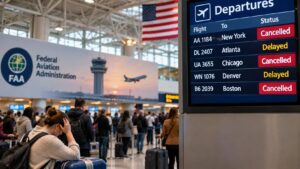
According to FlightAware, airlines cancelled more than 6,400 flights and recorded over 8,000 delays on Saturday. The situation continued into Sunday, when thousands of additional flights were affected.
JetBlue experienced particularly significant disruption, with approximately 27 percent of its scheduled flights cancelled. American Airlines cancelled around 13 percent of its flights, while Southwest Airlines, United Airlines and Delta Air Lines reported cancellation rates between 3 and 5 percent.
The disruption has affected passengers travelling for business, tourism, family visits and other important commitments.
Many travellers have faced extended waiting times, missed connections and unexpected overnight stays at airports.
Airlines have been working to restore their schedules, but the widespread disruption has made it difficult to return aircraft and flight crews to their original positions.
FAA Communications Failure Triggered Nationwide Ground Stop
The crisis began when communication problems affected the Federal Aviation Administration’s air traffic control network.
The FAA ordered a nationwide ground stop, preventing almost all departing aircraft from taking off while authorities assessed the situation.
The restriction lasted nearly five hours before being lifted.
Transportation officials explained that problems involving network routers caused excessive data traffic, affecting communications between air traffic control facilities.
The disruption was particularly concerning because air traffic controllers depend on reliable communication and radar systems to coordinate aircraft movements and maintain safe separation between planes.
Authorities said the ground stop was introduced as a precautionary measure to protect aviation safety.
Although departures gradually resumed, the consequences continued to affect airline operations long after the initial restriction was lifted.
Router Installation Linked to Widespread Network Problems
Investigators have focused on problems associated with the installation of a new router at an FAA facility in El Dorado, Arkansas.
According to Transportation Secretary Sean Duffy, the replacement triggered problems involving another recently installed router in Amarillo, Texas.
The affected equipment reportedly generated excessive data traffic, which overloaded communication systems at other air traffic control centres.
The resulting disruption affected facilities across the country and created difficulties for controllers communicating with aircraft.
The FAA subsequently disabled the functionality of the affected routers and approximately 60 similar units elsewhere in its air traffic control network.
Officials have stressed that the precise technical cause remains under investigation.
The investigation is examining why maintenance work that had reportedly been performed many times previously resulted in such widespread disruption.
No Evidence of Cyberattack or Deliberate Sabotage
The incident initially raised concerns about whether the disruption could have resulted from a cyberattack or deliberate interference with critical aviation infrastructure.
However, Duffy said there was no evidence of a cyberattack or malicious intent.
He also indicated that the worker responsible for installing the equipment was believed to have been acting professionally and that officials did not currently suspect deliberate sabotage.
Nevertheless, authorities have not yet established the complete technical root cause of the incident.
The investigation remains important because the disruption exposed how problems involving relatively limited network equipment can affect aviation operations across an entire country.
Ageing Air Traffic Control Infrastructure Under Renewed Scrutiny
The latest aviation crisis has intensified concerns about the condition of America’s air traffic control infrastructure.
The United States operates one of the world’s busiest aviation networks, handling enormous volumes of domestic and international passenger and cargo traffic.
However, several important components of the system rely on ageing technology, outdated communication equipment and infrastructure that requires modernisation.
A Government Accountability Office assessment found that more than three-quarters of the FAA systems reviewed were classified as unsustainable or potentially unsustainable.
Some facilities continue to depend on decades-old computers and telecommunications equipment.
The system also faces a shortage of several thousand air traffic controllers, creating additional pressure on operations.
The latest disruption has therefore renewed questions about whether the existing infrastructure can reliably support the increasing demands of modern aviation.
Transportation Secretary Seeks $50 Billion for Modernisation
Duffy has called for approximately $50 billion in additional funding to modernise America’s air traffic control infrastructure.
The proposed investment would support the replacement of outdated equipment, improvements to communications networks and the development of more advanced systems for managing aircraft movements.
The administration had previously sought approximately $30 billion for additional improvements.
Congress has already approved $12.5 billion for air traffic control upgrades, but lawmakers have questioned why a substantial portion of that funding remains unspent.
Democratic lawmakers Rick Larsen and André Carson have argued that approximately $11 billion of the previously approved funding had not yet been spent.
They have called for greater accountability and explanations about the need for additional financial assistance.
Duffy has responded that the earlier allocation was intended for specific projects and did not include sufficient funding for new software required to manage American airspace.
The disagreement highlights the financial and administrative challenges involved in modernising a nationwide aviation network.
President Trump Calls for Additional Funding
President Donald Trump has also commented on the continuing aviation disruption and supported efforts to accelerate the modernisation programme.
He called on Congress to approve additional funding, arguing that the necessary improvements should be completed through a coordinated programme rather than implemented gradually.
The administration has maintained that upgrading the country’s aviation infrastructure is essential to preventing similar incidents in the future.
However, lawmakers have also raised questions about spending efficiency, project implementation and the need to ensure that previously approved funding is used effectively.
The debate is expected to remain an important issue in discussions about the future of American transportation infrastructure.
Major Airlines Struggle to Restore Normal Operations
Airlines have faced considerable operational challenges as they attempt to recover from the disruption.
When flights are cancelled, aircraft and crews frequently end up in locations different from those originally planned.
This creates additional complications because airlines must reorganise schedules, reposition aircraft and ensure that pilots and cabin crews are available for subsequent services.
Passengers have also faced difficulties securing alternative flights, particularly on heavily travelled routes.
Several airlines have offered travel waivers allowing affected customers to change their bookings without additional fees.
The availability of alternative seats, however, remains dependent on individual routes and airline capacity.
The situation demonstrates how a disruption involving the national air traffic control system can quickly spread across multiple airlines and airports.
Passengers Face Delays, Cancellations and Travel Uncertainty
For travellers, the disruption has meant more than simply waiting for delayed departures.
Thousands of passengers have experienced missed connecting flights, disrupted business arrangements and unexpected accommodation expenses.
Some travellers have been forced to remain at airports overnight while waiting for replacement services.
Airline employees have also faced increased pressure as they work to assist passengers and reorganise disrupted operations.
The situation has highlighted the importance of reliable communication between aviation authorities, airlines and passengers during major operational emergencies.
Travellers have been encouraged to check flight information directly with their airlines before travelling to airports.
FAA Expects Flight Operations to Recover
Despite the continuing disruption, transportation officials have expressed confidence that airline operations will improve.
Duffy said flights were expected to return largely to normal, with a more complete recovery anticipated by Monday.
The FAA has continued monitoring the affected systems and implementing measures intended to prevent similar problems.
The agency has also emphasised that aviation safety remains its primary concern.
Although the immediate technical issue has been addressed through the disabling of affected routers, officials must still determine precisely why the equipment malfunctioned and whether additional vulnerabilities remain.
The recovery process will depend on airlines successfully repositioning aircraft and crews and restoring their regular operating schedules.
A Warning About America’s Aviation Infrastructure
The continuing disruption has become a major warning about the condition of the infrastructure supporting American aviation.
Modern air travel depends on reliable digital communication, radar monitoring, navigation systems and coordination between hundreds of aviation facilities.
When one component experiences a serious failure, the consequences can spread across the wider transportation network.
The latest incident has demonstrated the importance of investing in modern technology, maintaining effective backup systems and ensuring that essential infrastructure can withstand unexpected technical problems.
For millions of passengers who depend on air travel, the priority remains a return to reliable services and fewer unexpected cancellations.
As the FAA continues its investigation and airlines work to restore normal operations, attention is increasingly focused on the government’s ability to modernise the national air traffic control system.
The crisis has made clear that maintaining aviation safety requires not only experienced personnel but also dependable technology, effective maintenance and long-term infrastructure investment.