Maldives Launches First-Ever Nationwide Agricultural Census to Strengthen Food Security
The Maldives has launched its first-ever agricultural census in a major step toward understanding the country’s farming sector and improving domestic food production.

The nationwide initiative covers commercial farming islands across the island nation and aims to collect comprehensive information about agricultural activities, production capacity and challenges facing local farmers.
According to reports, the exercise is being conducted jointly by the Ministry of Fisheries, Agriculture and Ocean Resources, the Maldives Bureau of Statistics and the Food and Agriculture Organization of the United Nations (FAO).
Census Aims to Identify Agricultural Challenges
The first agricultural census is expected to provide important statistical information about the country’s farming industry. Authorities aim to use the findings to identify existing gaps, assess production limitations and develop policies that can improve agricultural performance.
The information gathered through the initiative is also expected to support evidence-based decision-making, helping policymakers identify areas where farmers need additional resources, infrastructure and technical assistance.
Strengthening food security remains an important priority for the Maldives, which relies significantly on imported food because of its limited agricultural land and geographical conditions.
Government Expands Domestic Farming Initiatives
Alongside the census, the government has introduced several initiatives to encourage local agricultural production.
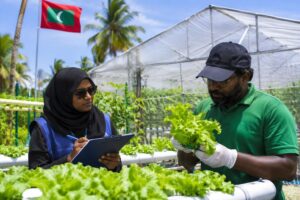
Model greenhouses have already been established on 12 islands across Haa Alifu, Haa Dhaalu and Shaviyani atolls. These facilities are intended to support farming activities and demonstrate improved agricultural techniques suitable for the country’s island environment.
Authorities have also expanded technical education and training opportunities for people involved in agriculture. So far, 1,062 individuals have received training through various agricultural development programmes.
The training initiatives are expected to help farmers improve cultivation methods, adopt modern practices and increase productivity.
Five More Islands Designated for Agricultural Activities
The government’s efforts to expand domestic food production have also included identifying additional locations for farming.
Over the past four months, five more islands have been designated for agricultural activities. These include Kaashidhoo in Kaafu Atoll.
The expansion reflects the country’s broader ambition to make better use of available land and encourage more communities to participate in agricultural development.
Focus on Long-Term Food Security
The launch of the agricultural census represents an important foundation for future planning in the Maldives. Reliable information about farming activities can help authorities understand the sector’s actual potential and direct investments toward areas with the greatest development needs.
By combining nationwide data collection, farmer training, greenhouse development and the expansion of agricultural locations, the government is seeking to build a more resilient domestic food production system.
The success of these initiatives could help the Maldives reduce its dependence on imported food, improve agricultural productivity and strengthen food security for communities across the island nation.