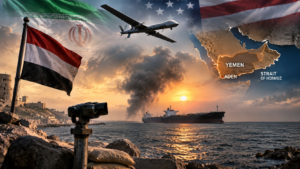
Iran Launches Fresh Drone Attack on US Military Targets in Bahrain as Middle East Tensions Rise
CAIRO, November 17, 2026 — Tensions across the Middle East have intensified after Iran launched another wave of drones toward American military infrastructure in Bahrain, raising concerns about a possible expansion of the ongoing conflict involving Tehran, Washington and regional allies.

The latest incident marks the third reported Iranian attack on US military facilities in Bahrain within a few days, ending a period of relative calm that had lasted approximately two months.
Bahraini authorities announced that their air defense systems successfully intercepted the incoming drones. The developments highlight growing security concerns across the Persian Gulf as diplomatic efforts to end the conflict continue to face serious obstacles.
Iran Increases Pressure on American Military Positions
Iran’s latest drone operation reportedly targeted a US radar installation in Bahrain. Tehran has presented its recent military actions as retaliation for American attacks against Iranian infrastructure and surveillance facilities.
Earlier incidents included attacks directed toward an early-warning radar facility and a helicopter base used by American forces.
Iran’s Revolutionary Guard has warned that military activities conducted against Iranian interests from facilities in neighboring countries will face consequences.
Security analysts believe Tehran may be changing its approach by attempting to disrupt the operational capabilities of American military installations rather than simply responding after attacks occur.
However, the full extent of the damage caused by the latest operations remains unclear, and Bahrain has reported successful interceptions.
Washington Strengthens Its Military Presence
The latest confrontation comes as the United States expands its military presence across the Middle East.
The arrival of the USS Theodore Roosevelt carrier strike group has increased the American naval deployment in the region to three aircraft carriers.
The Roosevelt joins the USS George H.W. Bush and USS George Washington, supported by additional naval vessels and military personnel.
The expanded deployment provides Washington with greater military capabilities, including air operations, surveillance and missile defense.
President Donald Trump has continued to consider different options for dealing with Iran, including maintaining economic pressure, strengthening regional defenses or potentially ordering additional military operations.
The growing American military presence has also increased concerns that a relatively limited confrontation could develop into a wider regional crisis.
Diplomatic Efforts Face Growing Difficulties
Despite continued international mediation, negotiations between Washington and Tehran have made limited progress.
Qatar has been involved in efforts to encourage both sides to find a diplomatic solution. However, disagreements over military activities, economic restrictions and control of important shipping routes remain major obstacles.
Iran has indicated that it remains open to negotiations but has also warned that it will not accept continued pressure without a response.
American policymakers, meanwhile, are weighing whether maintaining the existing naval blockade could weaken Iran’s economic position enough to encourage negotiations.
Analysts warn that both governments face difficult decisions. Additional military escalation could create serious consequences, while prolonged economic pressure may encourage Tehran to take greater risks.
Strait of Hormuz Becomes a Major International Concern
The conflict is also threatening one of the world’s most important maritime trade routes: the Strait of Hormuz.
The narrow waterway connects the Persian Gulf with international shipping routes and plays a critical role in global energy transportation.
Before the conflict, approximately one-fifth of the world’s traded oil and gas passed through this strategic corridor.
Iran’s restrictions and attacks on commercial shipping have significantly disrupted normal maritime activity. Reports of attacks on tankers and suspected naval mines have further increased concerns among shipping companies and international markets.
The United Kingdom Maritime Trade Operations organization reported that a tanker was attacked twice north of Oman, with the second incident causing a fire.
Iranian media also reported that two vessels had struck mines in the Strait of Hormuz, although the details surrounding those incidents remained uncertain.
Any prolonged disruption could affect international energy supplies, transportation costs and global economic stability.
Yemen Adds Another Layer to the Regional Crisis
The security situation is becoming more complicated because of developments around Yemen’s Bab el-Mandeb Strait.
Iran-backed Houthi forces have strengthened their position near this important maritime passage following the retreat of forces aligned with Yemen’s internationally recognized government.
The waterway connects the Gulf of Aden with the Red Sea and provides a vital route for international commercial shipping.
Together, the Strait of Hormuz and Bab el-Mandeb represent two important pressure points for global trade.
Increased instability around both routes could create additional difficulties for international shipping companies and countries dependent on energy imports.
A Dangerous Situation With No Clear Ending
The latest Iranian attacks on American facilities in Bahrain demonstrate how fragile the regional security situation has become.
Washington continues to maintain substantial military capabilities in the region, while Tehran appears increasingly willing to challenge American pressure through limited military operations.
For neighboring Gulf countries, the situation presents a difficult challenge. They must protect their territory and infrastructure while avoiding deeper involvement in a conflict that could threaten their economies and national security.
The coming weeks may prove critical as the United States considers its next steps and Iran decides whether to pursue negotiations or increase military pressure.
For now, the combination of military deployments, economic restrictions and threats to international shipping suggests that peace in the Middle East remains uncertain.