US Air Travel Chaos Continues for Third Day as Thousands of Flights Are Cancelled and Delayed After FAA System Failure
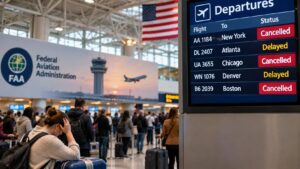
NEW YORK — Air travel disruptions across the United States have continued for a third consecutive day, leaving thousands of passengers stranded at airports as airlines struggle to restore normal operations following a major communications failure in the country’s air traffic control network.
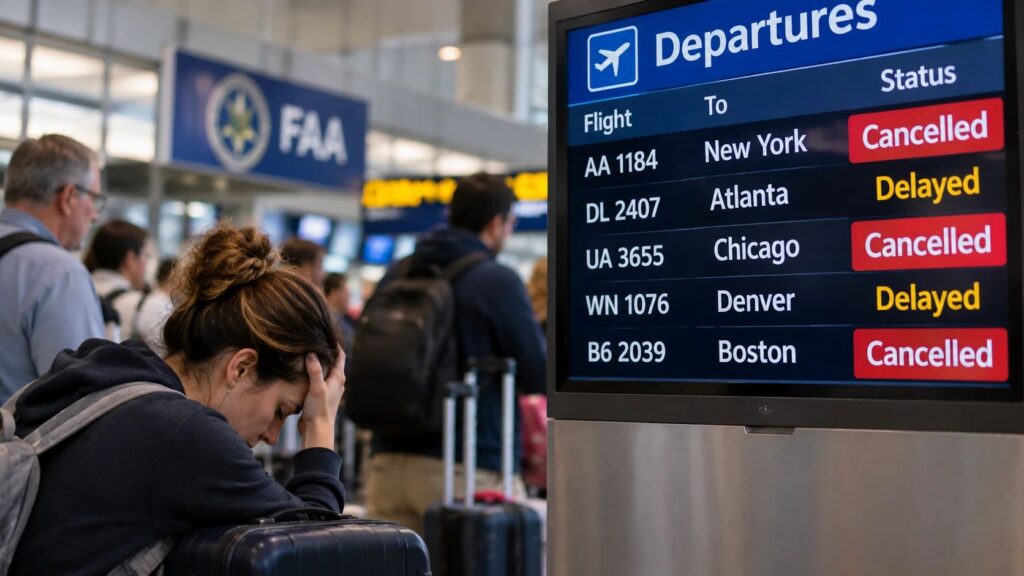
More than 5,200 flights had been affected by Sunday, including over 1,600 cancellations and nearly 3,600 delays, according to aviation data provider FlightAware.
The disruption began after the Federal Aviation Administration (FAA) ordered a nationwide ground stop that halted nearly all departing flights for almost five hours on Friday. The incident triggered widespread operational problems across the American aviation industry and affected major airlines, including JetBlue, American Airlines, Delta Air Lines, United Airlines and Southwest Airlines.
Transportation Secretary Sean Duffy has predicted that airline operations would largely return to normal by Monday, although airlines continue working to reorganise aircraft, crews and passenger schedules.
Thousands of Passengers Face Continuing Travel Problems
The disruption has created significant difficulties for domestic and international travellers, with airports experiencing crowded terminals, cancelled departures and long waiting times.
According to FlightAware, airlines cancelled more than 6,400 flights and delayed over 8,000 on Saturday alone.
On Sunday, JetBlue recorded cancellations involving approximately 27 percent of its scheduled flights, while American Airlines cancelled around 13 percent.
Southwest Airlines, United Airlines and Delta Air Lines reported cancellation rates ranging between 3 and 5 percent.
The widespread disruption has affected business travellers, tourists and passengers travelling to visit family members.
Many travellers have been forced to change their plans, book alternative flights or spend additional time at airports while waiting for airline updates.
Airlines have also faced difficulties because aircraft and flight crews were left in locations different from their original schedules.
FAA Communications Failure Triggered Nationwide Ground Stop
The crisis began when problems affected the FAA’s air traffic control communications network.
The agency ordered a nationwide ground stop on Friday, preventing almost all departing aircraft from taking off while officials assessed the technical situation.
The restriction lasted nearly five hours and represented the longest nationwide interruption to US air travel since the September 11, 2001 attacks.
Transportation Secretary Sean Duffy explained that instability involving communications equipment affected air traffic control operations across the country.
Although the FAA maintained that aircraft could be landed safely, officials considered a nationwide ground stop necessary to protect passengers and maintain aviation safety.
Flights gradually resumed after the restriction was lifted, but the operational consequences continued into the following days.
Router Installation Linked to Nationwide Aviation Disruption
Investigators have focused on problems involving routers installed by FAA contractor L3Harris.
According to officials, the installation of a replacement router at an FAA facility in El Dorado, Arkansas, triggered problems involving another recently replaced router in Amarillo, Texas.
The affected equipment reportedly generated excessive data traffic, overwhelming communications systems at other air traffic control centres.
The resulting disruption affected communication networks used to coordinate aircraft movements.
The FAA subsequently disabled the functionality of the affected routers and approximately 60 similar units across its air traffic control network.
However, authorities have not yet established the complete technical root cause of the incident.
Duffy said the maintenance work had been performed thousands of times previously without causing similar problems.
He also indicated that officials did not believe the employee responsible for the installation had deliberately attempted to sabotage the network.
Officials Rule Out Evidence of Cyberattack
The incident initially raised concerns about possible cyberattacks or deliberate interference with critical American aviation infrastructure.
However, Duffy said there was no evidence of a cyberattack or malicious intent.
He emphasised that investigators were still examining the technical circumstances behind the communications failure.
The incident has nevertheless highlighted the vulnerability of essential transportation infrastructure when outdated equipment and interconnected communications systems experience unexpected problems.
The investigation is expected to examine the router installation, equipment performance and the procedures used to maintain the national air traffic control network.
America’s Ageing Air Traffic Control System Faces Renewed Scrutiny
The latest disruption has intensified concerns about the condition of America’s air traffic control infrastructure.
The United States operates one of the world’s busiest aviation networks, but several components of its communications and monitoring systems rely on ageing technology.
Duffy said the routers involved in the incident had originally been purchased in 2001 and had become obsolete by 2006.
The country also faces a shortage of several thousand air traffic controllers, creating additional pressure on an already demanding aviation system.
The Government Accountability Office has previously identified significant weaknesses in the FAA’s technology infrastructure.
Its assessment found that more than three-quarters of the agency’s reviewed air traffic control systems were classified as unsustainable or potentially unsustainable.
The latest incident has renewed calls for substantial investment to replace outdated equipment and improve the reliability of communications networks.
Sean Duffy Calls for $50 Billion Modernisation Funding
Transportation Secretary Sean Duffy has called for approximately $50 billion in additional funding to modernise America’s air traffic control infrastructure.
The proposed investment would support the replacement of outdated communications equipment, improvements to digital systems and the introduction of more advanced technology for managing aircraft movements.
The administration had previously requested approximately $30 billion for modernisation.
Congress approved $12.5 billion for air traffic control improvements in 2025, but Democratic lawmakers have questioned why a substantial portion of that funding remains unspent.
Representatives Rick Larsen and André Carson said approximately $11 billion of the previously approved funding was still available.
They questioned why the administration was seeking additional money before fully using the existing allocation.
Duffy responded that the previously approved funds were designated for specific projects and did not include sufficient money for new software needed to manage American airspace.
The disagreement has highlighted the financial and administrative challenges surrounding the modernisation programme.
Trump Urges Congress to Approve Additional Funding
President Donald Trump has also weighed in on the aviation crisis, calling on Congress to approve additional funding for modernising the country’s air traffic control infrastructure.
Trump said the improvements should be completed through a coordinated effort rather than through smaller, gradual investments.
His comments came as the administration faced questions about the country’s preparedness for major aviation technology failures.
The debate over funding is expected to continue as lawmakers examine the causes of the disruption and assess the government’s modernisation plans.
Airlines Work to Restore Normal Flight Schedules
Airlines are continuing efforts to restore their operations following the nationwide disruption.
The process involves repositioning aircraft, arranging replacement crews and rescheduling flights that were cancelled during the ground stop.
Even after the FAA lifted its restrictions, airlines needed additional time to return their operations to normal.
The situation demonstrates how a technical failure affecting the national aviation network can create consequences lasting several days.
Passengers have been advised to check directly with their airlines for updated departure information and alternative travel arrangements.
Aviation Crisis Raises Questions About Future Infrastructure Investment
The continuing disruption has become a major warning about the importance of reliable communications technology in modern aviation.
Air traffic control systems coordinate thousands of aircraft movements every day, making dependable equipment essential for maintaining safety and operational efficiency.
The latest failure has demonstrated how a problem involving a limited number of network components can affect airports and airlines across an entire country.
For the US government, the challenge now involves identifying the precise cause, preventing similar failures and ensuring that modernisation programmes are implemented effectively.
Although officials expect flight operations to recover, the wider debate about ageing infrastructure, controller shortages and investment requirements is likely to continue.
The incident has reinforced the importance of modernising America’s aviation network to protect passengers and maintain confidence in one of the world’s largest air transportation systems.