128,000-Year-Old Ice in Tibet Could Reveal Secrets of Earth’s Ancient Climate, Scientists Find
TIBET, Scientists have uncovered remarkable evidence that ice preserved in the mountains of Tibet may be more than 128,000 years old, offering a rare opportunity to understand Earth’s climate history. The findings could help researchers investigate ancient temperature changes, glacier survival and environmental conditions that existed long before modern civilisation.
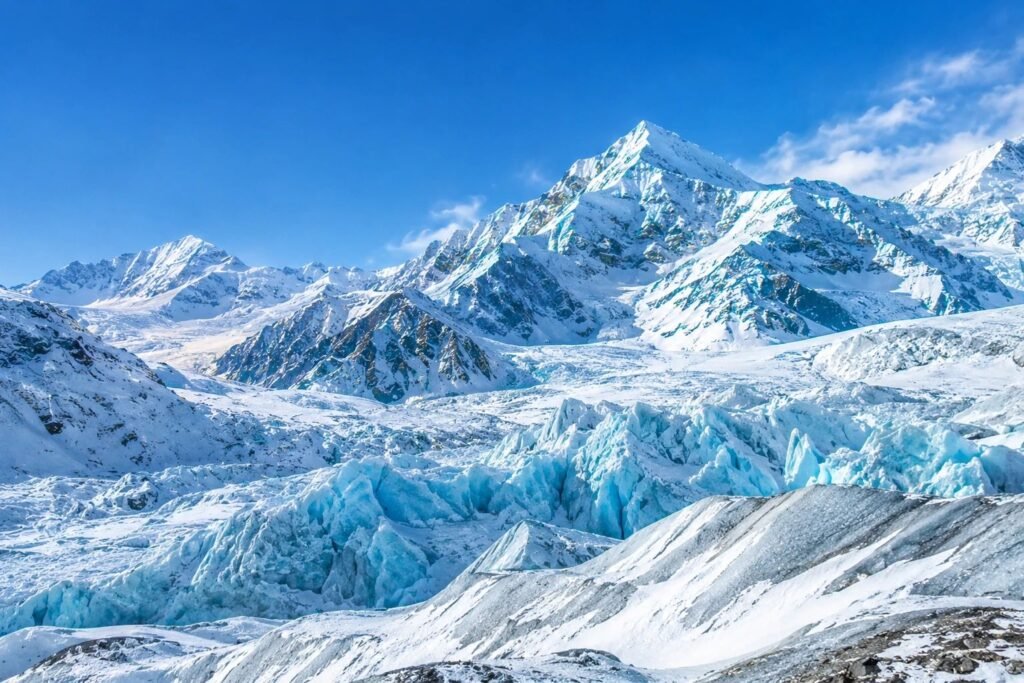
The research focuses on the Guliya ice cap, situated on the Tibetan Plateau in northwestern Tibet. Scientists believe this frozen landscape contains an exceptionally long record of past environmental conditions, potentially extending beyond the last major ice age.
The findings were reported on October 29, 2026, and published in the scientific journal Science Advances.
An Ancient Climate Archive Hidden in the Mountains
Ice formations are among the most valuable natural records available to climate researchers. Over thousands of years, layers of accumulated snowfall gradually become compressed into ice, preserving chemical traces of the atmosphere and environmental conditions from different periods.
By studying these layers, scientists can reconstruct changes in temperature, atmospheric composition and other environmental factors.
The Guliya ice cap is particularly important because its high-altitude location has allowed ancient ice to survive through major climatic changes.
Researchers now believe that this mountain glacier may preserve evidence from a period exceeding 128,000 years, significantly extending the previously understood history of Tibetan mountain ice.
How Researchers Determined the Age of the Ice
To investigate the age of the frozen material, scientists examined ice-core samples collected during two separate expeditions, one in 1992 and another in 2015.
Despite the 23-year difference between the collections, the samples displayed remarkably similar oxygen-isotope patterns.
Oxygen isotopes are commonly used in climate science because their proportions can provide information about past temperatures and environmental conditions.
Researchers also used radioactive isotopes of beryllium and chlorine to establish important chronological markers within the ice. These measurements helped identify chemical evidence associated with a major disturbance in Earth’s magnetic field known as the Laschamp event, which occurred more than 41,000 years ago.
By comparing these results with climate records preserved in nearby Tibetan cave deposits, the research team developed a stronger timeline suggesting that the Guliya ice record extends beyond 128,000 years.
Why This Discovery Is Important for Climate Science
The research could provide valuable information about how glaciers respond to long-term changes in global temperatures.
Earth has experienced several major climatic transitions throughout its history. During colder periods, glaciers expanded across many regions, while warmer conditions caused significant melting and retreat.
Understanding how mountain glaciers survived these changes is essential for reconstructing ancient climate patterns.
The Guliya ice cap offers researchers an unusual opportunity to examine a long-term climate record from a mountain region outside the polar areas.
Its evidence could help scientists better understand the relationship between global warming and glacier behaviour over geological timescales.
Tibet’s Geography Helped Preserve the Ancient Ice
The Tibetan Plateau is one of the highest and most geographically distinctive regions on Earth. Its enormous elevation, complex mountain systems and extreme climatic conditions create an environment where glaciers can develop and persist.
The Guliya ice cap appears to have benefited from geographical conditions that protected parts of its ancient ice through substantial environmental changes.
This makes the region especially valuable for researchers investigating the history of glaciers outside Antarctica and Greenland.
What Scientists Plan to Investigate Next
Although the new research provides important evidence, scientists still have more work to do.
Researchers plan to examine additional ice samples and investigate other chemical indicators that may reveal further details about ancient environmental conditions.
A more accurate timeline could also help answer fundamental questions about when glaciers formed, how they developed and how they responded to major climatic transitions.
The findings may eventually improve scientific understanding of natural climate variability and provide a broader historical perspective for studying today’s changing environment.
Conclusion
The possible discovery of a climate record extending beyond 128,000 years in Tibet represents an important development in the study of Earth’s geological and environmental history.
The Guliya ice cap is more than a frozen mountain landscape. It is a natural archive that may preserve information about climatic conditions from a distant period of Earth’s past.
As researchers continue investigating its ancient layers, this remarkable glacier could help unlock new knowledge about the planet’s climate evolution and the long-term survival of mountain ice.






