U.S.-Iran Diplomacy Intensifies as Hormuz Deal Nears, While White House Faces Ballroom Court Battle
The developments show how closely U.S. foreign policy and domestic politics are intersecting. A potential Hormuz agreement could ease pressure on global shipping and energy markets, but maritime incidents remain a major obstacle. At home, the White House ballroom dispute could become an important test of presidential authority, while Todd Blanche’s narrow confirmation highlights the deep political divisions surrounding the Justice Department.
Washington, D.C. — The Trump administration is confronting a rapidly developing mix of international diplomacy, military pressure and domestic legal challenges as Washington works to manage the continuing conflict with Iran.
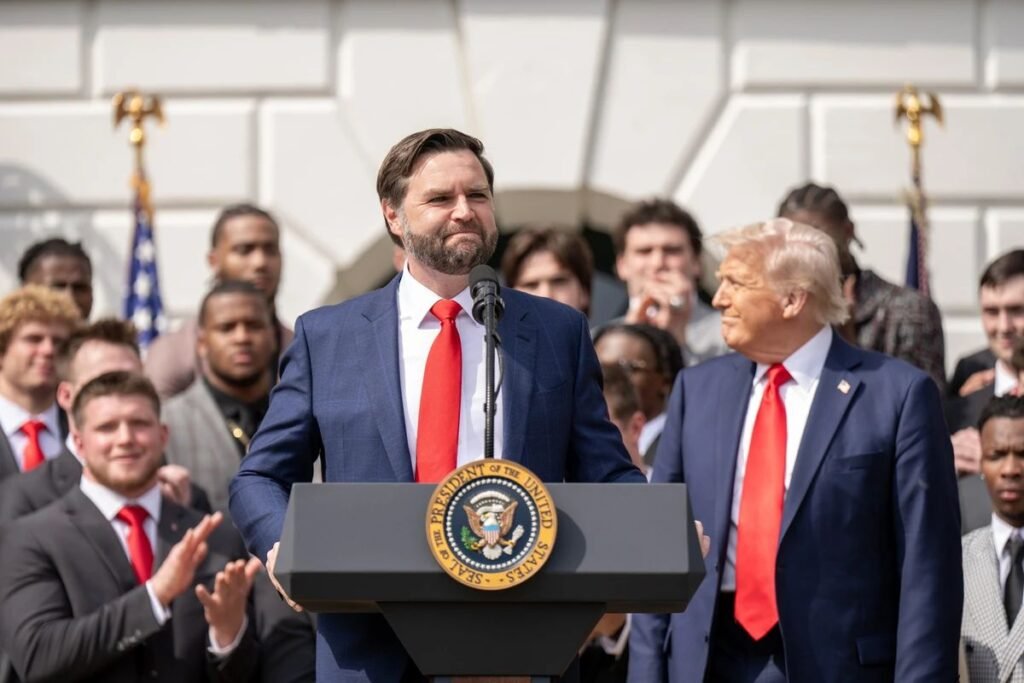
Vice President J.D. Vance has described the confrontation with Tehran as far from finished, signaling that the administration believes negotiations and pressure remain part of a broader strategy rather than evidence that the conflict has reached a definitive conclusion.
At the center of the diplomatic effort is the Strait of Hormuz, one of the world’s most strategically important maritime passages. Iran and Oman are reportedly moving closer to an arrangement intended to establish conditions for safer maritime traffic, although major differences remain and an agreement has not yet been finalized.
Hormuz Becomes Central to Diplomatic Negotiations
The Strait of Hormuz has assumed an increasingly important role in the conflict because of its significance to global energy markets. A substantial share of international oil and gas shipments normally passes through the narrow waterway, making disruptions there a potential concern for energy prices, shipping companies and economies around the world.
Iran has confirmed that discussions with Oman are approaching an agreement, but Tehran has also made clear that an understanding with Muscat alone would not automatically mean a full reopening of the waterway. Reuters reported that Iran has linked the restoration of normal maritime activity to wider conditions involving the United States and the conflict.
Washington, meanwhile, is seeking guarantees that commercial vessels can safely move through the strait and that energy shipments can return toward pre-conflict levels. Vance has indicated that the administration intends to judge Tehran by its actions rather than simply relying on diplomatic assurances.
The negotiations therefore involve more than simply reopening a shipping route. They touch on maritime security, military activity, sanctions, regional stability and the broader relationship between Washington and Tehran.
Maritime Security Remains a Major Concern
Diplomatic progress has been accompanied by continuing security concerns in and around the waterway.
The United Arab Emirates has reported another incident involving an Iranian strike against a vessel, while Oman has condemned attacks on ships. Such incidents could complicate negotiations because any new attack has the potential to undermine confidence in a proposed maritime arrangement.
Vance has emphasized that the United States expects Iran to prevent attacks on commercial vessels and help establish a system under which ships can safely navigate the waterway. Reports have also raised concerns about mines and the practical challenges involved in making shipping lanes safe again.
For international shipping companies, the difference between a political announcement and an operationally safe waterway is significant. Even if negotiators reach a framework, insurers, ship operators and governments may require evidence that vessels can actually travel without facing unacceptable risks.
Washington Says Pressure Will Continue
The administration is pursuing multiple avenues simultaneously, including diplomacy, economic measures and military pressure.
Vance’s description of the conflict as being “in the middle of the game” reflects the administration’s position that negotiations should not be interpreted as an end to the confrontation. Instead, Washington appears to be using the possibility of an agreement alongside continued pressure to seek concessions from Tehran.
Iran, however, has its own demands. Recent reporting indicates that Tehran has sought broader changes, including an end to hostilities, sanctions relief and other measures, making a final settlement considerably more complicated than a simple maritime agreement.
The result is a delicate diplomatic calculation. Both sides have reasons to seek de-escalation, but neither appears ready to abandon its core demands.
White House Ballroom Faces a New Legal Setback
While the administration is dealing with the Middle East crisis, President Donald Trump is also facing a major domestic legal dispute over his planned White House ballroom.
A federal appeals court has ruled against the administration’s effort to continue construction without congressional authorization. The decision represents a significant setback for a project that Trump has repeatedly defended as an important modernization of the White House.
The proposed ballroom, estimated at roughly $400 million and designed to occupy the site of the former East Wing, has been at the center of a lengthy legal dispute over presidential authority. Earlier proceedings also questioned whether the administration could undertake such a large-scale alteration of the White House without Congress.
The administration argues that the project is connected not only to presidential events but also to security considerations. Officials have pointed to the limitations of existing facilities and the need to provide a safer venue for major gatherings involving the president and other senior officials.
The courts, however, have focused on the constitutional and statutory question of presidential authority. The dispute is therefore about more than the ballroom itself: it raises questions about how far a president can go in altering federal property without congressional approval.
Trump Plans Supreme Court Appeal
Trump has indicated that his administration will seek review by the U.S. Supreme Court.
The legal battle could therefore continue well beyond the appeals court ruling. A Supreme Court review would place the broader issue of presidential power and control over the White House complex before the nation’s highest court.
The administration’s national-security argument is expected to remain central to its case. Officials have argued that the Secret Service and other security authorities have legitimate concerns about protecting presidents and managing large events.
The courts must nevertheless determine whether those practical considerations provide sufficient legal authority for the project to proceed without Congress.
The dispute has already generated several stages of litigation. Earlier in the year, an appeals court temporarily allowed portions of construction to continue while legal questions were considered, illustrating the complicated procedural history surrounding the project.
Todd Blanche Confirmed as Attorney General
Another major development inside Washington came from the U.S. Senate, which narrowly confirmed Todd Blanche as attorney general.
Blanche won confirmation by a 50-49 vote, completing a politically contentious process. All Senate Democrats opposed his confirmation, while two Republican senators also voted against him.
Blanche, a former personal attorney for Trump, had already been serving in an acting capacity at the Justice Department. His formal confirmation now gives him permanent authority to lead the department.
His confirmation is politically significant because the Justice Department occupies a central role in several issues involving the Trump administration, including federal prosecutions, national security matters and ongoing legal controversies.
Opponents have raised concerns about Blanche’s previous relationship with Trump and questioned whether the department can maintain sufficient independence from the White House. Supporters, meanwhile, have argued that his experience and familiarity with the administration make him capable of leading the department.
The narrow Senate vote demonstrates the political divisions surrounding the Justice Department and the broader Trump administration.
A Week of High-Stakes Decisions
Taken together, the developments highlight the extraordinary range of challenges facing Washington.
On the international front, the administration is attempting to turn diplomatic contacts with Iran and Oman into a workable arrangement for reopening the Strait of Hormuz while military and maritime tensions remain unresolved.
At home, Trump’s White House ballroom project has encountered another major judicial obstacle, forcing the administration to prepare for a possible Supreme Court battle.
At the same time, the Senate’s confirmation of Blanche gives Trump a permanent attorney general at a moment when the Justice Department is facing intense political scrutiny.
The coming days could prove decisive on all three fronts. A workable Hormuz arrangement could reduce pressure on global energy markets and create an opening for broader negotiations with Iran. A Supreme Court appeal could determine the future of Trump’s White House construction plans and clarify the limits of presidential authority over major federal property projects.
Meanwhile, Blanche’s tenure at the Justice Department will be closely watched as the department navigates some of the most politically sensitive legal issues in Washington.
For now, however, none of these disputes has reached a final resolution. The diplomatic channel with Iran remains fragile, the future of the White House ballroom remains in the hands of the courts, and the newly confirmed attorney general begins his tenure under intense political scrutiny.
Washington’s next moves could therefore have consequences far beyond the capital — affecting global energy security, U.S. foreign policy, presidential authority and the independence of the country’s justice system.