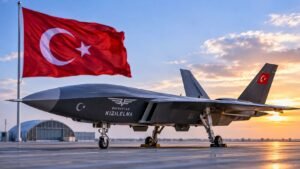
Türkiye Introduces First Jet-Powered Unmanned Fighter as Kızılelma Enters Military Service
ANKARA, November 20, 2026 — Türkiye has marked a significant milestone in its domestic defence industry with the introduction of its first jet-powered unmanned fighter aircraft into military service, expanding the country’s ambitions in next-generation combat aviation.
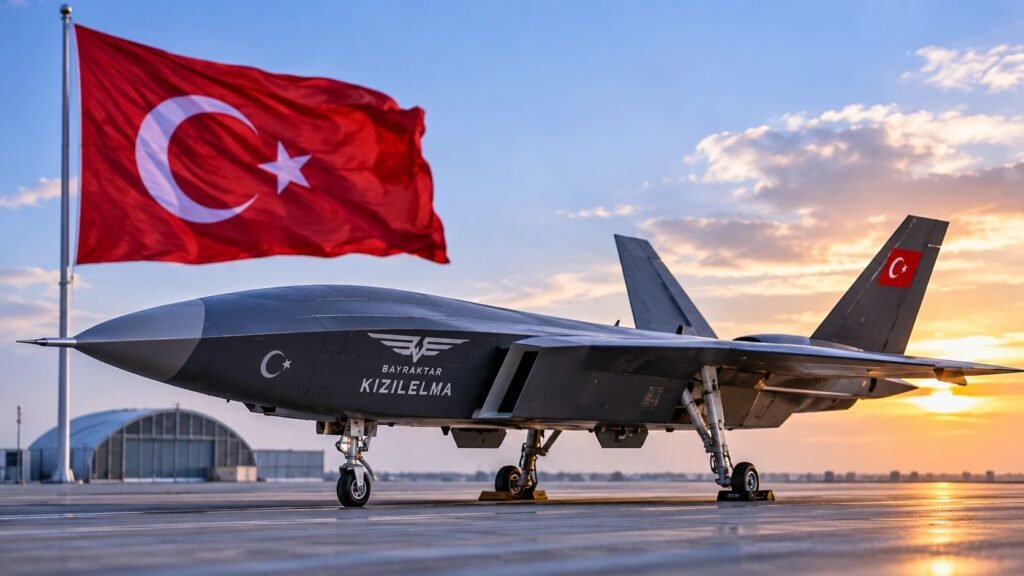
The Bayraktar Kızılelma, developed by Turkish defence manufacturer Baykar, has entered the country’s military inventory following the delivery of its first three aircraft to Turkish security forces on November 19.
The development represents a new phase in Türkiye’s efforts to strengthen its domestic aerospace capabilities and reduce dependence on foreign military technology.
A New Generation of Unmanned Combat Aviation
Unlike conventional military drones primarily designed for surveillance and ground attacks, Kızılelma has been developed as an unmanned fighter platform capable of performing both air-to-air and air-to-ground missions.
The aircraft is designed to operate without a pilot onboard, using advanced autonomous flight systems and integrated sensors.
Baykar says the aircraft can reach a maximum speed of Mach 0.9 and remain airborne for more than three hours. Its maximum take-off weight is approximately 8.5 tonnes, with a stated payload capacity of 1,500 kilograms.
These specifications place Kızılelma in a different category from smaller propeller-driven combat drones.
Advanced Radar and Missile Capabilities
One of the programme’s most important milestones came in November 2025, when a Kızılelma prototype successfully engaged a jet-powered aerial target using a domestically developed Gökdoğan beyond-visual-range air-to-air missile.
The demonstration involved ASELSAN’s MURAD active electronically scanned array radar, highlighting the integration of several Turkish-developed defence technologies within a single aircraft.
The platform has also undergone tests involving guided air-to-ground weapons and internal weapons storage systems.
These developments demonstrate progress towards expanding the role of unmanned aircraft beyond traditional reconnaissance and strike missions. However, successful trials do not automatically establish that every tested capability is approved for routine operational use.
Strengthening Türkiye’s Domestic Defence Industry
The Kızılelma programme reflects Türkiye’s broader strategy of developing indigenous military aircraft, electronic systems, sensors and weapons.
The project began in 2021, and the prototype completed its maiden flight in December 2022.
Its development has taken place alongside the expansion of Türkiye’s wider unmanned aviation industry, which already includes the Bayraktar TB2 and Akıncı platforms.
The delivery of the first three Kızılelma aircraft represents a transition from experimental development towards military operation. The manufacturer has reported approximately 600 test and training sorties.
International Market and Future Prospects
The aircraft is also attracting international attention as Türkiye seeks to expand its defence exports.
Baykar secured an initial export agreement with Indonesia in May 2026 for 12 Kızılelma aircraft, with an option for additional purchases.
The company is also exploring the possibility of adapting the platform for operations from short-deck naval vessels. However, shipboard landing capabilities remain an area requiring further development.
A Changing Landscape for Military Aviation
The introduction of Kızılelma highlights the growing importance of jet-powered unmanned aircraft in modern military aviation.
Countries are increasingly investing in autonomous aircraft that can complement conventional fighter jets, expand surveillance and combat capabilities, and operate as part of integrated airpower systems.
For Türkiye, the aircraft’s entry into military service represents an important industrial and technological milestone.
Its future significance will depend on operational testing, weapons integration, maintenance arrangements and the ability to demonstrate reliable performance in demanding military environments.