Malaysia Records 1.4 Billion USD Current Account Surplus in Third Quarter Despite Growing Economic Pressures
KUALA LUMPUR, November 18, 2026: Malaysia maintained a positive external financial position in the third quarter of 2026, recording a current account surplus of approximately 1.4 billion US dollars, supported by stronger merchandise exports and continued demand for its manufactured products.
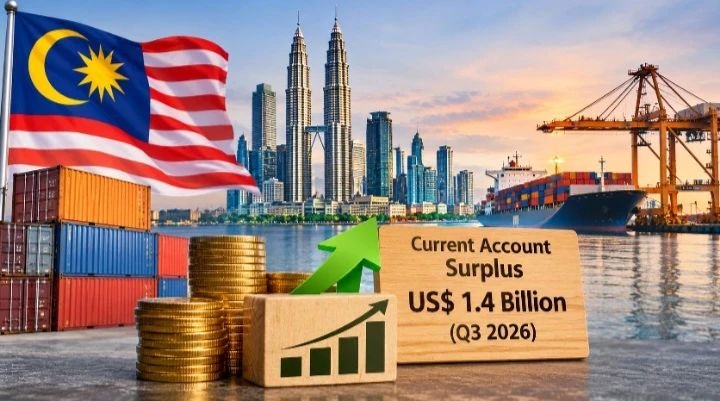
According to the latest balance of payments figures, released on Wednesday, the country’s current account registered a surplus of 5.7 billion Malaysian ringgit between July and September 2026. However, the figure was lower than the 10.8 billion ringgit surplus recorded in the previous quarter.
The latest performance highlights the continuing importance of international trade to Malaysia’s economy, even as rising service-related payments and investment income outflows put pressure on its external balance.
Stronger Goods Exports Support the Surplus
Malaysia’s merchandise trade performance provided the biggest support to its current account during the reporting period.
The goods account generated a surplus of 56.2 billion ringgit, increasing from 40.7 billion ringgit in the second quarter.
Exports of goods reached approximately 409.7 billion ringgit, compared with imports of 353.5 billion ringgit.
Demand for electrical and electronic products, including technology-related manufacturing goods, played an important role in supporting export activity. Growing demand linked to artificial intelligence infrastructure, high-performance computing and advanced semiconductor technologies also contributed to the broader manufacturing environment.
Services and Income Payments Weigh on Performance
Despite the stronger goods surplus, Malaysia experienced greater pressure from other components of its current account.
The services account recorded a deficit of 6.9 billion ringgit during the third quarter, compared with a deficit of just 700 million ringgit in the previous quarter.
Higher payments for imported business services contributed to the deterioration. Expenditure on professional and management consultancy services was among the factors behind the increased deficit.
The primary income account also recorded a wider deficit of 41.8 billion ringgit, compared with 27.2 billion ringgit in the preceding quarter.
This reflected higher earnings generated by foreign-owned companies operating in Malaysia, which increased the amount of investment income flowing overseas.
Foreign Investment Shows Improved Momentum
Malaysia also experienced a notable improvement in financial account activity during the third quarter.
The financial account recorded a net inflow of 19.8 billion ringgit, reversing the net outflow of approximately 27 billion ringgit reported in the second quarter.
Foreign direct investment (FDI) recorded a net inflow of 14.3 billion ringgit, almost twice the 7.4 billion ringgit registered in the previous quarter.
The stronger investment performance indicates continued interest in Malaysia’s business environment, particularly in sectors associated with technology, manufacturing and digital infrastructure.
International reserves also remained broadly stable, reaching 537.6 billion ringgit at the end of September 2026.
What the Latest Figures Mean for Malaysia
The third-quarter results present a mixed picture of Malaysia’s external economic performance.
On one hand, the expanding goods surplus and improved foreign investment inflows demonstrate the country’s continued ability to attract international business and benefit from global trade.
On the other hand, the growing deficits in services and primary income show that stronger exports do not automatically translate into a larger overall current account surplus.
The figures also underline the importance of developing higher-value domestic industries, strengthening local service providers and improving the country’s position in international technology supply chains.
Outlook for the Coming Months
Malaysia’s external economic performance will continue to depend on global demand, export competitiveness, investment activity and international financial conditions.
The technology and electronics industries could remain important sources of export growth, although changes in global trade conditions may influence future performance.
The latest surplus suggests that Malaysia continues to generate more income from its international transactions than it spends through its current account activities.
Maintaining this position while encouraging productive investment and strengthening domestic industries will remain important priorities for the country’s economic policymakers.