Egypt Uncovers Ancient Cemetery Containing Hundreds of Coffins Dating Back to the Ptolemaic Period
MENOUFIA, EGYPT: Egyptian archaeologists have uncovered an extensive ancient cemetery containing hundreds of stone and pottery coffins at the Tell Atrib Abu Bello archaeological site in Menoufia Governorate, revealing new evidence about burial traditions and everyday life in ancient Egypt.
The discovery was made by an Egyptian archaeological mission working under the country’s Supreme Council of Antiquities. Initial examinations suggest that the cemetery was used during several historical periods, including the Late Period, the Ptolemaic Period and the beginning of the Roman era.
The discovery is particularly significant because of the large number of burials found within an open burial courtyard, offering researchers an opportunity to investigate ancient Egyptian funerary customs and social structures.
Hundreds of Ancient Coffins Discovered
Archaeologists uncovered hundreds of stone coffins, pottery coffins and remains of wooden coffins across the excavation area.
The cemetery also contains several mudbrick vaulted tombs, including structures featuring distinctive architectural designs.
Some of the stone coffins were discovered without lids, while others had suffered damage from earlier looting and quarrying activities.
Researchers also identified different types of pottery coffins. Some feature stylised human facial characteristics, while others follow traditional human-shaped coffin designs.
The variety of burial structures suggests that the cemetery served different sections of society over an extended period.
Evidence Points to the Ptolemaic Period
Preliminary archaeological studies indicate that most of the newly discovered burials date to the early Ptolemaic Period, particularly the third and second centuries BC.
Some graves, however, appear to date back to the end of the Late Period, while other evidence points towards continued use during the beginning of the Roman era.
Archaeologists established the preliminary dating through several indicators, including pottery, coffin designs, burial arrangements, architectural features and the archaeological layers in which the objects were discovered.
The findings provide an opportunity to understand how burial practices developed as Egypt experienced different political and cultural influences.
Gold Jewellery and Religious Artefacts Unearthed
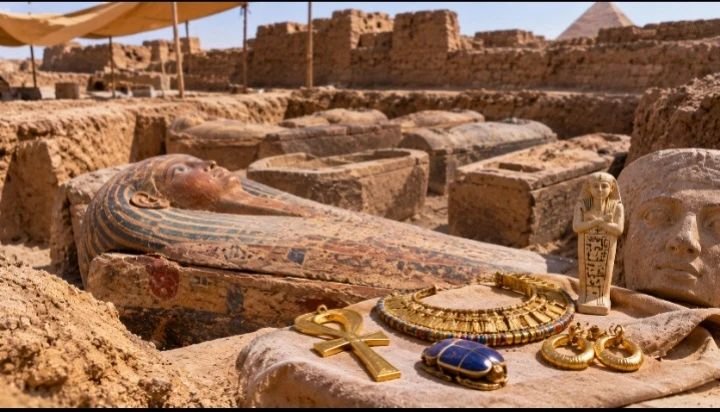
The excavation has also produced several valuable objects that provide insight into the religious beliefs and funerary traditions of ancient Egyptians.
Among the discoveries are:
- Gold tongues and gold sheets.
- Gold earrings and necklace pendants.
- Scarabs made from schist and lapis lazuli.
- Wedjat eye amulets.
- Faience ushabti figurines, some carrying hieroglyphic inscriptions.
- Offering tables and small limestone statue heads.
- Sphinx figurines and fragments of statues depicting the falcon god Horus.
Researchers also discovered terracotta figures representing Isis-Aphrodite, including part of a vessel lid depicting the goddess seated on a lotus flower while nursing the infant Harpocrates.
These objects demonstrate the mixture of Egyptian and Greco-Roman religious traditions that developed during the Ptolemaic era.
Evidence of Ancient Mummification Practices
Although many of the human remains were poorly preserved, researchers identified traces of embalming materials and resins.
Fragments of cartonnage and plaster layers were also discovered, featuring traces of yellow, red, blue and gold colouring.
These materials offer important evidence of the preparation and decoration of bodies for burial.
The findings suggest that traditional Egyptian funerary beliefs continued to influence burial practices during periods of foreign political and cultural influence.
Ancient City of Teranothis Adds Historical Importance
The cemetery is situated within the archaeological area associated with the ancient city of Teranothis, near the eastern entrance to Wadi El-Natrun.
The surrounding region was historically known for its natron deposits, a mineral that played an important role in ancient Egyptian mummification.
Previous archaeological investigations in the area have uncovered remains of the ancient settlement and a temple dedicated to the goddess Hathor, worshipped locally as the Lady of Turquoise.
The newly discovered cemetery adds another important dimension to the archaeological history of the region.
More Excavations Planned
Egyptian archaeological authorities have indicated that excavation and scientific documentation will continue at the site.
Researchers hope that further investigations will reveal additional tombs, architectural structures and burial objects hidden beneath accumulated sand and debris.
The discovery could also provide valuable information about the social organisation, religious traditions and burial customs of communities living in the region thousands of years ago.
A Major Addition to Egypt’s Archaeological Heritage
The discovery highlights the continuing archaeological importance of Egypt, where new excavations regularly reveal evidence of ancient civilisations.
Beyond the valuable artefacts, the cemetery offers an opportunity to understand how ordinary people lived, worshipped and prepared for the afterlife during different periods of Egyptian history.
As archaeological work continues, the site could provide further insights into the cultural connections between ancient Egyptian and Greco-Roman societies.