5.8-Magnitude Earthquake Hits Off the Coast of Peru, German Research Centre Reports
An earthquake measuring 5.8 in magnitude struck near the coast of Peru on Wednesday, November 18, 2026, according to the GFZ German Research Centre for Geosciences.
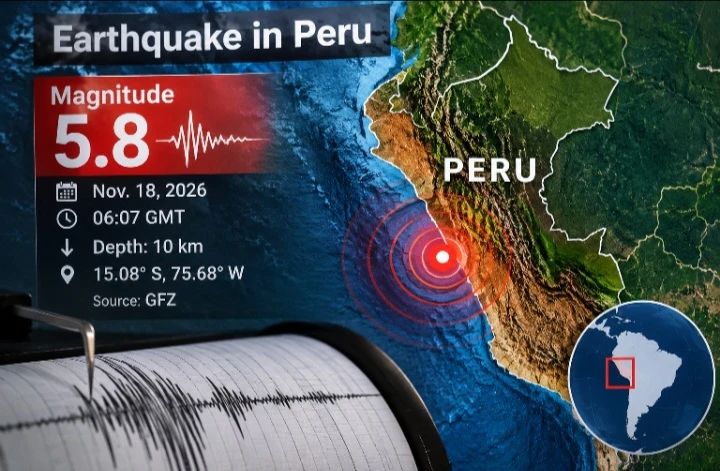
The earthquake occurred at 06:07 GMT, with its epicentre initially located at 15.08 degrees south latitude and 75.68 degrees west longitude.
GFZ reported that the earthquake originated at a relatively shallow depth of approximately 10 kilometres below the Earth’s surface.
Shallow Earthquake Raises Coastal Monitoring Concerns
Earthquakes occurring at shallow depths can produce stronger shaking near their epicentres than deeper seismic events of similar magnitude.
The location of the latest earthquake near Peru’s Pacific coastline makes monitoring particularly important for nearby communities and infrastructure.
Authorities and seismic monitoring agencies typically assess earthquake magnitude, depth and distance from populated areas when evaluating potential impacts.
Peru Located Along the Pacific Ring of Fire
Peru is situated along the Pacific Ring of Fire, one of the world’s most seismically active regions.
The country experiences frequent earthquakes because of the movement and interaction of tectonic plates beneath the Pacific Ocean and South America.
The Nazca Plate moves beneath the South American Plate along the Peru-Chile Trench, creating significant geological pressure that can trigger earthquakes.
This tectonic activity makes earthquake preparedness an important priority for Peruvian authorities.
Monitoring Continues Following the Seismic Event
The initial GFZ report provided the earthquake’s magnitude, estimated depth and geographical coordinates.
Further assessments would be necessary to determine whether the event caused damage, injuries or other significant consequences.
The initial earthquake measurement may also be revised as additional seismic data becomes available.
Importance of Earthquake Preparedness
The latest earthquake highlights the continuing seismic risks facing countries along South America’s Pacific coastline.
Preparedness measures, early-warning systems and resilient infrastructure remain important tools for reducing the potential consequences of future earthquakes.
Seismic monitoring agencies will continue analysing the event to improve understanding of its characteristics and possible regional effects.