Pineapple Peeling Inspires Chinese Surgeons to Develop Groundbreaking Minimally Invasive Heart Surgery Technique
WUHAN, CHINA: An unusual observation of a fruit seller peeling a pineapple has helped inspire a major innovation in heart surgery, as Chinese medical researchers have developed a specialised technique to remove abnormally thickened heart muscle without stopping the heart or performing traditional open-chest surgery.
The pioneering procedure, developed by a team at Tongji Hospital affiliated with Huazhong University of Science and Technology in Wuhan, offers a new surgical approach for patients suffering from hypertrophic cardiomyopathy (HCM).
The development has attracted international medical attention after two research papers describing the technique were published in the prestigious cardiovascular journal Circulation.
The innovation demonstrates how an everyday activity can sometimes inspire solutions to complex medical challenges.
How Pineapple Peeling Inspired a Medical Breakthrough
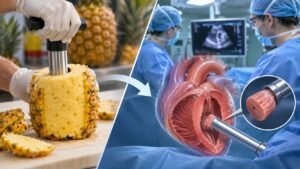
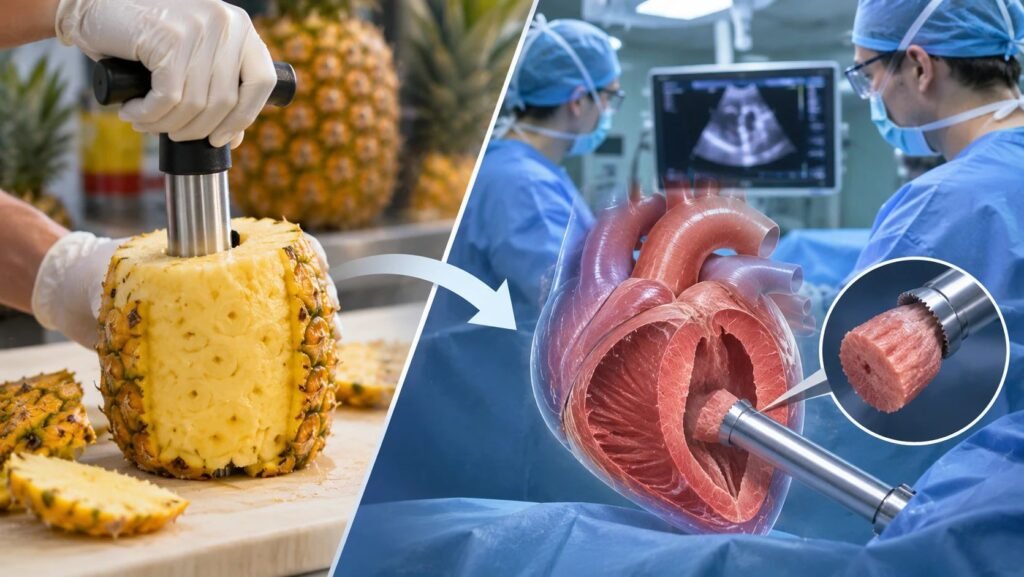
The idea originated in 2018 when cardiac surgeon Professor Wei Xiang observed a fruit seller removing the central core of a pineapple using a specialised rotating cutting tool.
The technique involved inserting a blade into the fruit, cutting around its central core and extracting the unwanted portion without significantly damaging the surrounding flesh.
Wei began considering whether a similar mechanical principle could be adapted to remove excessive heart muscle in patients with hypertrophic cardiomyopathy.
After extensive research, equipment development and testing, his team created a specialised instrument capable of removing thickened cardiac tissue through a minimally invasive approach.
The device uses a tubular cutting mechanism and a needle designed to secure the targeted tissue before removal.
Understanding Hypertrophic Cardiomyopathy
Hypertrophic cardiomyopathy is a heart condition in which the heart muscle becomes abnormally thick.
The condition can interfere with normal blood flow and make it more difficult for the heart to pump blood efficiently.
Patients may experience symptoms such as:
- Chest pain and discomfort.
- Breathlessness, particularly during physical activity.
- Heart palpitations.
- Dizziness and fainting.
- Increased risk of dangerous cardiac arrhythmias.
In some patients, the thickened heart muscle obstructs blood leaving the left ventricle. This condition is known as obstructive hypertrophic cardiomyopathy.
Traditional surgical treatment generally involves removing a portion of the thickened heart muscle through open-heart surgery, often requiring the heart to be temporarily stopped and supported by a heart-lung machine.
Such procedures can be technically demanding and require considerable surgical expertise.
New Technique Allows Surgery on a Beating Heart
The Chinese research team developed a procedure known as transapical beating-heart septal myectomy, or TA-BSM.
Unlike conventional surgery, the technique is designed to avoid opening the chest through a traditional sternotomy and does not require the heart to be stopped.
Surgeons introduce a specialised cutting instrument through the apex, or tip, of the heart.
Using ultrasound imaging for precise guidance, the instrument reaches the targeted area and removes the excessive muscle tissue.
A specialised mechanism helps secure the tissue during cutting so that the removed material can be extracted safely.
The approach aims to reduce surgical trauma while allowing more precise removal of the thickened muscle.
Nearly 1,600 Patients Have Received the Procedure
According to the research team, nearly 1,600 patients with obstructive hypertrophic cardiomyopathy had undergone the procedure at Tongji Hospital since 2022, as reported in the November 18 announcement.
The experience represents an important stage in the development and clinical application of the technique.
The newly published research provides a detailed account of its development, operating principles, clinical evidence, patient selection criteria and management of potential complications.
Researchers also describe its potential application across different forms of hypertrophic cardiomyopathy, including selected patients without conventional outflow obstruction.
However, treatment decisions must depend on individual clinical assessment and specialist evaluation.
Potential Advantages Over Traditional Surgery
The new technique could offer several potential advantages compared with conventional open-heart procedures.
These include:
- Avoiding a traditional chest-opening operation.
- Performing the procedure while the heart continues beating.
- Using ultrasound imaging to guide tissue removal.
- Reducing the need for conventional cardiopulmonary bypass.
- Offering an alternative approach for selected patients.
The technology could also help address some of the technical challenges associated with traditional septal myectomy.
Nevertheless, further clinical evaluation and independent research will remain important in establishing its long-term safety, effectiveness and suitability for different patient groups.
International Medical Attention
The publication of two papers in Circulation has brought the Chinese team’s work to greater international attention.
The research is particularly significant because hypertrophic cardiomyopathy affects patients worldwide and can create serious health risks when left untreated or inadequately managed.
Medical specialists are increasingly interested in developing less invasive procedures that can improve patient recovery while maintaining effective treatment outcomes.
The Wuhan team’s approach represents an example of how engineering concepts can be translated into practical medical technologies.
A Simple Observation With Major Medical Potential
The development of the heart surgery technique highlights the importance of creative thinking in medical research.
An ordinary pineapple-peeling process provided the initial inspiration, but transforming that observation into a medical procedure required years of engineering work, laboratory testing, clinical investigation and surgical expertise.
The innovation offers another example of China’s growing contribution to advanced medical technology.
As further research and international clinical evaluation continue, the technique could create additional treatment opportunities for carefully selected patients living with hypertrophic cardiomyopathy.