China Expands Marine Investment Vision with New Focus on Underwater Storage and Deep-Sea Innovation
BEIJING, November 20, 2026 — China is opening new investment opportunities in advanced ocean technologies after introducing an updated marine industry financing framework that places emerging underwater infrastructure and deep-sea innovations among its priority areas.
The newly released 2026 Marine Industry Investment and Financing Guidance Catalogue aims to attract capital towards developing technologies that could reshape the future of the global ocean economy.
The framework was jointly issued by five major Chinese institutions, including the Ministry of Natural Resources, the National Development and Reform Commission, the People’s Bank of China, the National Financial Regulatory Administration and the China Securities Regulatory Commission.
Underwater Storage Emerges as a New Investment Frontier
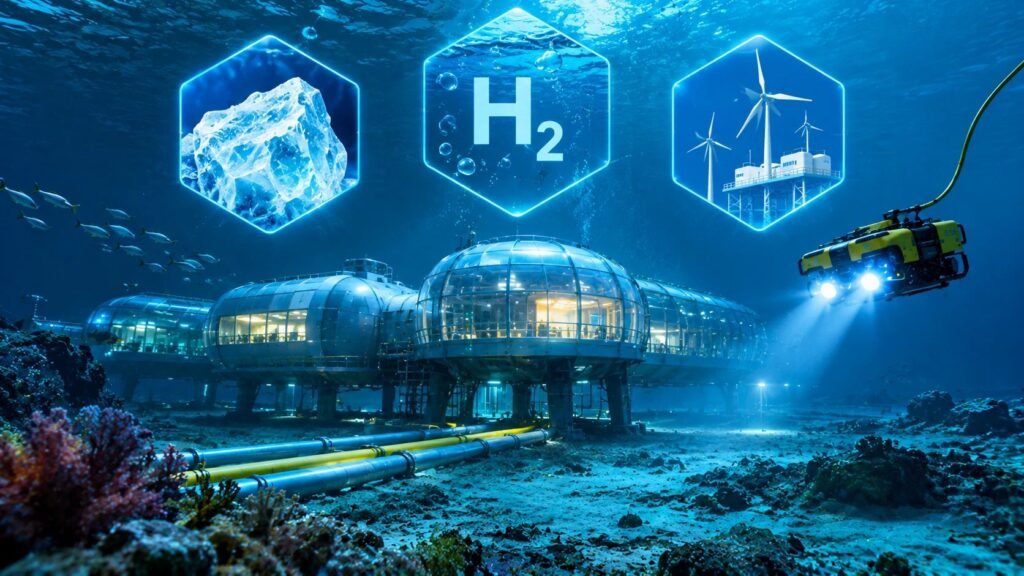
A major feature of the updated catalogue is the inclusion of subsea storage infrastructure within China’s marine investment support framework for the first time.
These specialised facilities are constructed beneath the ocean surface and can serve different purposes, including scientific research, storage and computing infrastructure.
Potential applications include underwater hotels, subsea tunnels and underwater data centres.
Developing such facilities requires advanced engineering because underwater structures must withstand enormous pressure, corrosion caused by seawater and the accumulation of marine organisms on their surfaces.
These challenges are also creating opportunities for technological breakthroughs in specialised construction materials, structural engineering and underwater monitoring systems.
New Energy Technologies Gain Attention
The updated framework also identifies gas hydrate exploration and trial production as important emerging areas.
Gas hydrates, commonly known as combustible ice, contain natural gas trapped within ice-like crystalline structures under specific geological conditions.
Their exploration and extraction could open new research opportunities in marine energy, although technical and environmental challenges remain.
Another important area is hydrogen production using seawater-related technologies. This emerging field could contribute to research into future clean-energy systems and expand the possibilities of ocean-based energy development.
Five Government Agencies Support Marine Industry Development
The catalogue covers 11 major categories of marine industries, including fisheries, aquatic product processing, shipbuilding, ocean engineering equipment, marine power, pharmaceuticals, biological products and seawater desalination.
Its broader objective is to direct investment towards strategic sectors, strengthen industrial innovation and encourage cooperation between financial institutions, businesses and research organisations.
According to Shen Jun, an official with China’s Ministry of Natural Resources, the global marine industrial landscape is undergoing significant changes, with the blue economy and deep-sea technologies attracting increasing attention.
Building the Next Generation of Blue Economy Industries
China’s latest initiative reflects an expanding vision of how ocean resources and marine technologies could contribute to future economic development.
Rather than concentrating exclusively on conventional maritime activities, the country is placing greater emphasis on advanced infrastructure, emerging energy technologies and specialised deep-sea engineering.
The new investment framework could help businesses identify opportunities in developing technologies while encouraging financial institutions to support promising marine projects.
Although several of these technologies remain at an early stage of development, their inclusion in the catalogue indicates growing interest in their long-term industrial potential.
As technological competition expands beneath the world’s oceans, investment in marine innovation could become an increasingly important part of the global economic landscape.