Taiwan Stock Market Suffers Historic Sell-Off as Technology Shares Face Heavy Losses
TAIPEI, November 2026 — Taiwan’s stock market experienced one of its steepest single-day declines on record on Friday, as widespread selling pressure hit major technology companies and intensified concerns about the island’s economic dependence on the semiconductor industry.
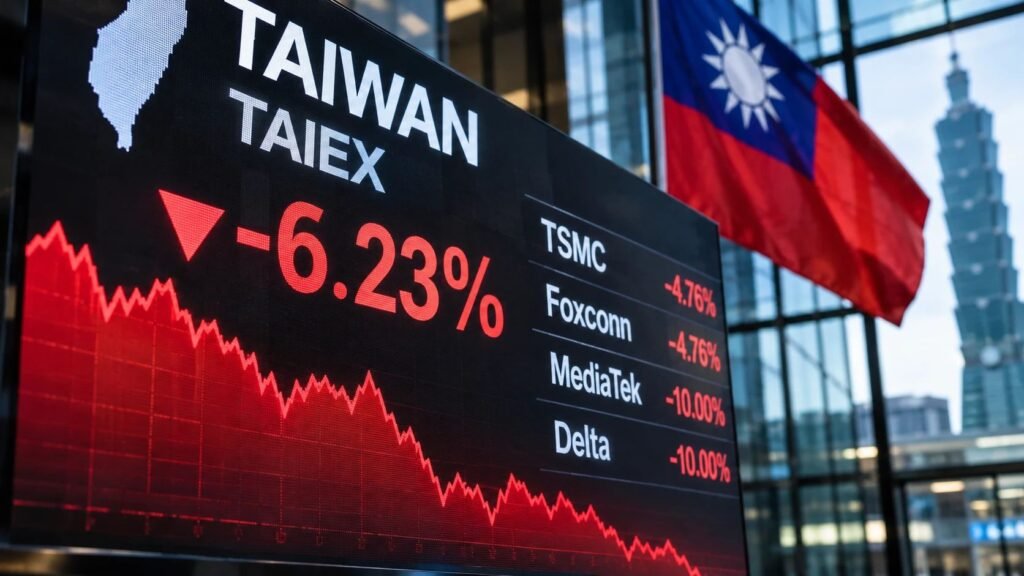
The benchmark weighted index plunged 6.23 percent, losing 2,393.6 points to close at 36,033.29 points. The decline represented the third-largest single-day point loss in the market’s history.
Trading activity remained exceptionally high, with total turnover reaching 877.35 billion New Taiwan dollars, equivalent to approximately 26.62 billion U.S. dollars.
The latest decline extended an already difficult week for investors, with the benchmark index losing 7,641.83 points, or 17.5 percent, over five trading sessions.
Technology Giants Lead the Market Decline
Major technology companies were among the biggest contributors to Friday’s losses.
Taiwan Semiconductor Manufacturing Company (TSMC), one of the world’s leading semiconductor manufacturers, fell 4.76 percent to 2,000 New Taiwan dollars.
Hon Hai Precision Industry, widely known internationally as Foxconn, also declined 4.76 percent, closing at 210 New Taiwan dollars.
MediaTek suffered a particularly sharp setback, falling to its daily trading limit of 10 percent and ending the session at 3,350 New Taiwan dollars.
Delta Electronics also reached its daily decline limit, closing at 900 New Taiwan dollars.
The performance of these companies reflected the broad pressure affecting Taiwan’s technology-heavy stock market.
Selling Spreads Across Nearly Every Sector
The market downturn was not restricted to semiconductor manufacturers.
All eight major stock categories finished lower, indicating widespread weakness across the exchange.
Plastics and chemicals shares recorded the largest sectoral decline, falling 8.42 percent. Machinery and electrical equipment stocks dropped 6.29 percent, while cement and ceramics companies lost 6.27 percent.
Financial stocks also faced substantial selling pressure, declining 5.82 percent.
Only 16 listed stocks advanced during the session, while more than 1,000 shares declined. Falling stocks accounted for over 90 percent of the listed market.
Investors Face an Increasingly Difficult Trading Environment
Friday’s market performance added to concerns following another major decline earlier in the week.
On November 16, Taiwan’s benchmark index had already recorded its second-largest single-day closing-point loss.
The consecutive market setbacks have highlighted the vulnerability of investor sentiment amid heightened uncertainty surrounding technology valuations and broader economic conditions.
The semiconductor industry has been an important driver of Taiwan’s economic growth and international investment appeal. However, the concentration of market value and investment activity in technology-related businesses can also expose the wider market to sector-specific shocks.
Questions Over Taiwan’s Semiconductor Dependence
Financial analysts cited deeper structural vulnerabilities in Taiwan’s economy as one factor behind the latest market turmoil.
These concerns include the island’s heavy reliance on semiconductor and other technology industries, as well as the uneven distribution of economic benefits generated by the artificial intelligence boom.
Although demand for advanced chips has supported significant growth in the technology sector, changing investor expectations can produce considerable volatility in companies associated with the AI industry.
The latest sell-off has therefore renewed attention on the importance of economic diversification and the risks associated with concentrated investment exposure.
Global Technology Markets Under Close Watch
Taiwan occupies an important position in the international semiconductor supply chain, supplying advanced chips and electronic components used in smartphones, computers, artificial intelligence infrastructure and industrial applications.
Consequently, major movements in its stock market attract attention from international investors and technology businesses.
The latest decline raises questions about the sustainability of technology-sector valuations and the extent to which financial markets have already incorporated expectations of future AI-related growth.
For investors, the immediate focus will be on market stability, corporate earnings and the direction of international technology demand.