China Targets 90% Intelligent Computing Capacity by 2030 as AI Infrastructure Expansion Accelerates
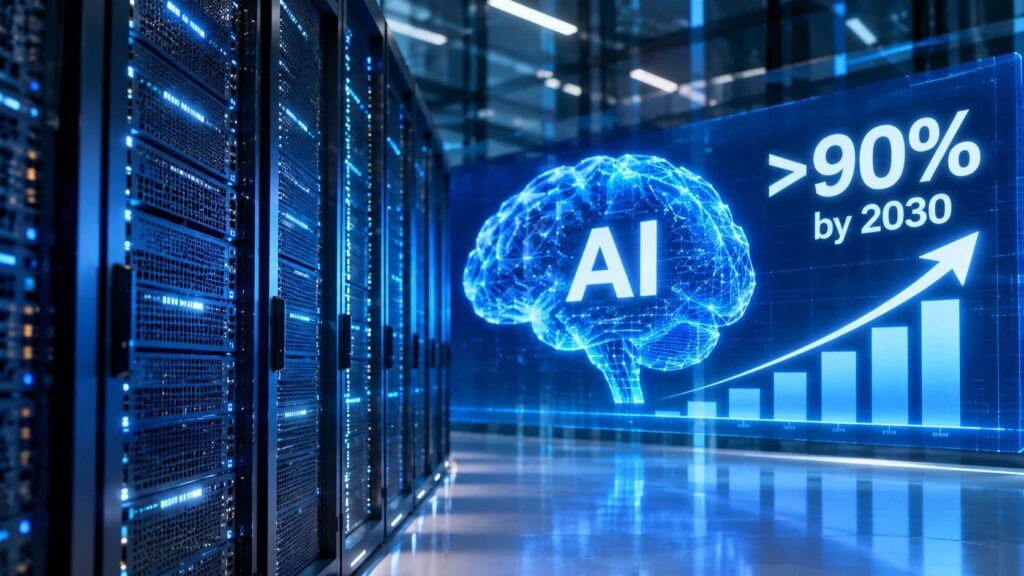
CHANGSHA, November, 2026 — China is preparing for a major transformation of its national computing infrastructure, with artificial intelligence-driven intelligent computing expected to account for more than 90 percent of the country’s total computing capacity by 2030.
The projection was highlighted at the 2026 World Computing Conference, which opened on Friday in central China’s Hunan Province. The event unveiled 10 major trends expected to shape the country’s computing industry over the coming years.
Liu Wenqiang, vice president of the China Center for Information Industry Development, said China’s intelligent computing capacity could approach 10,000 EFLOPS by 2030, reflecting the growing importance of artificial intelligence in the country’s digital economy.
Artificial Intelligence Reshapes China’s Computing Landscape
Intelligent computing refers to computing infrastructure specifically designed to support artificial intelligence applications, including machine learning, large language models, advanced data analysis and automated decision-making.
According to figures presented at the conference, China’s intelligent computing capacity reached 2,592 EFLOPS by the end of September 2026, representing a 146 percent increase compared with the same period a year earlier.
The expansion reflects rising demand for computing resources as businesses, research institutions and technology companies increasingly integrate AI into their operations.
Inference Computing Expected to Dominate
One particularly significant forecast concerns inference computing, which is expected to represent approximately 85 percent of China’s intelligent computing capacity by 2030.
Inference computing enables trained AI models to generate responses, analyse information, recognise patterns and perform tasks using previously developed models.
Its growing importance reflects the transition of artificial intelligence from experimental development towards widespread commercial and industrial applications.
As AI services become more widely adopted, demand for efficient and accessible inference infrastructure is expected to increase.
Nationwide Network of Computing Facilities Expands
China is also accelerating the development of a nationwide integrated computing network designed to distribute computing resources across different regions.
The country has established a framework involving eight national computing hubs, 10 national data centre clusters and three regions designated for coordinated development of computing and energy infrastructure.
By the end of September, China had 52 intelligent computing facilities, each equipped with more than 10,000 AI chips.
This infrastructure is intended to support large-scale AI training, industrial applications and growing demand for digital services.
Green Computing Becomes a Strategic Priority
Environmental sustainability is emerging as another important consideration in the development of artificial intelligence infrastructure.
The conference identified a shift in green computing evaluation from traditional energy efficiency towards carbon efficiency.
This approach places greater emphasis on the carbon emissions associated with electricity consumption and computing operations.
As data centres require substantial amounts of electricity and cooling resources, improving their environmental performance will become increasingly important.
Coordinating computing infrastructure with energy availability could help reduce operational costs and environmental pressures.
Space Computing Opens a New Technology Frontier
Another emerging trend highlighted at the conference is the development of space-based computing networks.
China is expected to build a commercial space computing network involving 1,000 satellites by 2030.
Such infrastructure could create new possibilities for processing information in orbit, supporting remote sensing, satellite communications and other space-based digital services.
The development of space computing also reflects growing interest in integrating terrestrial data centres with advanced orbital infrastructure.
A New Phase in Global Computing Competition
China’s ambitious computing expansion comes amid increasing international competition in artificial intelligence infrastructure.
Countries and technology companies are investing heavily in advanced processors, high-performance computing facilities, data centres and energy systems to support increasingly sophisticated AI applications.
The ability to provide reliable, efficient and affordable computing resources is becoming an important factor in technological development and industrial competitiveness.
China’s projected expansion towards 10,000 EFLOPS of intelligent computing capacity would represent a substantial increase from its current level.
However, achieving this target will require continued investment in semiconductors, energy infrastructure, networking technologies and advanced computing systems.
The latest projections demonstrate how artificial intelligence is becoming a central driver of China’s digital infrastructure strategy, with computing capacity increasingly viewed as a foundation for future economic and technological development.