US Intercepts Iranian Attack Drones as Tehran Claims Strike on American Radar in Bahrain
MANAMA: Military tensions in the Persian Gulf have intensified after the United States announced that it had intercepted two Iranian attack drones heading towards Bahrain, while Iran’s Islamic Revolutionary Guard Corps (IRGC) claimed to have destroyed an American early-warning radar installation in the Gulf kingdom.
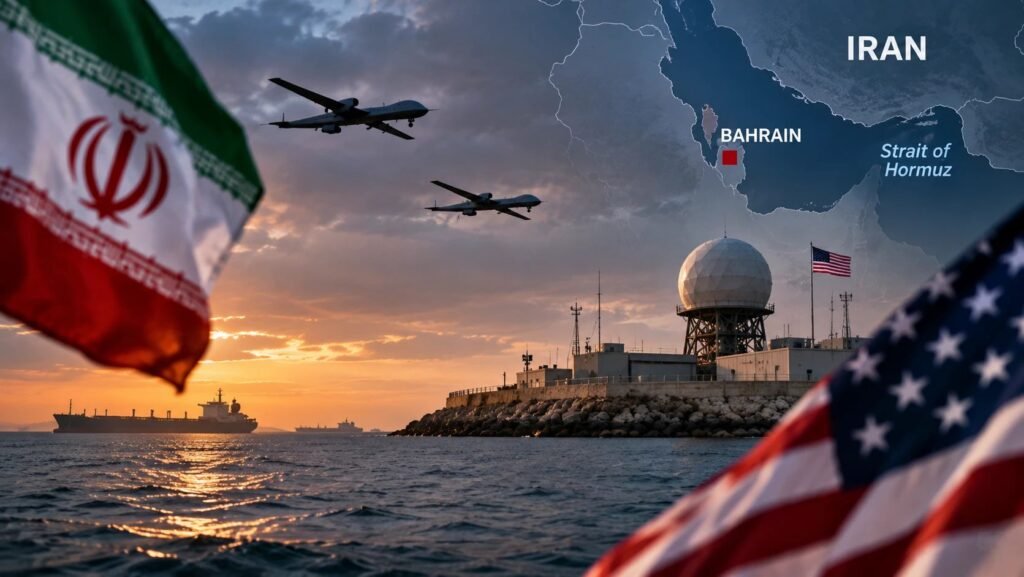
The latest developments have raised fresh concerns about regional security, particularly around Bahrain and the strategically important Strait of Hormuz, a major international route for energy transportation.
According to the US military’s Central Command (CENTCOM), American forces intercepted the two Iranian drones before they could reach their intended destination.
US officials reported that the incident caused no injuries or damage.
Iranian authorities, meanwhile, presented a different account of the confrontation, claiming that their forces had successfully targeted an American military radar facility in Bahrain.
The competing statements highlight the continuing uncertainty surrounding military operations in the region.
Iran Claims Destruction of US Early-Warning Radar
Iran’s Revolutionary Guard announced that its aerospace forces had targeted and destroyed a US early-warning radar system located in Bahrain.
According to Iran’s official IRNA news agency, the operation was carried out in response to an American strike on a telecommunications installation in the southern Iranian port area of Sirik.
Iranian military officials described the reported operation as a warning to Washington against further attacks on Iranian infrastructure.
However, the claim that the radar installation was destroyed could not be independently verified.
The US military disputed Iran’s account, while Bahrain’s authorities had not immediately provided a detailed public response.
Bahrain is particularly important to American military operations in the Middle East because it hosts the headquarters of the US Navy’s Fifth Fleet.
US Military Reports Interception of Two Iranian Drones
The American military confirmed that its forces intercepted two Iranian attack drones heading towards Bahrain.
CENTCOM said the interception was successful and that no casualties or damage were reported.
The incident comes amid a broader period of military confrontation involving American and Iranian forces across the Gulf region.
Both countries have maintained military capabilities in strategically important areas, including maritime surveillance, air defence and drone operations.
The use of unmanned aircraft has become an increasingly important feature of modern military confrontations because drones can conduct surveillance and carry out attacks without placing pilots directly in danger.
Iran Reports Explosion Involving LPG Tanker
In another development, Iran’s Revolutionary Guard claimed that a liquefied petroleum gas (LPG) tanker struck a naval mine while attempting to pass through the Strait of Hormuz.
According to the Iranian state news agency IRNA, the vessel ignored repeated warnings while travelling through the eastern section of the strategic waterway.
The Guard said the incident resulted in an explosion.
However, the circumstances surrounding the reported tanker incident remain unclear, and the claim could not be independently confirmed.
The United Kingdom Maritime Trade Operations (UKMTO), which monitors maritime security incidents, had not immediately reported the alleged explosion.
Details concerning the vessel’s identity, its crew and the extent of any possible damage were also not immediately available.
Strait of Hormuz Remains a Major Security Concern
The Strait of Hormuz is one of the world’s most important maritime transportation routes.
Connecting the Persian Gulf with the Gulf of Oman, the narrow waterway carries substantial quantities of internationally traded oil and petroleum products.
Any disruption to commercial shipping through the strait can have consequences for international energy markets, maritime insurance and global supply chains.
The continuing military tensions have increased concerns among shipping companies and energy traders about the safety of vessels operating in the surrounding waters.
Iran has repeatedly warned commercial vessels against using routes it considers unauthorised or dangerous.
Meanwhile, the United States has maintained its military presence in the region to protect its strategic interests and maritime operations.
Bahrain’s Strategic Military Importance
Bahrain occupies an important position in the Gulf’s security structure because of its close defence relationship with Washington.
The country hosts the headquarters of the US Navy’s Fifth Fleet, which oversees American naval operations across a large area of the Middle East.
Its geographical location makes it strategically significant for monitoring maritime movements and protecting important shipping corridors.
Any confirmed attack on American military infrastructure in Bahrain would therefore carry implications beyond the immediate confrontation between Tehran and Washington.
It could also increase security concerns among neighbouring Gulf countries.
Regional Tensions Raise International Concerns
The latest developments demonstrate how quickly military incidents involving drones, radar installations and commercial shipping can increase uncertainty across the Middle East.
Although the United States has confirmed intercepting two Iranian drones, Iran’s claims concerning the destruction of the radar installation and the tanker explosion remain independently unverified.
The absence of complete information makes it difficult to establish the full circumstances surrounding the reported incidents.
International observers will continue monitoring military statements, maritime security reports and diplomatic developments for further clarification.
As tensions persist, protecting commercial shipping and preventing additional military confrontations remain major challenges for countries operating in the Persian Gulf.
The situation also highlights the importance of diplomatic communication in avoiding further escalation between Iran and the United States.