European Stocks Face Fresh Pressure as Democratic Election Sweep Raises AI Investment Fears
Dateline: November 4, 2026
European financial markets are bracing for a weaker trading session after a decisive Democratic victory in the United States midterm elections unsettled global investors and raised fresh concerns about the future of artificial intelligence investment.
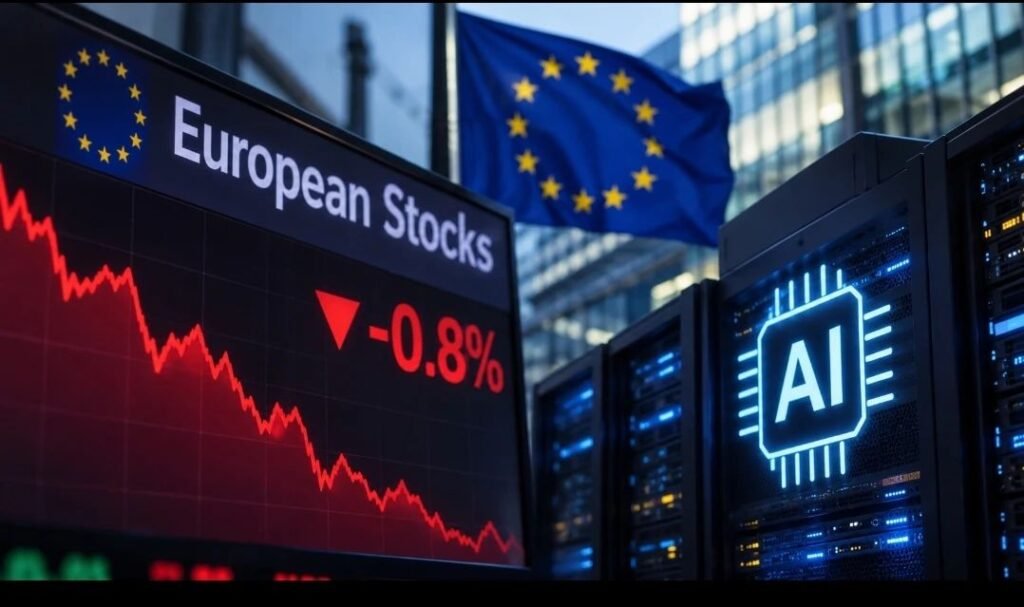
The election result, which gives Democrats control of both chambers of Congress, has prompted investors to reconsider the political and regulatory environment surrounding major technology companies. European stock futures moved lower as markets assessed the possibility that tighter oversight and political uncertainty could slow the expansion of AI infrastructure in the United States.
The reaction highlights how closely European markets are connected to developments in the American technology sector, particularly companies involved in semiconductors, data centres, industrial automation and digital infrastructure.
Democratic Victory Creates New Uncertainty for Investors
The Democratic sweep represents a significant shift in the US political landscape. Investors are now considering how the new balance of power could influence legislation, government spending, corporate taxation and technology regulation.
Although major policy changes may face political and legislative obstacles, a stronger Democratic presence in Congress could increase scrutiny of large technology companies and their investment plans.
Market participants are particularly concerned about the possibility of additional restrictions affecting the construction and operation of AI data centres. These facilities require substantial electricity, water, land and investment, making them increasingly important in debates about local infrastructure and environmental policy.
The prospect of political disputes over these projects has added another source of uncertainty to an already volatile technology market.
AI Investment Concerns Weigh on European Markets
Artificial intelligence has become a major driver of global equity performance. Technology companies have invested heavily in advanced processors, cloud computing facilities and data-centre infrastructure to support the rapid growth of AI applications.
European businesses are also exposed to this investment cycle. Semiconductor equipment manufacturers, chip suppliers, engineering groups and electrical infrastructure companies provide products and services needed to expand computing capacity.
Companies with significant exposure to the American data-centre market could therefore face pressure if projects are delayed, redesigned or subjected to stricter regulatory requirements.
The latest political developments are also arriving at a time when investors are questioning whether the enormous spending commitments made by technology companies will generate sufficient returns.
This combination of regulatory uncertainty and concerns about investment profitability is making market participants more cautious about technology-related shares.
European Technology Companies in the Spotlight
European technology and industrial companies could experience uneven market reactions as investors distinguish between businesses with direct exposure to US AI infrastructure and those supported by other sources of demand.
Semiconductor equipment producers, including major suppliers to the global chip industry, may attract particular attention. Companies involved in power management, industrial automation, networking and data-centre equipment could also be affected by changing expectations for American technology investment.
However, the impact is unlikely to be identical across the sector. Businesses serving multiple industries and geographical markets may prove more resilient than companies heavily dependent on a single investment cycle.
Healthcare, utilities and other defensive industries could receive renewed investor interest if uncertainty continues to push money away from high-growth technology shares.
Global Markets Move Toward Safer Assets
The election result has triggered a broader shift in market sentiment beyond European equities.
Reuters reported that US stock futures declined, with Nasdaq futures falling more sharply before recovering part of their losses. European equity futures were also lower, while government bonds attracted demand as investors sought relatively safer assets.
The US dollar weakened against several major currencies, while the Japanese yen and Swiss franc benefited from defensive positioning.
These movements suggest that investors are reassessing risk across several asset classes rather than simply reacting to one political event.
The potential implications extend beyond technology. Changes in American fiscal policy, defence spending, trade relations and international diplomacy could influence corporate earnings expectations and global investment flows.
Why the AI Spending Debate Matters
The central issue for investors is whether AI infrastructure spending will continue at its current pace.
Technology companies have committed enormous resources to developing computing capacity. Semiconductor manufacturers, equipment suppliers, energy companies and data-centre operators have all benefited from the expansion.
However, the economics of these projects remain under scrutiny. High construction costs, electricity requirements, financing expenses and uncertainty over future revenues have made investors more selective.
If political pressure creates additional delays or restrictions, companies involved in the supply chain could face weaker growth expectations. On the other hand, strong demand for computing power may continue to support investment even in a more complicated regulatory environment.
The market will be watching corporate spending announcements, earnings forecasts and policy developments for evidence of whether the AI expansion is slowing or simply entering a more cautious phase.
What Investors Will Watch Next
European investors are likely to focus on several developments in the coming sessions:
- Technology regulation: Whether the Democratic victory translates into stronger oversight of AI companies and data-centre projects.
- Infrastructure approvals: Potential restrictions involving electricity, water consumption and new data-centre construction.
- Corporate investment: Whether major technology companies maintain or revise their AI capital expenditure plans.
- European earnings: How companies exposed to US technology spending describe their growth prospects.
- Global monetary conditions: Whether changing expectations for economic growth and inflation influence bond yields and central-bank policy.
These factors could determine whether the latest market weakness develops into a broader correction or remains a short-term reaction to political uncertainty.
Conclusion: Political Change Adds Another Challenge for European Equities
European stocks are entering a more uncertain period as the US election outcome adds a new political dimension to concerns about the global AI investment boom.
The Democratic victory does not automatically mean that AI infrastructure spending will stop. However, the possibility of tighter scrutiny, local development restrictions and political gridlock has encouraged investors to reconsider the risks surrounding technology valuations.
For European markets, the consequences could be significant because many companies depend on continued investment in American computing infrastructure.
The direction of equities will ultimately depend on how political developments translate into actual policy and whether demand for AI technology remains strong enough to support current investment levels. Until greater clarity emerges, investors may favour caution and pay closer attention to companies’ earnings, valuations and exposure to the US technology market.