Scientists Turn Ordinary Light into a Quantum Computing System That Operates at Room Temperature
A research team at Louisiana State University has demonstrated a new approach to quantum information processing using readily available classical light, potentially offering a way to overcome some of the technology’s biggest challenges.
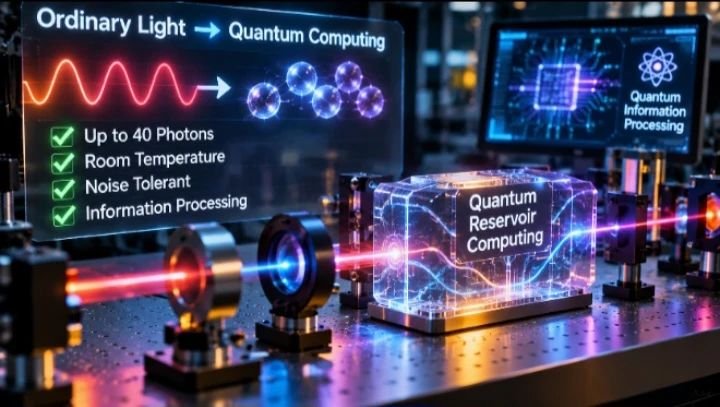
Scientists have taken an important step toward more practical quantum technologies by demonstrating a system that extracts useful quantum behaviour from ordinary light. The experimental platform can process information using multiphoton systems containing up to 40 photons while operating at room temperature and tolerating significant levels of noise and signal loss.
The research was conducted by physicists at Louisiana State University (LSU), working with collaborators from institutions in Mexico. Their findings were published in the scientific journal Advanced Science under the title Multiphoton Quantum Reservoirs for Robust Multidimensional Computing.
The development could provide an alternative approach to building quantum information-processing systems, which traditionally depend on carefully controlled and highly delicate quantum states.
Why Quantum Computers Are Difficult to Build
Quantum computers work differently from conventional computers. Instead of relying exclusively on ordinary binary bits, they use quantum systems to represent and process information.
This approach offers the possibility of tackling certain complex calculations that would be extremely demanding for conventional machines. However, quantum systems are highly sensitive to disturbances.
Noise, environmental changes and the loss of particles can damage the delicate quantum states needed to perform calculations. Maintaining these states often requires sophisticated equipment and carefully controlled conditions.
These difficulties have become major obstacles to developing quantum computers that are reliable, scalable and suitable for practical applications.
Ordinary Light Provides a Different Approach
The LSU research team explored a different way to access quantum behaviour.
Rather than relying entirely on specially prepared quantum light sources, the researchers began with bright classical light and passed it through an interconnected optical network.
They then used specialised photon-number-resolving detectors, which can identify how many photons arrive at a detector during a measurement.
By selecting particular photon-counting events, the scientists were able to extract multiphoton quantum systems from the classical light field.
The researchers combined three important properties of light: polarisation, spatial structure and photon number. Together, these properties created a complex network of possible states that could be used to process information.
The resulting quantum reservoir contained 861 measurable components and provided access to multiphoton systems involving as many as 40 particles.
How the Quantum Reservoir Processes Information
The system uses a computational approach known as reservoir computing.
In this method, information enters a complex physical network and undergoes transformations as it moves through interconnected pathways. The resulting patterns are then analysed to produce useful computational outputs.
Instead of programming every individual interaction inside the network, researchers train a comparatively simple final processing stage to interpret the system’s output.
In the LSU experiment, the optical network performed the complex transformations, while photon-counting measurements helped researchers extract the information.
This arrangement allowed the team to use the same optical platform for several different computational and simulation tasks.
Simulating Complex Quantum Behaviour
The researchers first tested the system as a quantum simulator.
In one experiment, they reproduced the behaviour of a quantum random walk, a process in which quantum particles spread through different possible pathways.
The platform also simulated thermalisation and anti-thermalisation in synthetic lattices. These processes describe how fluctuations in many-particle systems can evolve as the system changes over time.
Importantly, the researchers demonstrated that the platform could reproduce these effects even when the optical network experienced noise.
The results suggest that the approach may be useful for studying complex quantum systems without requiring the same level of environmental isolation demanded by some conventional quantum technologies.
The System Also Learned Mathematical Functions
Beyond quantum simulation, the research team investigated whether the optical platform could perform information-processing tasks.
The researchers tested its ability to learn six different mathematical functions, including functions with complex nonlinear behaviour.
They kept the optical network in a fixed configuration and encoded different inputs through the polarisation of light. The reservoir transformed these inputs into richer patterns involving spatial modes and photon numbers.
Only the final readout needed to be trained.
The results showed that the same physical system could handle different mathematical tasks without requiring researchers to rebuild or reconfigure the optical network each time.
This demonstrated the potential of combining quantum effects with reservoir computing to create flexible information-processing platforms.
Why Operating at Room Temperature Matters
One of the most promising aspects of the research is its ability to function at room temperature while remaining useful in the presence of substantial noise and signal loss.
Many existing quantum technologies require carefully maintained environments to protect fragile quantum states. Reducing dependence on such demanding conditions could eventually make some quantum systems easier to operate and integrate into research laboratories.
However, the achievement should not be confused with the development of a fully practical, general-purpose quantum computer.
The experiment demonstrates a promising research platform for quantum information processing and simulation. Further work will be required to establish its performance at larger scales and determine how it could be integrated into real-world computing applications.
The researchers also identified faster and more capable photon-number-resolving detectors as an important requirement for expanding the technology.
A Promising Direction for Future Quantum Technologies
The study highlights how conventional optical equipment and quantum measurement techniques can work together to create new computational possibilities.
By using ordinary light as a starting point, scientists may be able to reduce some of the difficulties associated with generating and maintaining fragile quantum resources.
If further research confirms that the approach can scale effectively, it could contribute to more robust quantum simulators and specialised information-processing systems.
For now, the findings represent an important experimental advance rather than an immediate replacement for conventional computers. Nevertheless, they demonstrate that some promising routes toward quantum technology may emerge from rethinking how ordinary physical resources can be used.