Taiwan Steps Up Military Readiness as President Oversees Coastal Defense Drills Amid China Tensions
The most important feature of this year’s drills is their realism. Taiwan is not simply practicing how to fight; it is testing whether the military, government, infrastructure and civilian population could continue functioning under severe pressure.That approach reflects the changing nature of modern conflict, where communications, airports, ports, roads, information networks and supply chains can be targeted alongside military bases.If Taiwan can successfully integrate its armed forces with civilian institutions and maintain command continuity during simulated disruptions, it could significantly strengthen its deterrence.
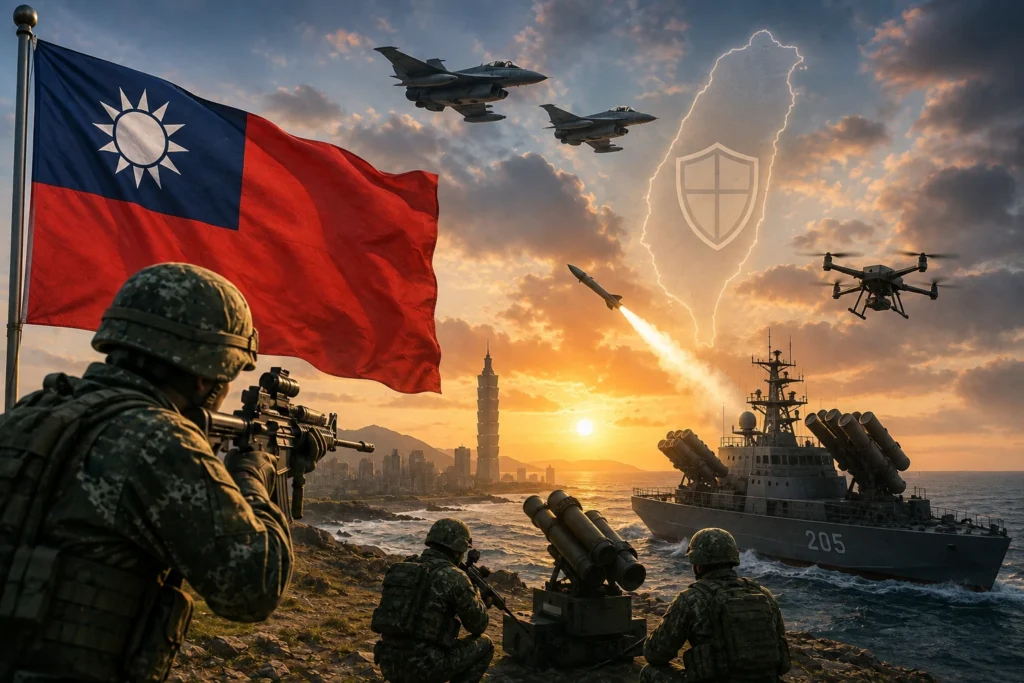
AI Generated Image
Taipei, August 8, 2026: Taiwan has intensified its military preparedness through a major annual defense exercise, with President Lai Ching-te personally observing coastal combat drills designed to test the island’s ability to respond to a potential attack.
The 10-day Han Kuang military exercise is taking place amid continued tensions between Taiwan and China. The drills involve live troops, real terrain and operational military equipment, with Taiwan focusing on how quickly its forces can respond to an unexpected assault.
The exercises are among Taiwan’s most important annual tests of military readiness and are intended to identify weaknesses before a real crisis occurs.
President Lai Observes Coastal Defense Operations
Lai visited a naval facility in Kaohsiung and boarded a fast attack missile boat while observing exercises along Taiwan’s coast.
During the drills, Taiwanese forces practiced responding to a simulated amphibious assault. Attack drones were used as part of the exercise, while coast guard vessels also participated in the defense scenario.
The participation of the Coast Guard is significant because Taiwan is increasingly planning for situations in which military and civilian security agencies would have to operate together.
Lai emphasized the importance of strengthening the island’s military and coast guard capabilities and improving coordination between the different forces.
Although he did not directly name China while speaking during the exercise, the drills are clearly taking place against the backdrop of Beijing’s claim over Taiwan and its continuing military pressure around the island.
Han Kuang Exercise Takes a More Realistic Approach
This year’s Han Kuang exercise has been designed to simulate the uncertainty of an actual conflict rather than simply demonstrate predetermined military movements.
Taiwanese commanders are being asked to make decisions when circumstances change unexpectedly.
Reuters reported that the exercise includes a U.S.-style “backbrief” system intended to improve communication between commanders and ensure that military orders are properly understood.
The exercise also deliberately introduced communication difficulties by slowing mobile internet services in selected scenarios.
The objective is to determine how Taiwan’s military and government could continue operating if communications infrastructure were disrupted during a conflict.
That reflects a growing recognition that a modern war would not necessarily begin with a conventional invasion alone.
Taiwan Practices Government Continuity
One of the most notable elements of the exercise occurred earlier this week when President Lai participated in a contingency drill involving the relocation of the country’s leadership.
He was transported in an armored personnel carrier to an alternative command center as part of a scenario designed to test whether Taiwan’s government could continue functioning during a military emergency.
The exercise involved senior officials and focused on maintaining communication and coordination between government institutions.
Such preparations are based on the possibility that Taiwan’s primary government facilities could become targets during a major conflict.
The goal is to ensure that leadership can continue issuing orders even if conventional command facilities are damaged or inaccessible.
Air Force Tests Rapid Fighter Deployment
Taiwan has also been testing how quickly its fighter aircraft can return to action after an attack.
During the exercise, the island’s aging French-made Mirage fighters were scrambled and crews practiced rapid rearming and maintenance procedures.
The aircraft were shown being prepared with air-to-air missiles so they could return to the air as quickly as possible.
Taiwan also conducted runway-repair exercises.
Military and civilian teams practiced repairing simulated bomb damage by filling craters and laying temporary surfaces so aircraft could resume operations.
The exercise aims to demonstrate that Taiwan’s air bases could remain functional even after being attacked.
Protecting Critical Infrastructure
Taiwan’s military is also practicing the defense of strategically important infrastructure.
Troops simulated securing the Danjiang Bridge, an important transportation route near Taipei, while other units practiced protecting the country’s main international airport.
Such scenarios demonstrate that Taiwan’s defense planning goes beyond protecting military bases.
Roads, bridges, airports, ports, communications networks and energy facilities could all become strategically important during a conflict.
Keeping these facilities operational would be essential for moving military forces, maintaining supply chains and supporting the civilian population.
Thousands of Reservists Take Part
More than 20,000 reservists are participating in the wider exercise, adding a significant civilian-military dimension to Taiwan’s preparedness program.
Reservists could play an important role during a prolonged crisis because Taiwan’s active-duty military alone would have to defend a geographically complex island.
The exercises therefore test how quickly reserve personnel can be mobilized and integrated into operational units.
Taiwan is also conducting resilience exercises involving civilian agencies and local communities.
These activities are intended to test how society would respond to disasters and disruptions that could accompany a major military confrontation.
China Remains the Main Strategic Concern
Beijing considers Taiwan part of China and has repeatedly refused to rule out the use of force to bring the island under its control.
Taiwan’s government rejects Beijing’s sovereignty claims and maintains that its future should be determined by its people.
The political disagreement has been accompanied by increasing Chinese military activity around Taiwan.
Taiwan’s Defense Ministry regularly reports Chinese military aircraft and naval vessels operating around the island.
That activity has encouraged Taipei to strengthen its ability to respond rapidly without waiting for a crisis to fully develop.
Taiwan Also Faces the Risk of a Blockade
Military planners are increasingly considering scenarios other than a full-scale invasion.
A blockade or quarantine of Taiwan’s ports and shipping routes could potentially create severe economic pressure without requiring an immediate amphibious assault.
Taiwan’s defense minister has previously warned that a maritime blockade would have serious consequences but could also create economic and political costs for China because of its dependence on international trade.
The Han Kuang exercises therefore include scenarios involving transportation disruptions, communications problems and protection of critical infrastructure.
This reflects a broader shift toward preparing for multiple forms of coercion.
Civilian Factories Could Support the Military
Taiwan is also examining how civilian industrial capacity could be mobilized during an emergency.
The exercise includes scenarios involving civilian factories and supply networks.
That is important because a prolonged conflict would require much more than weapons and soldiers.
Military forces would need spare parts, transportation, food, fuel, medical supplies and repair capabilities.
Integrating civilian industry into national defense planning could help Taiwan maintain essential operations during an extended crisis.
Disinformation Becomes Part of the Exercise
Modern warfare also involves information.
Taiwan is experimenting with ways to assess how journalists and media organizations might respond during a military emergency.
The exercise includes efforts to examine real-time media reactions and counter possible disinformation campaigns.
This reflects concerns that an adversary could attempt to create panic or confusion without relying solely on conventional military force.
False information about military defeats, government collapse or shortages could potentially damage public confidence during a crisis.
Taiwan is therefore treating information resilience as part of national defense.
Why the Drills Matter Beyond Taiwan
The exercises are being closely watched internationally because any major conflict involving Taiwan could have consequences far beyond the island.
Taiwan sits at a strategically important position in the western Pacific and is central to global semiconductor supply chains.
A major military crisis could disrupt shipping, technology production and international trade.
It could also draw in the United States and other regional powers, potentially creating one of the most serious geopolitical crises in Asia.
For that reason, Taiwan’s preparations are being studied by military planners and governments around the world.
A Test of Readiness, Not a Prediction of War
Taiwan’s military leadership has emphasized preparedness rather than suggesting that an attack is imminent.
Large-scale exercises are intended to identify weaknesses before an emergency occurs.
The realism of this year’s Han Kuang drills is particularly notable because Taiwan is testing what happens when communications fail, runways are damaged, commanders are forced to relocate and civilian infrastructure is disrupted.
These scenarios provide military planners with information that conventional demonstrations cannot.
Conclusion
Taiwan’s latest military exercise represents a broad effort to prepare the island for an increasingly uncertain security environment.
From coastal missile operations and fighter aircraft to emergency government relocation and civilian mobilization, the drills cover almost every aspect of national defense.
The participation of President Lai has also highlighted the political importance of maintaining Taiwan’s military readiness.
The exercises do not mean that war is inevitable. Instead, they demonstrate Taiwan’s attempt to make any potential attack more difficult, costly and unpredictable.
As tensions with China continue, Taipei appears determined to strengthen both its military capabilities and the resilience of its civilian society.
Expert Take
The most important feature of this year’s drills is their realism. Taiwan is not simply practicing how to fight; it is testing whether the military, government, infrastructure and civilian population could continue functioning under severe pressure.
That approach reflects the changing nature of modern conflict, where communications, airports, ports, roads, information networks and supply chains can be targeted alongside military bases.
If Taiwan can successfully integrate its armed forces with civilian institutions and maintain command continuity during simulated disruptions, it could significantly strengthen its deterrence.
Tags
Taiwan, China, Taiwan Strait, Han Kuang Exercise, Lai Ching-te, Taiwan Military, China Taiwan Tensions, Taiwan Defense, Military Drills, East Asia, Indo-Pacific, Chinese Military, Taiwan Navy, Taiwan Air Force, Geopolitics, Asian Security, Global Security, World News
Slug
taiwan-military-drills-han-kuang-china-tensions-defense-readiness
Taipei, August 8, 2026: Taiwan has intensified its military preparedness through a major annual defense exercise, with President Lai Ching-te personally observing coastal combat drills designed to test the island’s ability to respond to a potential attack.
The 10-day Han Kuang military exercise is taking place amid continued tensions between Taiwan and China. The drills involve live troops, real terrain and operational military equipment, with Taiwan focusing on how quickly its forces can respond to an unexpected assault.
The exercises are among Taiwan’s most important annual tests of military readiness and are intended to identify weaknesses before a real crisis occurs.
President Lai Observes Coastal Defense Operations
Lai visited a naval facility in Kaohsiung and boarded a fast attack missile boat while observing exercises along Taiwan’s coast.
During the drills, Taiwanese forces practiced responding to a simulated amphibious assault. Attack drones were used as part of the exercise, while coast guard vessels also participated in the defense scenario.
The participation of the Coast Guard is significant because Taiwan is increasingly planning for situations in which military and civilian security agencies would have to operate together.
Lai emphasized the importance of strengthening the island’s military and coast guard capabilities and improving coordination between the different forces.
Although he did not directly name China while speaking during the exercise, the drills are clearly taking place against the backdrop of Beijing’s claim over Taiwan and its continuing military pressure around the island.
Han Kuang Exercise Takes a More Realistic Approach
This year’s Han Kuang exercise has been designed to simulate the uncertainty of an actual conflict rather than simply demonstrate predetermined military movements.
Taiwanese commanders are being asked to make decisions when circumstances change unexpectedly.
Reuters reported that the exercise includes a U.S.-style “backbrief” system intended to improve communication between commanders and ensure that military orders are properly understood.
The exercise also deliberately introduced communication difficulties by slowing mobile internet services in selected scenarios.
The objective is to determine how Taiwan’s military and government could continue operating if communications infrastructure were disrupted during a conflict.
That reflects a growing recognition that a modern war would not necessarily begin with a conventional invasion alone.
Taiwan Practices Government Continuity
One of the most notable elements of the exercise occurred earlier this week when President Lai participated in a contingency drill involving the relocation of the country’s leadership.
He was transported in an armored personnel carrier to an alternative command center as part of a scenario designed to test whether Taiwan’s government could continue functioning during a military emergency.
The exercise involved senior officials and focused on maintaining communication and coordination between government institutions.
Such preparations are based on the possibility that Taiwan’s primary government facilities could become targets during a major conflict.
The goal is to ensure that leadership can continue issuing orders even if conventional command facilities are damaged or inaccessible.
Air Force Tests Rapid Fighter Deployment
Taiwan has also been testing how quickly its fighter aircraft can return to action after an attack.
During the exercise, the island’s aging French-made Mirage fighters were scrambled and crews practiced rapid rearming and maintenance procedures.
The aircraft were shown being prepared with air-to-air missiles so they could return to the air as quickly as possible.
Taiwan also conducted runway-repair exercises.
Military and civilian teams practiced repairing simulated bomb damage by filling craters and laying temporary surfaces so aircraft could resume operations.
The exercise aims to demonstrate that Taiwan’s air bases could remain functional even after being attacked.
Protecting Critical Infrastructure
Taiwan’s military is also practicing the defense of strategically important infrastructure.
Troops simulated securing the Danjiang Bridge, an important transportation route near Taipei, while other units practiced protecting the country’s main international airport.
Such scenarios demonstrate that Taiwan’s defense planning goes beyond protecting military bases.
Roads, bridges, airports, ports, communications networks and energy facilities could all become strategically important during a conflict.
Keeping these facilities operational would be essential for moving military forces, maintaining supply chains and supporting the civilian population.
Thousands of Reservists Take Part
More than 20,000 reservists are participating in the wider exercise, adding a significant civilian-military dimension to Taiwan’s preparedness program.
Reservists could play an important role during a prolonged crisis because Taiwan’s active-duty military alone would have to defend a geographically complex island.
The exercises therefore test how quickly reserve personnel can be mobilized and integrated into operational units.
Taiwan is also conducting resilience exercises involving civilian agencies and local communities.
These activities are intended to test how society would respond to disasters and disruptions that could accompany a major military confrontation.
China Remains the Main Strategic Concern
Beijing considers Taiwan part of China and has repeatedly refused to rule out the use of force to bring the island under its control.
Taiwan’s government rejects Beijing’s sovereignty claims and maintains that its future should be determined by its people.
The political disagreement has been accompanied by increasing Chinese military activity around Taiwan.
Taiwan’s Defense Ministry regularly reports Chinese military aircraft and naval vessels operating around the island.
That activity has encouraged Taipei to strengthen its ability to respond rapidly without waiting for a crisis to fully develop.
Taiwan Also Faces the Risk of a Blockade
Military planners are increasingly considering scenarios other than a full-scale invasion.
A blockade or quarantine of Taiwan’s ports and shipping routes could potentially create severe economic pressure without requiring an immediate amphibious assault.
Taiwan’s defense minister has previously warned that a maritime blockade would have serious consequences but could also create economic and political costs for China because of its dependence on international trade.
The Han Kuang exercises therefore include scenarios involving transportation disruptions, communications problems and protection of critical infrastructure.
This reflects a broader shift toward preparing for multiple forms of coercion.
Civilian Factories Could Support the Military
Taiwan is also examining how civilian industrial capacity could be mobilized during an emergency.
The exercise includes scenarios involving civilian factories and supply networks.
That is important because a prolonged conflict would require much more than weapons and soldiers.
Military forces would need spare parts, transportation, food, fuel, medical supplies and repair capabilities.
Integrating civilian industry into national defense planning could help Taiwan maintain essential operations during an extended crisis.
Disinformation Becomes Part of the Exercise
Modern warfare also involves information.
Taiwan is experimenting with ways to assess how journalists and media organizations might respond during a military emergency.
The exercise includes efforts to examine real-time media reactions and counter possible disinformation campaigns.
This reflects concerns that an adversary could attempt to create panic or confusion without relying solely on conventional military force.
False information about military defeats, government collapse or shortages could potentially damage public confidence during a crisis.
Taiwan is therefore treating information resilience as part of national defense.
Why the Drills Matter Beyond Taiwan
The exercises are being closely watched internationally because any major conflict involving Taiwan could have consequences far beyond the island.
Taiwan sits at a strategically important position in the western Pacific and is central to global semiconductor supply chains.
A major military crisis could disrupt shipping, technology production and international trade.
It could also draw in the United States and other regional powers, potentially creating one of the most serious geopolitical crises in Asia.
For that reason, Taiwan’s preparations are being studied by military planners and governments around the world.
A Test of Readiness, Not a Prediction of War
Taiwan’s military leadership has emphasized preparedness rather than suggesting that an attack is imminent.
Large-scale exercises are intended to identify weaknesses before an emergency occurs.
The realism of this year’s Han Kuang drills is particularly notable because Taiwan is testing what happens when communications fail, runways are damaged, commanders are forced to relocate and civilian infrastructure is disrupted.
These scenarios provide military planners with information that conventional demonstrations cannot.
Conclusion
Taiwan’s latest military exercise represents a broad effort to prepare the island for an increasingly uncertain security environment.
From coastal missile operations and fighter aircraft to emergency government relocation and civilian mobilization, the drills cover almost every aspect of national defense.
The participation of President Lai has also highlighted the political importance of maintaining Taiwan’s military readiness.
The exercises do not mean that war is inevitable. Instead, they demonstrate Taiwan’s attempt to make any potential attack more difficult, costly and unpredictable.
As tensions with China continue, Taipei appears determined to strengthen both its military capabilities and the resilience of its civilian society.