Greenhouse Gas Levels Hit Record Highs in 2025, Locking the World Into Further Global Warming
Global concentrations of greenhouse gases reached unprecedented levels in 2025, raising fresh concerns about the future of the Earth’s climate. According to the World Meteorological Organization (WMO), carbon dioxide, methane and nitrous oxide all recorded new highs, adding to the amount of heat trapped in the atmosphere.
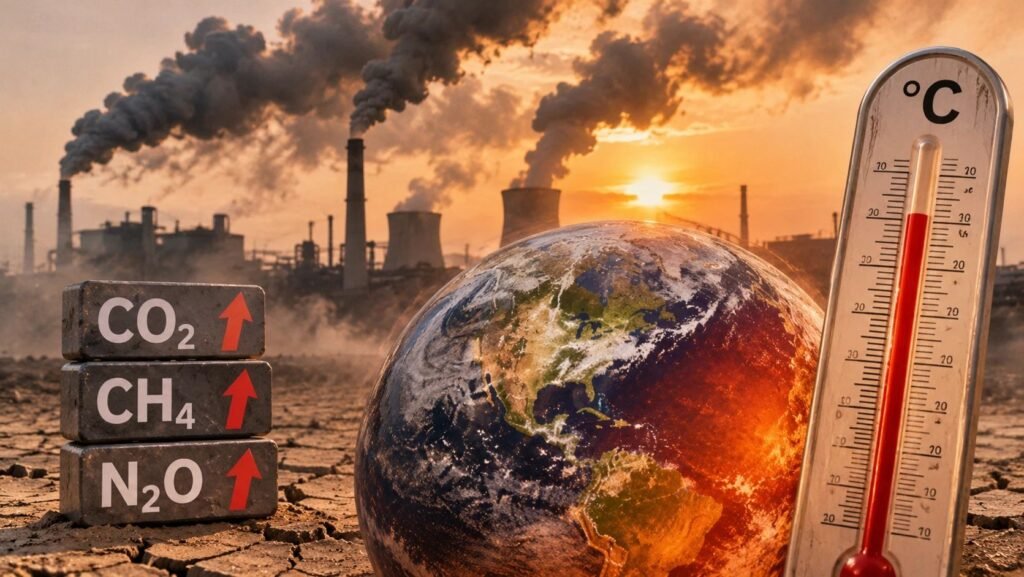
The findings, published in the WMO’s latest Greenhouse Gas Bulletin on October 27, 2026, highlight the continuing impact of human activities such as fossil fuel consumption, industrial production, agriculture and changes in land use.
Scientists warn that the rising concentration of these gases will influence global temperatures for decades and, in the case of carbon dioxide, potentially for centuries.
Carbon dioxide reaches 426.8 parts per million
Carbon dioxide (CO₂) remains the largest contributor to human-driven global warming among the long-lived greenhouse gases.
The WMO reported that the global average concentration of carbon dioxide reached 426.8 parts per million (ppm) in 2025. This was approximately 53 per cent higher than the pre-industrial level recorded around 1750.
The increase between 2024 and 2025 was 2.8 ppm. Although this was lower than the unusually large rise of 3.6 ppm recorded between 2023 and 2024, it remained above the average annual growth rate of the previous decade.
Carbon dioxide is released through activities including burning coal, oil and natural gas, cement manufacturing, deforestation and other changes in land use.
A major concern is its long atmospheric lifetime. A substantial portion of emitted carbon dioxide remains in the atmosphere for a very long period, continuing to contribute to global warming.
Methane and nitrous oxide also set records
The report found that methane and nitrous oxide, the second- and third-most important long-lived greenhouse gases associated with human activities, also reached unprecedented concentrations.
Global methane concentrations rose to 1,948 parts per billion (ppb) in 2025, around 167 per cent above pre-industrial levels.
Methane is emitted from several sources, including livestock farming, rice cultivation, landfills, fossil fuel extraction and natural wetlands. Although it remains in the atmosphere for a shorter period than carbon dioxide, it has a powerful warming effect.
Nitrous oxide concentrations reached 339.1 ppb, approximately 26 per cent above pre-industrial levels. Major human-related sources include the use of nitrogen-based fertilisers, agricultural activities, industrial processes and biomass burning.
The simultaneous rise of all three gases demonstrates that the challenge extends beyond reducing emissions from fossil fuels alone.
Greenhouse gases are trapping more heat
Greenhouse gases naturally help maintain temperatures suitable for life on Earth. However, human activities have increased their atmospheric concentrations, strengthening the greenhouse effect.
As more heat is retained in the atmosphere, the global climate system experiences additional warming. This can influence rainfall patterns, increase the intensity of certain extreme weather events and place pressure on ecosystems, agriculture and water resources.
WMO Deputy Secretary-General Ko Barrett warned that greenhouse gases are trapping unprecedented amounts of heat and providing energy for more extreme weather and associated risks to societies and economies.
The organisation also noted that the past 11 years were the warmest on record.
Natural systems face growing pressure
Forests, soils and oceans absorb a significant share of the carbon dioxide released by human activities. These natural systems help slow the accumulation of greenhouse gases in the atmosphere.
However, their ability to absorb carbon can change with rising temperatures, droughts, wildfires and other environmental disturbances.
The WMO bulletin pointed to a likely recovery in land carbon sinks and lower emissions from fires in 2025 as possible reasons why the annual increase in atmospheric carbon dioxide was smaller than the previous year’s exceptional rise.
This does not mean the climate problem is improving. Atmospheric carbon dioxide continued to increase, and the latest annual rise remained substantial.
Scientists are also monitoring the possibility that warming oceans could become less effective at absorbing carbon dioxide, potentially adding further pressure to the global climate system.
Industrial gases create another climate concern
Beyond the three major greenhouse gases, the WMO bulletin also highlighted the growing presence of certain industrial gases.
Sulphur hexafluoride (SF₆), used in electrical equipment as an insulating gas, is particularly concerning because it has an extremely high warming potential and can remain in the atmosphere for more than a thousand years.
The expansion of electricity networks and industrial infrastructure makes the management of such gases increasingly important as countries move towards cleaner energy systems.
The bulletin also discussed hydrogen leakage. Hydrogen is not itself a greenhouse gas, but it can indirectly influence atmospheric chemistry and contribute to warming.
Stronger climate action remains essential
The latest measurements underline the need for countries to reduce greenhouse gas emissions across energy, transport, industry and agriculture.
Expanding renewable energy, improving energy efficiency, protecting forests, reducing methane leaks and adopting more sustainable agricultural practices can all contribute to limiting future warming.
Governments must also improve monitoring systems and strengthen climate adaptation measures to protect communities from rising temperatures and extreme weather.
The WMO findings deliver a clear warning: even when the annual growth rate of a greenhouse gas slows, its atmospheric concentration can continue to rise. Without sustained reductions in emissions, the accumulated heat-trapping gases will continue to shape the planet’s climate for generations.