Spain’s Canary Islands Record Highest Daily Migrant Arrivals in 32 Years as More Than 1,500 People Reach European Territory
MADRID, November 2026 — Spain’s Canary Islands have recorded their highest number of migrant arrivals in a single day in 32 years, after at least 1,580 people reached the Atlantic archipelago on Saturday aboard boats travelling from West Africa, highlighting the continuing humanitarian challenges along one of Europe’s most dangerous migration routes.
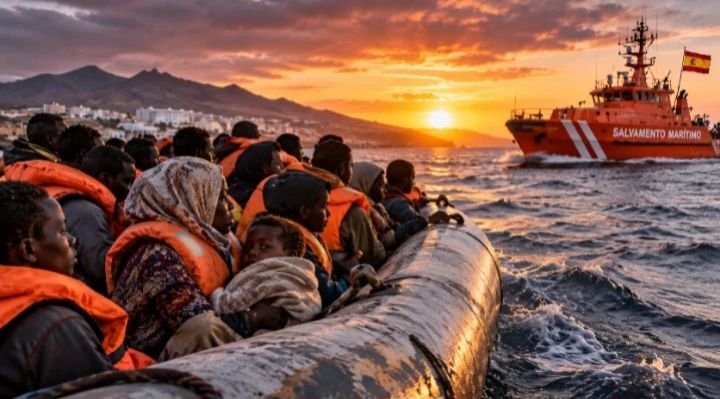
The latest arrivals mark a significant increase in migration activity across the Atlantic route, which connects several West African countries with Spain’s Canary Islands. The figure represents the highest single-day total recorded along the route in more than three decades, according to Spanish news agency EFE.
The previous record was 1,461 rescues, registered on November 7, 2020. The latest figure exceeds that level by 119 people, demonstrating the scale of the latest arrivals.
More than 2,400 migrants reached the Canary Islands on Friday and Saturday combined, according to EFE, placing considerable demands on maritime rescue teams and local authorities responsible for receiving and assisting people arriving by sea.
The majority of Saturday’s arrivals were recorded on El Hierro, the westernmost island in the Canary Islands archipelago. A total of 1,327 people disembarked there after completing dangerous journeys across the Atlantic Ocean.
The arrivals included large groups travelling aboard overcrowded vessels, many of which had departed from coastal areas of West Africa several days earlier.
El Hierro Receives More Than 1,300 Migrants in a Single Day
El Hierro accounted for the largest share of Saturday’s arrivals, with 1,327 people reaching the island.
Among the largest groups was a vessel carrying 240 migrants that had departed from Gunjur in The Gambia six days before reaching the Spanish archipelago.
The journey illustrates the considerable distances covered by migrants attempting to reach Europe through the Atlantic route.
People travelling along this corridor frequently face difficult maritime conditions, limited access to food and drinking water, overcrowded boats and the risk of mechanical failures during prolonged journeys.
Another vessel carrying 203 people reached Gran Canaria. Seventeen passengers from that boat required hospital treatment after arriving.
A further 50 migrants landed on Tenerife, where one person was also taken to hospital.
The distribution of arrivals across several islands required coordinated assistance from rescue personnel and emergency services.
Women and Children Among Those Reaching the Islands
Provisional figures indicated that at least 120 women and 173 minors were among the people who arrived on Saturday.
Their presence highlights the humanitarian dimension of the Atlantic migration crisis, particularly the risks faced by vulnerable individuals attempting lengthy sea crossings.
Migrants arriving on El Hierro had reportedly spent between four and seven days at sea.
The boats had departed from Senegal, The Gambia and Mauritania, three West African countries that serve as important departure points for people attempting to reach Spain through the Atlantic Ocean.
Extended journeys in small and overcrowded vessels can expose passengers to dehydration, exhaustion, injuries and other serious health problems.
The number of people requiring medical assistance after reaching Gran Canaria and Tenerife also demonstrated the need for continued emergency and healthcare support.
Spanish Rescue Teams Conduct Extensive Maritime Operations
Spanish maritime rescue authorities deployed significant resources to assist vessels arriving in the Canary Islands.
Six vessels operated by Salvamento Marítimo, Spain’s maritime rescue service, took part in Saturday’s operations. Two Civil Guard patrol boats also participated in the rescue efforts.
The coordinated deployment was necessary to manage the unusually high number of arrivals and ensure that people travelling aboard different vessels could receive assistance.
Maritime rescue operations along the Atlantic migration corridor are particularly challenging because of the long distances involved and the condition of many boats used by migrants.
Rescue personnel must locate vessels, provide assistance at sea and coordinate safe disembarkation before passengers can receive medical checks and other essential support.
The latest operation represents another major challenge for Spanish authorities as they continue responding to migration movements from West Africa.
Overall Arrivals Decline Compared With Last Year
Despite Saturday’s record-breaking arrivals, official statistics indicate that the total number of migrants reaching the Canary Islands by sea during the first ten months of 2026 was lower than in the corresponding period last year.
According to figures from Spain’s Ministry of the Interior, 13,327 migrants arrived in the archipelago by sea between January 1 and October 31, 2026.
This represented a decrease of 5.5 percent compared with the same period in 2025.
The figures demonstrate that a record single-day arrival does not necessarily indicate an overall increase in annual migration.
Instead, migration movements can fluctuate considerably, with particular days experiencing exceptionally large numbers of arrivals even when the cumulative yearly total remains below the previous year’s level.
The latest developments nevertheless underline the continuing importance of the Canary Islands as a major entry point for migrants attempting to reach European territory through the Atlantic Ocean.
Rights Group Warns of Deadly Consequences of Atlantic Crossing
While thousands of people have managed to reach the Canary Islands, the Atlantic route continues to claim numerous lives.
According to the migrant rights organisation Walking Borders, also known as Caminando Fronteras, at least 635 people died while attempting to cross the Atlantic to the Canary Islands during the first five months of 2026.
The organisation estimated that approximately 21 people died for every 100 migrants who successfully reached the islands during that period.
These figures highlight the extreme dangers associated with the journey, which is widely regarded as one of the most hazardous migration routes towards Europe.
Deaths at sea can occur because of severe weather, insufficient supplies, overcrowding, vessel breakdowns and the physical exhaustion experienced during prolonged journeys.
The actual humanitarian consequences can be difficult to establish because not every missing vessel or passenger is necessarily recorded.
Canary Islands Remain a Key Route for Migration to Europe
The Canary Islands have become an important destination for migrants departing from parts of West Africa in search of safety, employment and better living conditions in Europe.
The Atlantic route is particularly dangerous because boats must travel long distances across open water, often without adequate safety equipment or sufficient supplies.
The latest record-breaking arrivals have once again drawn attention to the responsibilities facing Spain and other European countries in managing migration while protecting human life.
The situation also highlights the importance of maritime rescue operations, humanitarian assistance and cooperation with countries of departure.
Although the overall number of arrivals during the first ten months of 2026 remained below last year’s level, Saturday’s record demonstrates that large-scale migration movements can still place considerable pressure on island communities and emergency services.
As Spain continues to respond to arrivals from West Africa, the challenge will remain balancing border management, regional cooperation and the protection of people undertaking dangerous journeys across the Atlantic.