Finnish Prime Minister Petteri Orpo’s Party Hits Record-Low Poll Rating Ahead of Election
Original English news article | November 18, 2026
Finland’s Prime Minister Petteri Orpo is facing growing political pressure as his National Coalition Party (NCP) records historically low support in opinion polls ahead of the country’s next parliamentary election.
The latest polling figures indicate that support for Orpo’s party has fallen to levels not previously recorded in some major Finnish opinion surveys, while opposition parties continue to attract substantial voter backing.
The development presents a significant challenge for the governing coalition as Finland approaches its scheduled parliamentary election in April 2027.
National Coalition Party Falls Behind Its Political Rivals
A new survey published by Finnish newspaper Helsingin Sanomat found that the National Coalition Party received just 15.6 percent of voter support, its lowest result in the newspaper’s polling history dating back to 1991.
An earlier survey conducted for Finnish public broadcaster Yle placed the party’s support even lower, at 15.4 percent.
The figures indicate a difficult period for Orpo’s party as competing political groups seek to attract voters ahead of the election. Yle +1
Opposition Social Democrats Maintain Their Lead
The opposition Social Democratic Party (SDP), led by Antti Lindtman, remained the most popular political party in the latest Helsingin Sanomat survey, receiving 23 percent support.
The Finns Party, which is also part of the governing coalition, recorded 15.4 percent, placing it just 0.2 percentage points behind the National Coalition Party.
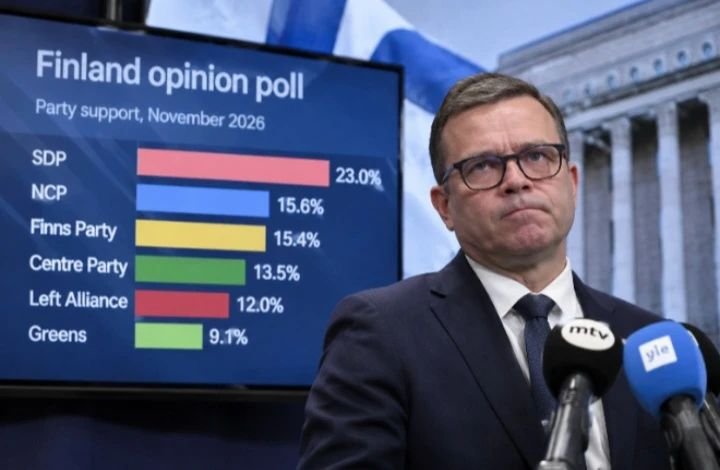
Other parties recorded the following levels of support: Political party Support Social Democrats (SDP) 23.0% National Coalition Party 15.6% Finns Party 15.4% Centre Party 13.5% Left Alliance 12.0% Greens 9.1%
The survey included more than 4,000 respondents and was conducted by Verian. Its margin of error for the largest parties was approximately 1.5 percentage points. Yle
Government Faces Pressure Over Economic Policies
Orpo’s four-party coalition has faced political debate surrounding public spending reductions, social security reforms, employment conditions and Finland’s economic outlook.
The government has defended its fiscal adjustment programme as necessary to address public finances and strengthen the country’s long-term economic position.
However, opposition parties have criticized several government measures, particularly those affecting social protection and public services.
These disagreements have become important issues in the political debate ahead of the next parliamentary election.
Finns Party Gains Ground Within the Governing Coalition
The Finns Party, led by Riikka Purra, has attracted additional attention as its support approaches that of Orpo’s National Coalition Party.
According to Yle’s November survey, the Finns Party reached 16.7 percent, while the National Coalition Party stood at 15.4 percent.
The polling analysis suggested that some former National Coalition supporters were moving towards the Finns Party and opposition parties, while others remained undecided. Yle
Finland Approaches the 2027 Parliamentary Election
Finland’s next parliamentary election is scheduled for April 18, 2027. Political parties will have several months to present their programmes, address voter concerns and compete for public support.
The latest surveys provide an indication of current political preferences, but they do not determine the eventual election result.
The margin of error and the possibility of changing voter preferences mean that polling figures should be interpreted as snapshots of public opinion rather than predictions.
Political Competition Intensifies Ahead of Election
The declining polling figures for Orpo’s party highlight the changing political landscape in Finland.
The relationship between the governing coalition partners, economic policy disagreements and public attitudes towards government reforms are likely to remain important subjects during the election campaign.
With the parliamentary vote approaching, the coming months will provide further opportunities to assess how Finnish voters respond to the government’s policies and the alternatives presented by opposition parties.