New Zealand Election Count Begins in Tight Race as National and Labour Battle for Power
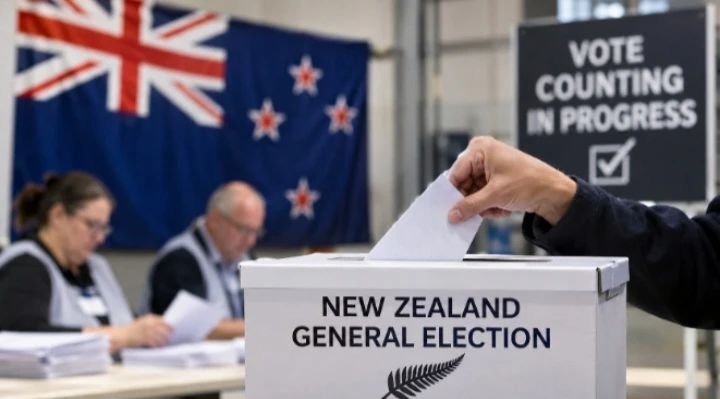
WELLINGTON, November 7, 2026 – Vote counting has begun in New Zealand’s closely contested general election, with early results indicating a narrow race between the ruling National Party and the opposition Labour Party.
The election is being closely watched as Prime Minister Christopher Luxon seeks another term in office against former prime minister Chris Hipkins, who is leading Labour’s campaign to return to government.
Initial figures reported by Reuters showed National receiving 31.58 percent of the party vote, compared with 28.37 percent for Labour, with approximately 5.7 percent of results counted at that stage. The figures represent an early snapshot and are not final results.
The outcome could depend heavily on smaller political parties, as neither major political bloc entered election day with a clear path to securing a parliamentary majority.
Smaller Parties Could Determine the Next Government
New Zealand follows a mixed-member proportional (MMP) electoral system, under which voters choose both a political party and a local electorate representative.
This system frequently results in coalition governments, making smaller parties important participants in negotiations over government formation.
The centrist Opportunity Party has attracted particular attention during the campaign. Its electoral performance could influence negotiations between the major political groups.
Other parties, including the Greens, ACT New Zealand, New Zealand First and Te Pāti Māori, are also important to the parliamentary balance.
The final distribution of parliamentary seats will therefore be significant in determining which political groups can assemble enough support to govern.
Cost of Living and Economic Concerns Dominate Campaign
Economic pressures have been central to the election campaign.
New Zealand voters have faced concerns over household expenses, unemployment, housing affordability and the country’s economic recovery.
Unemployment reached 5.7 percent in the third quarter, its highest level in 11 years, according to figures discussed during the campaign.
The National Party has defended its economic policies and highlighted its approach to managing government finances.
Labour, meanwhile, has sought to present itself as an alternative, focusing on household affordability, employment and public services.
Healthcare, wages, infrastructure investment and housing have also featured prominently in discussions among voters.
Christopher Luxon and Chris Hipkins Face Crucial Political Test
For Christopher Luxon, the election represents an important opportunity to secure another term for the National-led governing coalition.
His government has worked alongside ACT New Zealand and New Zealand First, pursuing policies covering economic management, public services and government spending.
Chris Hipkins, who previously served as prime minister, is seeking to bring Labour back into government with support from other left-leaning parties.
The competing political groups have presented different approaches to economic management, social policy and public administration.
The close contest means both leadership teams will have to consider the possibility of extensive coalition negotiations.
Official Results Will Take More Time
Although preliminary results are being released progressively, election-night figures will not represent the final certified outcome.
New Zealand’s Electoral Commission has scheduled the official declaration of the 2026 general election results for November 27.
The final count will include special votes, including ballots cast overseas and votes from people who voted outside their registered electorates.
These additional ballots could affect party vote shares and the final allocation of parliamentary seats.
As a result, political parties may have to wait before knowing the precise parliamentary balance and the possibilities for forming a government.
New Zealand Enters an Important Political Transition
The 2026 election is taking place at a time when economic pressures and public expectations are influencing political debate across New Zealand.
The close competition between National and Labour demonstrates the uncertainty surrounding the country’s political direction.
Smaller parties may become central to the next stage of government formation, making coalition discussions particularly important.
For now, the country awaits the completion of vote counting and the official results.
The final outcome will determine the composition of the next Parliament and shape New Zealand’s economic and political priorities for the coming years.