Starlink Sets Its Sights on America’s Wireless Giants as Musk Pushes Into Mobile Connectivity
Elon Musk’s Starlink is moving closer to becoming a direct competitor to America’s biggest mobile network operators, potentially reshaping a telecommunications market long dominated by AT&T, Verizon and T-Mobile.
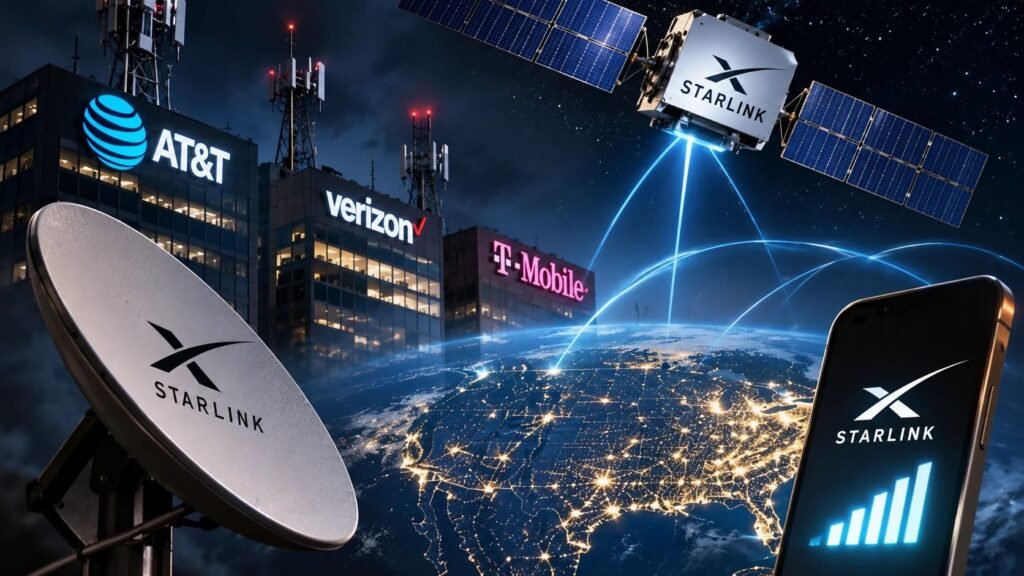
SpaceX, Starlink’s parent company, is pursuing a strategy that combines satellite connectivity with traditional ground-based mobile infrastructure. The ambition is to turn Starlink Mobile into a broader wireless service rather than simply a backup connection for people living or travelling beyond the reach of conventional cell towers.
From satellite internet to a mobile network
Starlink has already built a large satellite constellation that provides broadband internet in areas where conventional networks are limited. Its next challenge is to extend that capability to ordinary mobile devices and compete for customers who currently depend on established wireless carriers.
A key part of the strategy is access to additional radio spectrum. SpaceX has pursued spectrum acquisitions intended to strengthen its mobile service, including low-band frequencies that can travel longer distances and penetrate buildings more effectively than some higher-frequency signals.
The company is also exploring ways to expand its terrestrial infrastructure. Reports of discussions involving access to as many as 80,000 US cell sites suggest that SpaceX may be considering a hybrid network combining satellites, spectrum and ground-based equipment. Such discussions do not, however, amount to a completed tower-access agreement or a confirmed nationwide rollout.
A new competitive challenge for AT&T, Verizon and T-Mobile
The prospect of another nationwide competitor could put pressure on the established carriers in several areas.
AT&T, Verizon and T-Mobile have invested heavily in spectrum, cell towers, fibre connections and network equipment. Their infrastructure provides reliable coverage and high capacity in cities and densely populated areas—advantages that a satellite-focused newcomer would find difficult and expensive to reproduce quickly.
Starlink could nevertheless offer a different proposition. Satellite connectivity may help extend coverage to remote communities, rural highways, maritime areas and other locations where building conventional infrastructure is costly. Bundling mobile service with Starlink broadband could also give SpaceX an opportunity to attract customers through a broader connectivity package.
The competitive impact may therefore extend beyond the number of subscribers Starlink can win. The possibility of a new rival could also influence pricing, customer retention and future investment decisions across the wireless industry.
The technology and infrastructure hurdles
Satellite-to-phone connectivity has important limitations. Dense urban areas, indoor environments and locations with heavy network traffic require substantial capacity and dependable connections. Satellites alone may not provide the same performance as a mature terrestrial network in these conditions.
That is why access to ground infrastructure could be important. A combination of satellite coverage and conventional cell sites would allow SpaceX to address some of the weaknesses of a purely space-based mobile service.
But building a competitive network would require substantial investment, regulatory approvals, technical coordination and time. SpaceX would also need to establish customer support, retail distribution, network reliability and competitive pricing on a scale comparable with established operators.
The company’s spectrum plans and infrastructure discussions indicate serious ambitions, but they do not yet demonstrate that Starlink can match the coverage, capacity and consistency of the leading mobile networks.
Telecom companies prepare for a different market
The threat is already influencing the industry’s strategic calculations. Deutsche Telekom chief executive Tim Höttges said on November 5 that investors were factoring in the possibility of SpaceX entering the US mobile market. He also argued that satellite services would not replace terrestrial networks, particularly in urban and indoor environments.
T-Mobile has an additional connection to Starlink because the companies previously worked together on direct-to-cell connectivity. That relationship illustrates how satellite technology can initially complement conventional mobile networks even as the companies involved consider competing business models.
The established carriers are also responding through industry coordination and regulatory engagement, particularly over spectrum access and the potential effects of satellite operations on existing 5G services.
A potential turning point for mobile connectivity
Starlink’s expansion could create a more competitive telecommunications market, especially if it succeeds in combining satellite coverage with a substantial ground network. Consumers could eventually benefit from broader coverage, more service options and increased pressure on prices.
However, the outcome is far from certain. SpaceX must overcome technical limitations, infrastructure costs, regulatory challenges and the advantages accumulated by established carriers over decades.
The central question is no longer simply whether satellites can connect mobile phones. It is whether Starlink can build a complete and commercially sustainable wireless network capable of competing with the largest telecommunications companies.
If it succeeds, the boundaries between satellite internet and traditional mobile service could become increasingly blurred—and the American wireless industry may face one of its most significant competitive challenges in years.