US Treasury Bonds Gain as Investors Retreat From Stocks Amid Growing Market Uncertainty
US government bonds attracted renewed investor demand on November as financial markets experienced another wave of selling pressure, encouraging investors to move money away from equities and towards relatively safer assets.
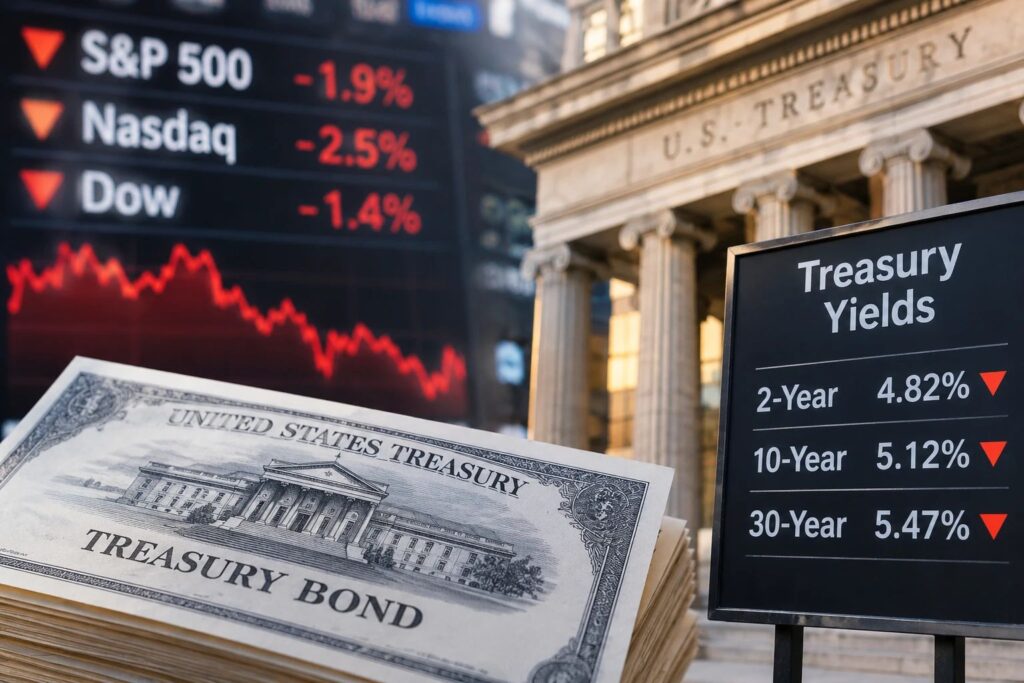
Treasury prices advanced while yields declined, reflecting a shift in market sentiment as concerns about technology stocks, artificial intelligence valuations and the broader economic outlook increased.
The movement represents a familiar pattern in financial markets: when uncertainty rises and investors become less comfortable holding risky assets, demand for government debt often increases.
Technology Selloff Triggers Flight to Safety
The latest bond market rally followed a sharp decline in US equities, with technology companies experiencing particularly heavy selling.
On Monday, November 16, the S&P 500 dropped 1.9%, while the Nasdaq Composite declined approximately 2.5%. The Dow Jones Industrial Average also fell 1.4%.
Concerns surrounding the artificial intelligence sector and uncertainty involving major technology companies contributed to the negative market sentiment.
The semiconductor industry experienced particularly significant losses, adding to investor concerns about the sustainability of technology stock valuations.
As equity prices declined, some institutional investors increased their exposure to government bonds to reduce portfolio risk.
Treasury Yields Move Lower
The increased demand for US government securities pushed Treasury prices higher and yields lower.
The benchmark 10-year Treasury yield declined to approximately 5.12%, retreating from levels reached during the previous week’s bond market selloff.
The two-year Treasury yield also moved lower to approximately 4.82%, while the 30-year yield declined to around 5.47%.
Bond prices and yields move in opposite directions. When investors purchase existing bonds, their market prices generally rise, reducing the yields available to new buyers.
The latest movement therefore indicates renewed demand for US government debt despite continuing concerns about inflation and monetary policy.
Federal Reserve Policy Remains a Major Concern
Investors are also closely monitoring expectations surrounding the Federal Reserve’s next interest-rate decisions.
Persistent inflation and recent comments from central bank officials have strengthened expectations that borrowing costs could remain elevated or increase further.
Financial markets are currently pricing in the possibility of additional monetary tightening, creating uncertainty for both equity and fixed-income investors.
The minutes from the Federal Reserve’s October meeting are also attracting attention because they could provide further information about policymakers’ views on inflation and interest rates.
Investors Reconsider Technology Exposure
The latest developments highlight the sensitivity of financial markets to changes in expectations surrounding artificial intelligence and major technology companies.
Investors have become increasingly focused on whether substantial investments in AI infrastructure will generate sufficient profits to justify current market valuations.
Any signs of weaker earnings, higher financing costs or slowing demand could create additional pressure on technology shares.
The movement into Treasury securities suggests that some market participants are prioritizing capital preservation and portfolio stability during the current period of uncertainty.
Global Financial Markets Watch the Bond Rally
Changes in US Treasury yields have significant implications for international financial markets because American government securities serve as a major benchmark for global borrowing costs.
Lower Treasury yields can influence mortgage rates, corporate financing expenses and investment decisions across multiple economies.
However, the latest rally does not necessarily indicate that concerns about the US economy have disappeared.
Inflation, government borrowing requirements and expectations for future Federal Reserve policy remain important factors influencing bond prices.
Market Direction Depends on Upcoming Economic Signals
Investors are now looking towards upcoming US economic releases, corporate earnings announcements and Federal Reserve communications for further indications about the direction of financial markets.
The Treasury market’s ability to maintain its recent gains will depend partly on whether concerns surrounding equities intensify or economic data changes expectations about interest rates.
For now, the latest movement highlights a renewed preference for relatively defensive investments as investors navigate uncertainty across the global financial system.