Israel Election Ends in Political Deadlock as Netanyahu and Eisenkot Compete to Form Government
Jerusalem, October 28, 2026
Israel is facing a period of political uncertainty after a closely contested national election left Prime Minister Benjamin Netanyahu and opposition leader Gadi Eisenkot without a clear path to a parliamentary majority.
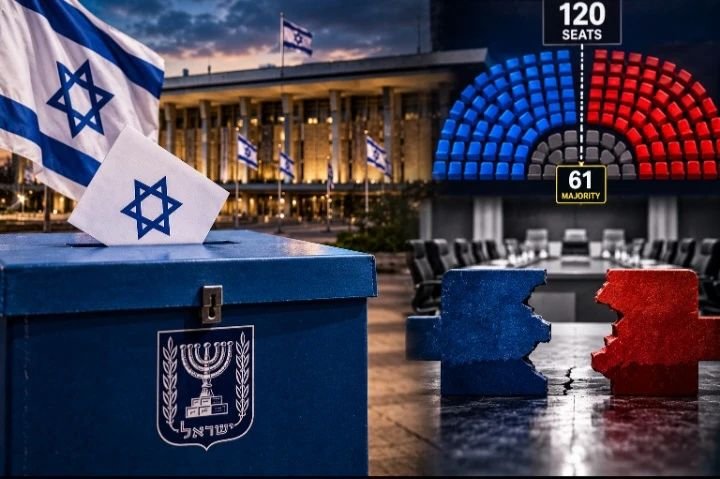
Exit polls released after voting ended on Tuesday suggested that the two political blocs were running almost level. With the official count still underway, neither side had secured the 61 seats needed to control the 120-member Knesset, Israel’s parliament.
Netanyahu and Opposition Both Claim a Mandate
Netanyahu, whose Likud party has dominated Israeli politics for years, called for a strong right-wing government and highlighted his administration’s military record.
Eisenkot, a former military chief seeking a change in leadership, argued that voters had signalled their desire for a new political direction. He urged Netanyahu to step aside and said his camp would work to form the next government.
Despite their competing claims, neither leader had established a definitive victory as counting continued. <Cite refs={[“turn472093news15″,”turn472093news2”]}/>
Smaller Parties Could Decide the Outcome
The election has placed smaller political parties in a potentially decisive position. Exit-poll projections suggested that Arab-led parties could win a substantial number of seats, making their support important to efforts to assemble a governing majority.
However, coalition negotiations may prove difficult. Netanyahu has rejected forming a government dependent on Arab parties, while Eisenkot also faces political challenges over the terms of any potential agreement.
The final distribution of seats will determine which alliances remain possible and whether either major bloc can secure enough parliamentary
High Turnout Reflects a Divided Electorate
Turnout reached approximately 77.7 percent, according to figures reported during the election coverage. The strong participation reflected the high stakes of a vote held after years of conflict and intense disagreement over national leadership and security policy. <Cite refs={[“turn472093news4″,”turn472093search9”]}/>
The election follows the Hamas-led attacks of October 7, 2023, and the wars and regional tensions that have since shaped Israeli politics. Security, the government’s performance and the country’s future direction remained central concerns during the campaign.
What Happens Next?
Israel’s president is expected to begin the formal process of selecting a candidate to attempt to form a government once the official results are finalised. Coalition negotiations could take weeks, and Netanyahu may remain caretaker prime minister while the political parties seek an agreement.
If no viable coalition emerges, the country could face a prolonged political stalemate or another election.
The central question is no longer simply which party wins the most seats, but which leader can build a stable parliamentary majority.