Satellites Expose Major Methane Leaks at Turkish Landfills Ahead of COP31 Climate Summit
Turkey’s waste management system faces renewed scrutiny as satellite monitoring reveals substantial greenhouse gas emissions from major landfill sites.
November 7, 2026 | Environment & Climate
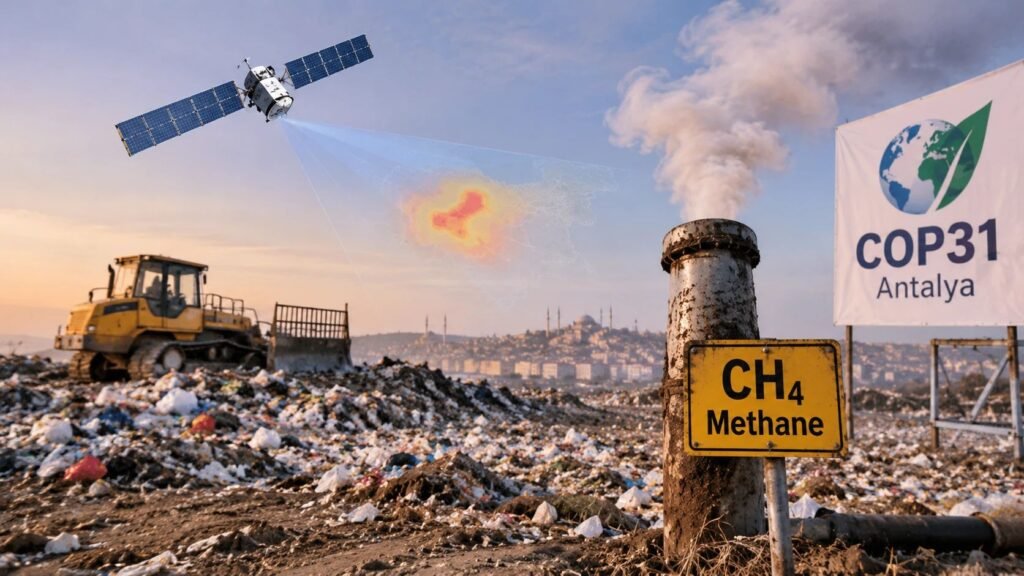
Turkey is facing growing scrutiny over methane emissions from its waste disposal sector after satellite observations identified significant gas leaks from several major landfill sites ahead of the upcoming COP31 United Nations climate conference.
The findings highlight a major environmental challenge for Turkey, which is preparing to host international climate negotiations in Antalya from November 9 to 20. Although the country has invested in systems that collect landfill gas and convert it into electricity, satellite data indicate that considerable quantities of methane continue escaping into the atmosphere.
One of the most significant sources identified is the Seymen landfill, located west of Istanbul, where thousands of tonnes of household rubbish are deposited every day.
Satellite Technology Reveals Significant Methane Releases
Researchers from the University of California, Los Angeles (UCLA), analysed observations collected by the Tanager-1 satellite and identified 70 methane emission plumes across Turkey’s ten highest-emitting waste facilities.
The analysis found that detected emission rates ranged from approximately 841 kilograms to 7.4 metric tonnes per hour.
The Seymen landfill recorded an average detected methane emission rate of around 7.4 tonnes per hour, placing it among the largest landfill methane sources identified globally.
The research used publicly available Carbon Mapper satellite observations collected between January 2025 and the end of May 2026.
Three of the identified emission sources were located around Istanbul, while others were detected near Ankara, Izmir and Antalya.
Istanbul’s Massive Waste Disposal Operation
The Seymen landfill illustrates the scale of Turkey’s urban waste management challenge.
The facility receives approximately 8,500 tonnes of household waste every day, representing a substantial share of Istanbul’s estimated daily waste production of 20,000 tonnes.
Methane generated through the decomposition of buried organic materials is collected and used to produce electricity at a nearby power facility.
The energy installation, which began operating in 2020, reportedly generates approximately 22,000 megawatt-hours of electricity each month.
However, the satellite findings suggest that existing collection infrastructure has not prevented substantial methane releases.
Researchers say improvements in collection networks, landfill covers and gas extraction wells could significantly reduce emissions.
Why Methane Is a Serious Climate Threat
Methane is one of the most important greenhouse gases contributing to global warming.
Although it remains in the atmosphere for a shorter period than carbon dioxide, methane has a much stronger warming effect over the first 20 years after its release.
According to climate assessments, its warming potential over that period is more than 80 times that of carbon dioxide.
This makes reducing methane emissions an important opportunity for governments seeking relatively rapid climate benefits.
Landfills are a major source because organic waste, including food scraps and other biodegradable materials, releases methane as it decomposes in oxygen-poor conditions.
Experts argue that preventing organic waste from reaching landfill sites, alongside improving gas collection systems, could substantially reduce these emissions.
Turkish Authorities Question Satellite Findings
Turkey’s Environment Ministry has disputed the interpretation of some satellite observations, arguing that individual measurements cannot establish the annual emissions of a landfill.
The ministry also pointed to progress under its Zero Waste Initiative, which aims to increase recycling and reduce the amount of rubbish sent to disposal facilities.
According to government figures, Turkey’s national waste recovery rate reached 37.53% in 2025, compared with 13% in 2017.
Officials associated with the Seymen landfill have also questioned whether the satellite readings accurately represent typical operating conditions.
The operator said methane emissions generally range between four and six tonnes per hour. It attributed an unusually high measurement to maintenance work on gas collection pipelines, uncovered landfill areas and atmospheric conditions.
The operator estimated that methane leakage at the facility is usually around 25%.
Turkey’s Absence From the Global Methane Pledge
Another issue attracting attention is Turkey’s absence from the Global Methane Pledge, an international initiative launched at COP26 in 2021.
Participating countries have committed to working towards a collective reduction of methane emissions by at least 30% from 2020 levels by 2030.
Turkey is not currently listed among the initiative’s participating countries.
Data from the World Bank, based on the European Commission’s EDGAR emissions database, indicate that Turkey’s methane emissions from solid waste increased by nearly 25% between 2014 and 2024.
By comparison, the global increase over the same period was approximately 6.5%.
Turkey’s waste-related emissions have remained at around 21 million tonnes of carbon dioxide equivalent annually since 2020.
Environmental policy experts say joining international initiatives would be meaningful only if accompanied by enforceable regulations, effective monitoring and measurable reductions.
Local Communities Face the Consequences
The environmental impact of landfill operations extends beyond greenhouse gas emissions.
Residents living close to the Seymen facility have reported unpleasant smells associated with decomposing household waste.
Methane itself is odourless, but other gases and compounds released during organic decomposition can create persistent unpleasant odours.
For people living nearby, the problem can affect everyday activities, particularly during warmer months when ventilation requires keeping windows open.
This highlights the importance of addressing landfill pollution as both a climate issue and a local public health and environmental management concern.
COP31 Puts Waste Emissions Under the Spotlight
The findings arrive at a significant moment for Turkey as it prepares to host COP31 in Antalya.
The conference is expected to bring together governments, climate scientists, environmental organisations and international institutions to discuss practical approaches to reducing greenhouse gas emissions.
Methane reduction could become an important part of these discussions because improvements in waste management can produce measurable environmental benefits without requiring an immediate transformation of the entire energy sector.
For Turkey, the satellite findings present an opportunity to examine whether existing landfill infrastructure is delivering the environmental results intended.
What Needs to Change?
Experts point to several measures that could help address the problem:
- Improved methane collection: Repairing damaged pipelines, gas wells and extraction systems.
- Better landfill covers: Preventing methane from escaping through exposed or damaged surfaces.
- Organic waste separation: Diverting food and biodegradable materials away from landfill sites.
- Continuous monitoring: Using satellites and ground-based equipment to identify emission hotspots.
- Stronger enforcement: Introducing regulations that require landfill operators to measure, capture and manage methane effectively.
The concentration of major emissions at a relatively small number of facilities suggests that targeted improvements could deliver significant reductions.
Conclusion
Satellite observations have brought renewed attention to the gap between methane collection infrastructure and actual emission control in Turkey’s waste sector.
As COP31 approaches, the findings raise an important question for policymakers: how can countries translate climate commitments and waste-management investments into measurable reductions in atmospheric pollution?
For Turkey, addressing emissions from its largest landfill facilities could become an important part of its wider climate strategy.
The challenge is no longer simply collecting methane for electricity production. It is ensuring that the gas is captured effectively before it escapes into the atmosphere.